
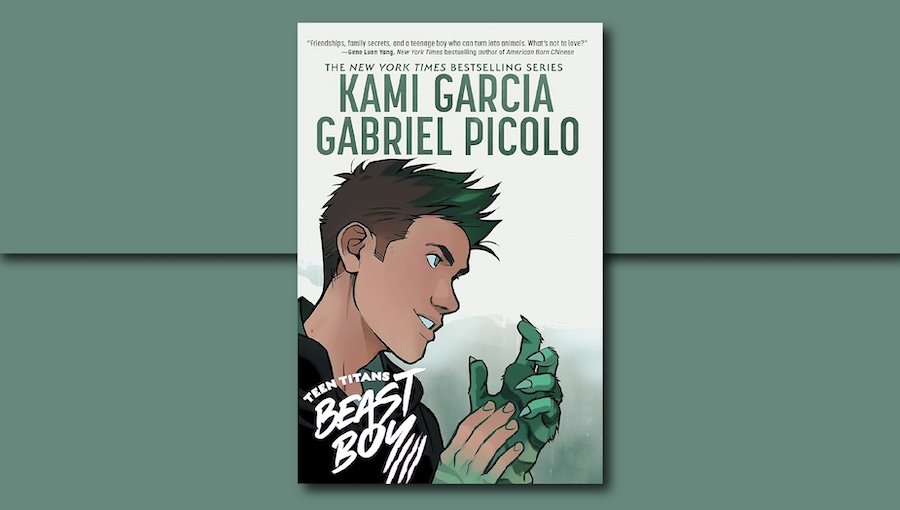
The second installment of Kami Garcia and Gabriel Picolo’s Teen Titans graphic novel series spotlights everyone’s favorite lovable goof, Beast Boy (a.k.a. Garfield “Gar” Logan).
Every iteration of Gar I’ve seen has always made him the comic relief character, and to a degree, that is his function in the team. You need someone to lighten the heavy moments. To me, Gar has always been the heart of the Teen Titans, keeping up morale with jokes, and often accused of not taking anything seriously. But Garcia explores Gar’s inner emotional depth. He’s a kid facing social peer pressure, worries that the only thing he has going for him is his humor, and feels like he’s behind developmentally. Basically, he’s a teenager trying to fit in.
But better than fitting in is belonging, and that’s where friends come in. Friendship has always been a major theme and draw for me to Teen Titans, and this book delivers that in spades. Gar’s friends, Stella and Tank, are the kind that I adore and want by my side. They’ll call you out on your crap one moment and help you through whatever hair-brained scheme you’ve come up with the next. The kind of friends that can see how great you are, even when you can’t.
There’s a moment early on where Stella nips Gar’s pity party in the bud by saying, “You’re talking about my best friend. And there’s nothing wrong with him. He just doesn’t know it yet.” I started to tear up. This is exactly the kind of friend you want in your corner, especially when your self-image is in the toilet. I appreciate that more stories are implementing this as a positive reframe to boost self-esteem. This is probably due to the acceptance around therapy and understating the nuances of mental health, and I appreciate Garcia including it in the story.
Gar’s upset that he’s not living the life he wants, and he kind of feels stuck despite trying his hardest to change himself. This feels so authentic to the teen experience, trying to fit in and find where you belong while still trying to figure out who exactly you are and want to be. And honestly, it was illuminating to see the social and peer pressure on boys to be masculine and tough – not that I think that pressure is good, I think it’s awful – but we typically focus more on the pressure put on young girls, so it was refreshing to see a new perspective and how terrible it can make you feel. It made me empathize with Gar all the more and though I was happy for him when he finally got what he wanted, I am firmly on Team Stella that there was nothing wrong with him to begin with.
Garcia crafts some great scenes that tug at your heartstrings. One in particular showcases where a bid for connection is missed. After a bad day at school, Gar’s mom asks how his day was, he lies and says it was good, but she’s so absorbed in her own world applying for grants that she doesn’t pick up on his low mood. They’re both so focused on themselves that they can’t meet each other in the moment and the opportunity to connect passes, causing them to drift apart rather than grow closer. It’s a brief moment but shows how we fail to connect with each other every day. These moments are often small, but they compound quickly. If we want to strengthen our bonds with others, it helps to be aware of these moments so they don’t pass us by. It’s moments of disconnection like this that naturally lead Gar to confide in his parents less and less and eventually leads to their confrontation at the end once Gar’s abilities have manifested.
The argument Gar has with his parents wrecked me because I can see both sides. I understand how Gar’s parents were desperate and wanted to protect him and I also understand how Gar feels like his agency was taken away. They all still love each other, but often those are the people you can have the nastiest conflicts with. There are no real winners in a fight like this, which is exactly what makes it so juicy. When the audience agree with both sides, it forces us to struggle with our own cognitive dissonance which makes us even more invested in the story. Well, most of us. Some people will tap out because they don’t know how to handle having two seemingly opposite things be true at the same time in their mind. But me, I thrive on that stuff.
Just like in Raven’s book, I appreciated how much Gar feels like an actual teen. He makes mistakes, tries to correct them (often fails or makes things worse), and we love him more for that resilience – even when he’s going after fleeting goals like raising his social status. Stella and Tank call him out on it, but Gar wants, just for once, to feel what it’s like to be in the spotlight instead of on the sidelines. And honestly, I get it. Even though I spent a good chunk of time yelling at Gar and shaking my head at his attempts to get in with the popular kids, I completely understand why he’s doing it. I mean, who of us hasn’t done stupid stuff as a kid (or adult) to fit in or impress people we want to like us? Every single one of your hands should’ve gone up. If it didn’t, I think you’re lying, or you have an astoundingly healthy amount of self worth. In that case, well done, and please teach me your ways.
Luckily, Gar’s actually self-aware on this front. When he gains social clout after activating his Beast Boy persona and powers, he knows that his newfound fame won’t last forever but he wants to enjoy and embrace it while it lasts. And honestly, I applaud his ability to live in the moment like that. It’s one of his strengths and an admirable quality that we can all strive to emulate, especially those of us that tend to focus on the future or ruminate on the past.
Gar ends in a similar place as Raven – he knows he’s different and he wants to understand what that means and how to get a handle on the things he can do. And he knows he needs to make this journey alone. But he has a direction after Slade Wilson gives him just enough information to lure him in. This also sets up a nice collision course for him and Raven in the next book. I have to say, though, I’m going to miss Stella and Tank. Part of me would love a single issue comic or something of those two carrying on in Gar’s absence or even reuniting with him later. They are just such good, supportive friends, and I want more of them.
The book ends on that bittersweet separation, and Garcia gives us a full-circle moment when Gar realizes that there’s more to him than just jokes and Stella reassures him that they already knew that. And I swear, I’m just as heartbroken as Stella that our little trio is temporarily disbanding. Gar wanted to be someone or something else (and now he literally can be), but his closest friends always saw how special he was – even without powers – and loved him regardless.
On the art front, Picolo only gets better. His art is gorgeous as ever. Gar’s facial expressions are amazing and show exactly what he’s feeling whether that’s embarrassment, joy, or shame. Honestly, just flipping through the pages and looking at the characters’ faces, you can track the emotional trajectory of the story, it’s incredible. And, ya’ll, when Gar has his little glow up in the book, he looks really, really good. It’s crazy how such small adjustments can make such a drastic change. Part of it is that Gar’s clothes are baggier before, the bone structure in his face is less pronounced and there’s less (if any) muscle definition before his change. It still amazes me that it’s literally just lines and color on a page, but it can look so beautiful and make us feel so much. I know I said it before, but I could look at Picolo’s art forever.
I really appreciated the color added in this book. As a generally cheerful character, I feel like Gar’s story is enhanced by more saturation and warm colors. The backgrounds still retain that almost watercolor look – similar to Raven’s book – which nicely ties the two together and helps to make the characters distinctive and pop. The animal transformations are also really exciting to see. There is one particular de-transformation that looks absolutely stellar. But if I’m honest, it’s the human emotions that Picolo is able to convey in his art that really captivate me.
And where Garcia made me choke up with Stella’s line to Gar, Picolo did the same to me in a moment where Gar feels utterly defeated and powerless and Picolo draws him sitting on his bathroom floor, arms on his knees and head hung low. Honesty, I just wanted to jump into the page and give him a hug to reassure him that everything’s going to be okay. After all, it’s just high school, thing’s get better. But knowing that and believing it are two different things, especially when you’re in the thick of it.
The subtle inclusion of diversity continues in this book continues with people in wheelchairs, with prosthetic limbs, of differing races and religions and even neurodivergent characters. It’s all there, just present and existing, doing some powerful work without being heavy handed.
I especially appreciated how they handled a neurodivergent character’s dyslexia diagnosis. For starters, the character is a more classic jock type, so it adds dimension to his character to have this as part of his characterization. Since he spends most of the story undiagnosed, he has a lot of shame, confusion, and frustration about himself and feels like there’s something wrong with him. This feels like a universal experience of anyone who’s felt different. The constant worry that there’s something wrong with you, and the anger and shame that comes with being unable to perform like everyone else really got to me because I know what that feels like and I’m sure many others do too. Thankfully, after the initial shock of the diagnosis fades, the character embraces this newfound part of himself and finds successful dyslexic people to look up to and inspire him. It’s a great example of reframing. Yes, a diagnosis like this can be scary, but seeing as most of us fear uncertainty more, it can actually be a relief to know that our struggles have a specific cause and we can implement tools and strategies to work with our diagnosis.
Once again, Garcia crafts a delightful story that digs into the inner emotional lives of our heroes, and Picolo takes great care in bringing them to life in pictures. They collaborate seamlessly to give us another fabulous entry to the Teen Titans universe.
Creative Team: Kami Garcia (writer), Gabriel Picolo (artist), Rob Haynes (artist), David Calderon (colorist), Gabriela Downie (letterer)
Publisher: DC Comics
Click here to purchase.
