I’ve been a fan of Teen Titans since I first watched the animated series back in the early 2000s. What’s not to love about a team of scrappy, goofy teens beating up bad guys and arguing over pizza? I wish they would’ve invited me to Titans Tower to hang out. Then, we had Titans, a grittier version of the group courtesy of HBO. More adult and darker in tone, but still full of found-family goodness. Now with a graphic novel series dedicated to these teen heroes, we have a new way to fall in love with them.
First up is Rachel Roth, a.k.a. Raven.
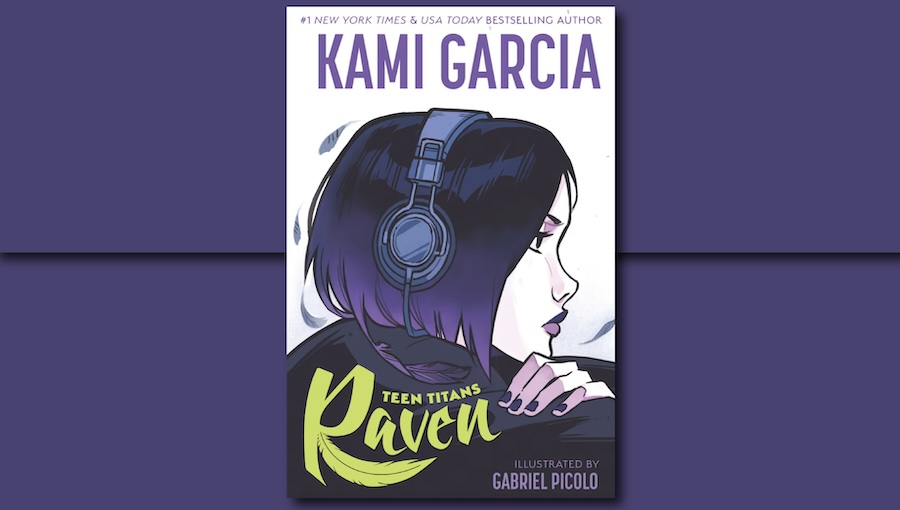
Many of us know Raven as the deadpan, demon goth girl. The grumpy of your grumpy/sunshine pairing, but writer Kami Garcia injects heart into Raven that allows readers to empathize and deeply connect with her. It’s a story of self-discovery, understanding who you are, and claiming your inner power with the knowledge that you get to decide who you want to become.
Garcia’s dedication at the beginning of the book shows us just how much she cares about Raven and the Titans in general and how devoted she is to bring their stories to life for a new generation of fans. She seems intent on giving readers hope, courage, and a sense of belonging.
This being Teen Titans, we get a good balance of both teen angst and titanic powers. High school can be rough even when you have everything going for you, but when you’re different, it can feel almost unbearable.
Garcia weaves a believable story of what the modern-day high school experience looks like… at least, according to this millennial. The confusion, delight, and embarrassment that comes with being an adolescent and trying to figure out who you are and where you fit in the world easily has us empathizing with Raven on her journey, as it reminds us of our own teenage days. Add in being an empath, where you literally feel everyone else’s emotions that are cracked up to eleven, and that’s a recipe for high school being absolutely horrendous.
On the emotional side, we feel the tingle of butterflies when Raven develops a crush, the anxiety of overthinking what to text said crush (perhaps one of the most relatable things in the entire book), and the relief when that attraction appears to be mutual. On the power side, we feel the confusion that comes with abilities we don’t understand, the fear of things that seem out of our control, and the worry that there may be something very wrong with us or that we may be broken.
But Raven gives us hope. Though she keeps her cards close to her chest as she tries to unravel the mystery of her life and powers, she’s still willing to get close to people. At least some people. In small doses. Especially those who actively try to help her. Honestly, that in and of itself takes courage. It’s much easier to shut down and close yourself off from connection to others (Totally calling myself out here.), but Raven is still willing to take that risk. She might not be jumping into the deep end, but she’s dipping her toes in. That takes guts. Especially when it seems like that risk was a mistake which is what happens with Raven. She feels wrong to have trusted and let herself be vulnerable, but, in truth, it was a valuable learning experience and moment of growth for her. But growth can be painful; we have to fall off the bike and get back up to learn how to properly ride. It hurts, but it makes us stronger. Just because a risk didn’t turn out the way we hoped doesn’t mean it was wrong to take it. But it sure can suck going through it.
That’s part of what makes us root for Raven. She’s been through so much and is still navigating her way through it (often alone); we can’t help but want her to be okay and make it through to the other side. We even hope that maybe, just maybe, she can actually be happy. That just makes it all the more crushing when she loses that happiness. She and we may hate it, but, man, does it make for some good storytelling. What better way to make us invested in a character’s journey than to give them what they want then take it away. When a story has me yelling and crying in equal measure, I know it’s solid.
Though most of the stakes are internal and emotional (which is totally my jam), there are real external stakes and danger, especially near the end when Raven discovers the truth about her powers, where they come from, and when we discover that people are looking for her. Garcia does a great job of laying the emotional groundwork early on so we care about these characters deeply by the time she builds up to the inevitable climax. I was engaged the entire time.
Now, yes, the story is great, but the art is fantastic. Gabriel Picolo’s art enhances this story so much. He may be my new favorite artist. His style is like a Disney/anime mashup. There’s a simplicity to his character work that allows the expressiveness and emotions to shine. A lot of it is in how he draws facial expressions and body posture. So much can be conveyed about a character’s attitude and emotions by just these two aspects. I can and have literally just stared at his art. It’s stunning and gorgeous. Sometimes, all it takes is a subtle blushing on a character’s cheeks or a tear bubble forming on their eyelid to really move me. It’s clear that he cares deeply about making the characters’ inner lives and emotions fully expressed on the page.
I have to say: I love the muted colors in this book. It feels like a deliberate choice. Raven’s aesthetic is more monochromatic grey/black with pops of purple which allowed her – and later the big bad of the issue – to really stand out. It very well could have been a financial choice, as well; color is expensive and this being the first book in the series probably meant they wanted to keep costs down. Whatever the reasoning, I think it really works.
One thing I really appreciated was how Garcia and Picolo seem devoted to inclusion in their work. The pair showcase diversity by subtly including queer characters, characters with disabilities, and characters of various ethnicity. It’s a small thing, but very impactful for people in those communities. The fact that it’s added without fanfare and that these characters are simply allowed to exist in the world is refreshing and reassures those of us in these communities that we’re allowed to take up space. There is a bit where queer characters are explicitly talked about, but they take down some of the stereotypes the straights have about them, so that’s all good in my book.
Teen Titans: Raven is a lovely introduction into the world of Teen Titans, and Garcia and Picolo work flawlessly together to create an emotional, endearing story we can’t wait to continue. It’s a story about discovering who you are, unique gifts and all. It reminds us that we’re often stronger than we give ourselves credit for and that having people who support and believe in us can help us believe in ourselves.
If you like Teen Titans or are in any way curious about them, this is an exciting way to get to know our adolescent heroes. And yes, there is more on the way.
Creative Team: Kami Garcia (writer), Gabriel Picolo (artist), Jon Sommariva (artist), Emma Kubert (artist), David Calderon (colorist), Tom Napolitano (letterer)
Publisher: DC Comics
Click here to purchase.
