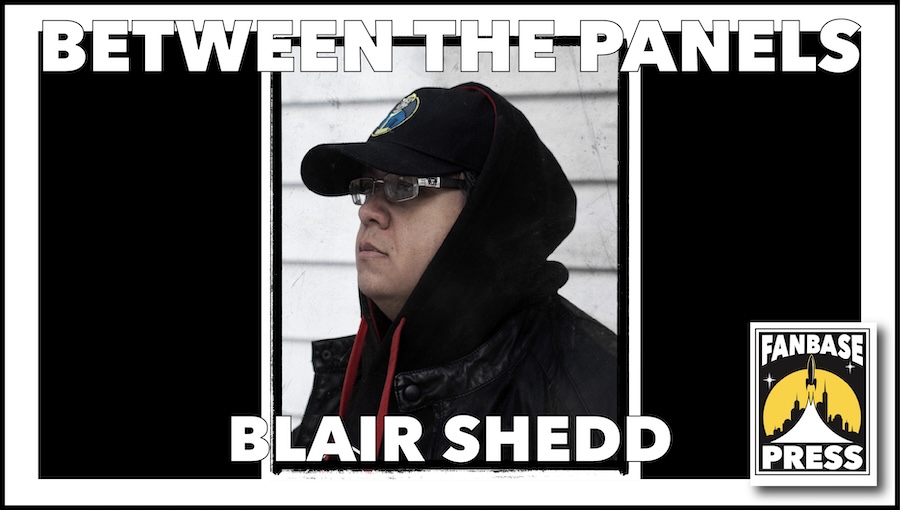
“Between the Panels” is a monthly interview series focusing on comic book creators of all experience levels, seeking to examine not just what each individual creates, but how they go about creating it.
As many creators can attest, making a living in comics can be a major uphill grind. Blair Shedd graduated from the Joe Kubert School into a different comics industry than existed when he enrolled, but since then has gone from posting fan art to having a portfolio of licensed covers. His new webcomic-turned-graphic novel is the culmination of years of work as both artist and writer.
First off, the basics…
Your specialties (writer/artist/colorist/letterer/etc.): Illustrator/writer
Your home base: Fairlee, Vermont
Website: oneGemini.com
Social Media
Facebook: @onegemini
Bluesky: @onegemini.com
Fanbase Press Contributor Kevin Sharp: What is it about the comics medium in particular that attracts you as a creator?
Blair Shedd: Comics — I think, and I have discussed this with others, some who agree — that it’s almost an illness. A sickness. The pay is poor, the respect is negligible. There’s no real social standing for doing this. No, we have to do this because we love it and/or because we MUST. We have no choice but to tell stories through a combination of pictures and words. Even with all the uphill this career has been, I’ve kept on going, as I just need to keep telling stories. And now self-publishing after doing a majority of “mainstream” work, not getting paid up front, and in fact facing debt and not profit, I still am working on more self-publishing. I am the Ouroboros choking on his own tail.
KS: As someone who currently both draws and writes, which of those skills was the first one you enjoyed practicing when younger?
BS: Very definitely enjoyed drawing more younger. My first mini comics around age 10 or so were ten words stops for all of the five pages that made them up. Before that I was drawing, as well, and probably only writing when I had to for school. I can’t recall much in the way of creative writing from early elementary school.
KS: Were you able to collect the comic titles you liked every month via a local comic store, or did you have to hunt for issues?
BS: When I was a kid collecting in the ’80s, there might’ve been a comic book store within an hour of me, but I, nor my parents, were aware of one. I got my comics from the general store in town, or the supermarket, or the gift shop in town. Wherever I could find them. Sometimes, I’d borrow from friends who went to different stores with their parents and found comics either out of stock in town or just unavailable. A friend got the original Teenage Mutant Ninja Turtles trades. Another kid brought in Ralf Snart books, ‘cos he enjoyed getting in trouble at school. For some reason, the elementary school library had a run of Elfquest collections. So, I had access to a little of everything, but not everything-everything.
KS: Was there any particular comic that had a strong influence on you, first as a reader but also in terms of thinking of pursuing the arts as a career?
BS: Understand, I was mostly a Marvel kid growing up. So, it was sometime after I read JM DeMatteis, Mike Zeck, and Bob McLeod’s Spider-Man: Kraven’s Last Hunt that ran through the Spidey titles in 1987. I was nine. Friends and I waited every week for those months for each issue. And the story did two things for me; it was the first time I saw comics as more than just happy ending superhero tales (or even for the most part the “aw, bummer” tales that Peter Parker had going). Kraven’s Last Hunt was dark, but not that forced kinda dark some would err into after The Dark Knight Returns. Mature stories that didn’t feel like they were talking down to me. I liked happier/gentler/cleaner stories just fine, but for various reasons, I spent a lot of time around adults, and most weren’t adults that talked down to me, so I didn’t want my entertainment to condescend me, even accidentally. Secondly, KLH was when the lightbulb went off and — ding — oh, there were real people out there putting out these stories for money. So, why couldn’t I try to do that?
KS: You ultimately ended up at the Kubert School. We’ve had a few graduates as Between the Panels guests — how did that school get on your radar as a possible destination?
BS: I was in high school, still reading comics, and had been reading Wizard magazine and Hero magazine. I preferred Hero. In 1994 I picked up an issue that had Spawn and Batman on the cover drawn by Greg Capullo. But at the last minute before press, they added a headline to the issue of the passing of Jack Kirby. Amongst the articles in that issue was one about the Kubert School. I gave it a read, but it didn’t click. A few weeks later, in the back of an issue of Spider-Man, I saw an ad for the same school. I had seen “cartoon school” ads before, but they were usually of the mail-away, most likely scam, variety.
KS: So, what ultimately got you to apply?
BS: I told my father about the school, and had to use the article in Hero to convince him, as he was also familiar with the scams. For the next two years, that’s what I aimed at, at what I worked towards, taking on every art class I could — even ones I wasn’t excited about at the time, like pottery or painting. It was also the only school I applied to. Luckily, I got in, and attended, and graduated. 1996-1999.
KS: A lot of parents would prefer their kids choose a “safe” area of study and keep art for a hobby on the side.
BS: Including mine. I’m half Filipino, my mother’s side. It’s a cliché but true — Filipino parents would love for us to become nurses or lawyers. Then again, I got this grand idea, and went to the Kubert School just before the comic bubble burst. It looked possible to make a living drawing comics at the time. By the time I got out of art school, all that was fast fading.
KS: Looking back now, what’s something specific you were better at as an artist after going through the program than you were before you started?
BS: Honestly, just about everything. Now, they specifically don’t teach you the very basics. They assume you know all that. They want to take what you have and refine it. They did introduce us to some new (to most of us) things like lettering, airbrushing, cutting color via Amberlith, etc. But they helped me look at my old ways of drawing, illustrating, and making me think of new ways to apply what I learned. “Bad is not a style” was allegedly said by Joe himself, and certainly said by some of the instructors. They knew that style would develop over time, the more we drew, the better we would (generally) get, and the more our own quirks would show through our basic artwork, and therefore become our style. They also introduced me to basic digital coloring, which was hard for me, and I was glad I wasn’t going to become a professional colorist in the future. Of course, I now color 95% of my work. Joke’s on me.
KS: Do you remember the first time you ever got paid for a piece of your art?
BS: Charlie Davenport paid me 10 cents for a lined piece of letter-sized paper with American jets on one side, facing off against Nazi planes on the other side. I and a friend would draw these battles, then draw the lines representing “shots” going across to enemy planes, and then we’d make explosion noises and scribble them out. This was about third grade. Charlie couldn’t, or didn’t, want to draw. So, he gave me a dime to make him one so he could make noises and scribble out airplanes. Past that, it was junior and senior years of high school before I would get paid to do art again — things like exercise sheets for the local hospital, t-shirt designs for local organizations, and playbills for local theatre and school productions.
KS: Jumping ahead from that ten-cent payday, what was your first pro comics gig?
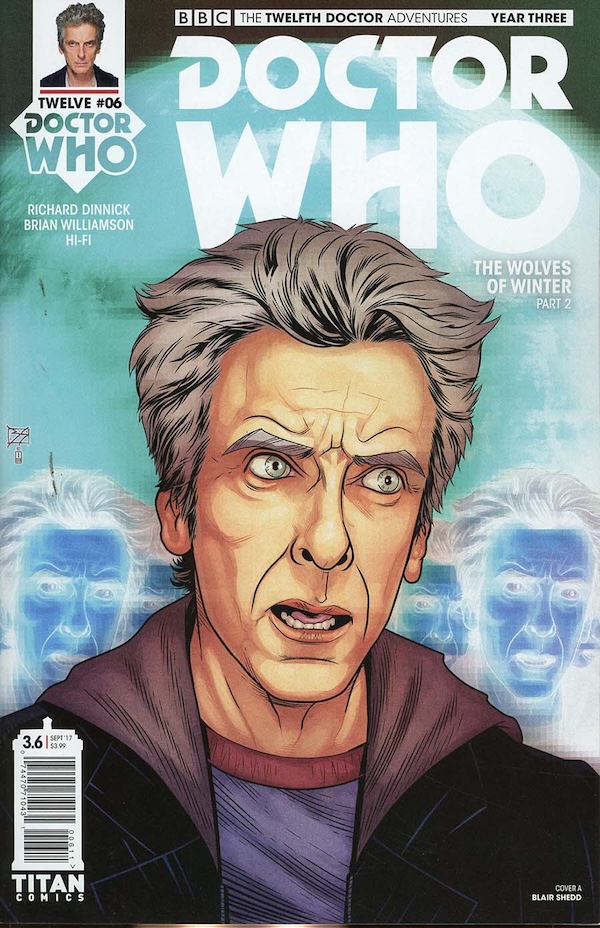
BS: I had worked on some indies and self-published stuff after art school, but it wasn’t until 2009 when IDW Publishing editor Denton Tipton brought me on board the Doctor Who licensed book. That was my first paid work for a mainstream publisher.
KS: Can you talk about the steps you took to get your work out in the world in order to be found by Denton in the first place?
BS: While I’m not sure if my path in is replicable, I was a Doctor Who fan from childhood, watching the Fourth Doctor (Tom Baker) on screen in reruns on PBS in the ’80s. So, when the 2005 series came, I was again a big fan. I was posting a lot of Doctor Who fan art to DeviantArt at the time, and some got lots of views, with some of those views being Doctor Who comic colorist Charlie Kirchoff, who mentioned me to Denton at about the same time I submitted samples. Both Denton and then-EIC Chris Ryall liked my samples, and I was allowed to play.
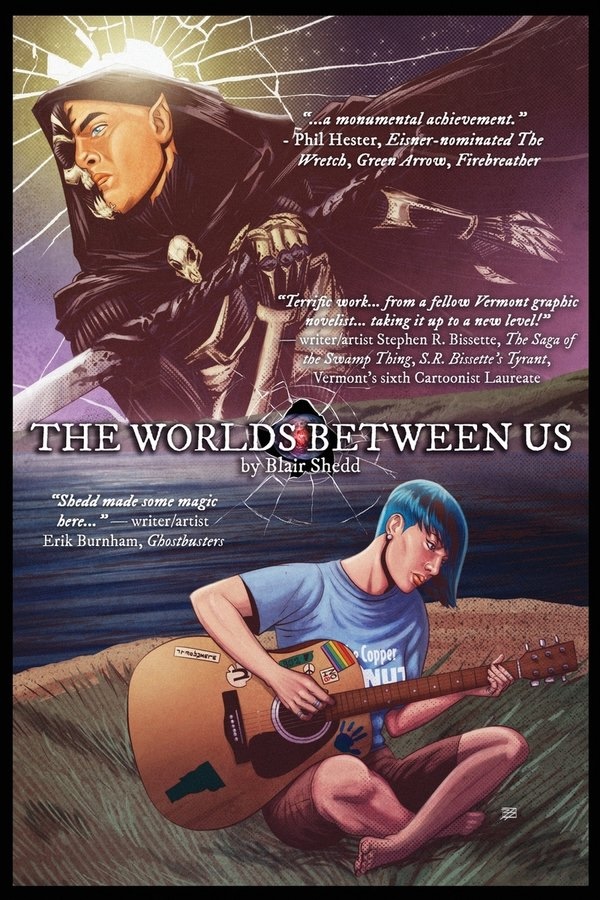
KS: Let’s move to your new graphic novel, The Worlds Between Us. Do you find your way into a story like that through the plot idea first or through images?
BS: The defining moment I said “ah-ha!” about the story is a secret. To say what spurred on the idea would spoil plans I have. And I have this book planned out for YEARS. But I will say in this case, there was an initial idea, a thing that happened in pop culture in 2017 that made a lot of headlines. And there were lauds and grumbles. I wondered if I could come up with a story to shine on the grumbling minority, while entertaining everyone else. So, in this case, plot definitely came first. Designs came later, but not too much later. The whole skeleton of the story was formed in about three months, and designs were done a few months after that.
KS: You originally published the work online. What was the path from there to a physical graphic novel?
BS: I launched TWBU as a webcomic. It did very, very, not much. About 100 readers tops. It slept for a long time. I tried to bring it back in 2022. Again, about 50 readers. But after November 2024, I needed a project to distract me, so I made it my goal to finish the story I started — at least that arc — and get it published one way or another.
KS: Please tell readers about a hobby of yours totally unrelated to comics, art, or anything you do as a pro.
BS: I come from a musical family, and have somewhat of a non-pro musical background. Choruses, musicals, and so far two rock bands. So, music is definitely a hobby, as are video games. Gaming is more of an escape, relaxation, while music is a passion, and something I definitely put effort into.
KS: Imagine a Comic Book Hall of Fame where you can nominate one title to be included that you think represents the medium at its best. This can be a single issue, miniseries, graphic novel… What gets your plaque?
BS: Jeff Smith’s Bone. Indirectly influential on my art and writing. Okay, maybe directly. It’s so “simple” in some ways, but such an involved and intriguing epic story. And the illustrations are so wonderfully clean and simple, while still being excellent pieces of draughtsmanship, which really appeals to one side of my art brain.
KS: Finally, please tell readers where they can learn more about TWBU and other work of yours.
BS: Well, if you like horror and fantasy, The Worlds Between Us has scares, terror, gore, magic, and even a horned-horse. You can find more about the book and purchase it at oneGemini.com. You can also have your local bookstore or library (Tell them!) to order a copy. This book was also born of years of being asked at comic cons, “When are we going to get a Doctor Who/Supernatural/Sherlock – SuperWhoLock – crossover comic?!” The technical answer is “never, outside of fan fic.” The now answer is The Worlds Between Us has the best of those worlds and more.
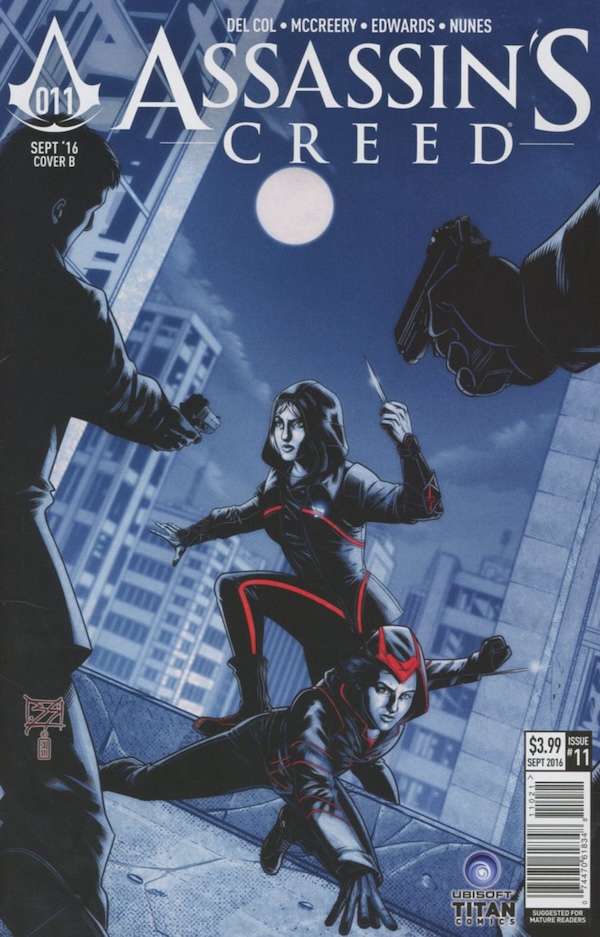
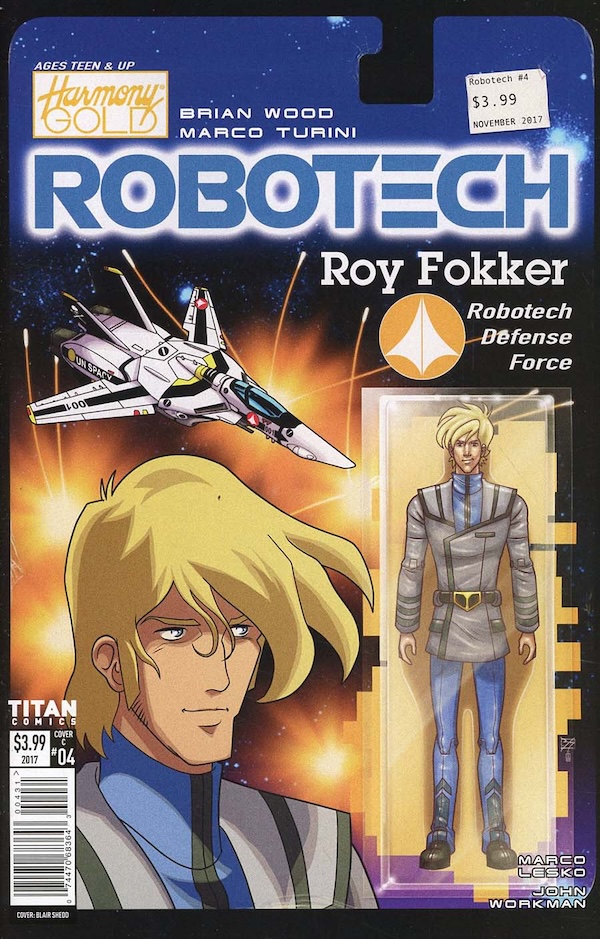
But if you’re a Doctor Who fan, search out The Ninth Doctor: Weapons of Past Destruction from Titan Comics. Illustrated by me (with fill-ins by Rachael Stott) and written by Cavan Scott. That’s probably my best Doctor Who work. You can also find my work on 60+ covers of Doctor Who and 30+ covers of Robotech, both for Titan Comics.
