
If you’re a kid who grew up in the ‘90s like me, no doubt you were raised on a steady diet of Disney, Pixar, and Don Bluth animated films which may have both delighted and scarred you. These films took many artists and many years to complete, thus is the world of animation.
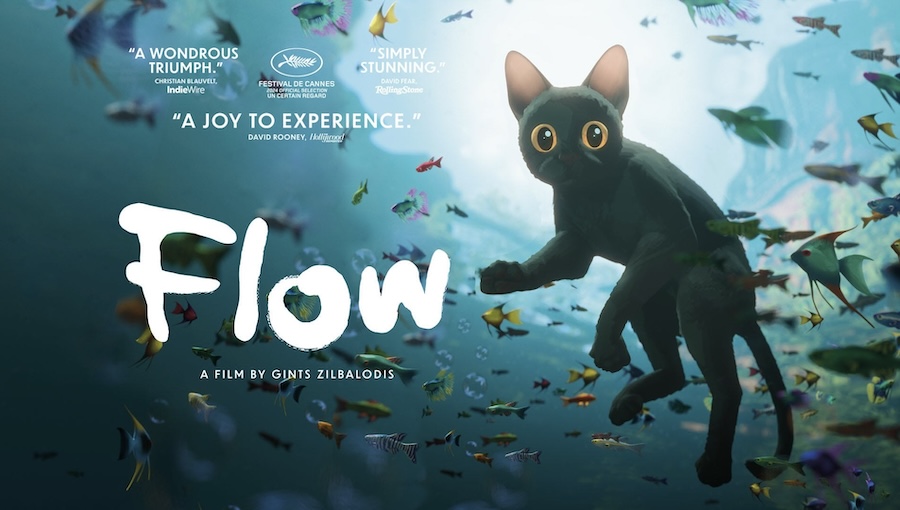
Though many of these films are great, every now and then one shines brighter than the rest, and one of the most recent animated films to do that is the 2025 Academy Award-winning Best Animated Feature film, Flow.
Put simply, this film is about how a cat survives a catastrophic flood. Sounds pretty simple when you put it like that. And on one hand, it is. But it’s often the simple things that can hit deep and really move us.
On one hand, Flow has no business wining the Academy Award. An animated film from Latvia? What chance did it stand? Anyone who’s seen the film knows exactly the chance. This film is truly incredible. Gints Zilbalodis did an an amazing job with the story, directing, composing (Honestly, nearly everything.) and gathering a team to bring his vision to life.
The film begins in media res – meaning we’re dropped right into the action without any explanation and are forced to figure out what’s happening. This is a great device storytellers use to make the audience an active participant in the story. If we’re trying to figure out what’s going on, we’re invested, which means we keep watching.
And I was invested from the get go.
As soon as I heard Cat cry and felt his confusion, sadness, and fear, I was hooked. That simple sound snapped something in me, and, suddenly, I was one thousand percent invested in making sure Cat was okay and would survive. Maybe it’s because I’ve owned cats, or because hearing an animal in distress does something to my primal brain where I just want to comfort the creature. Whatever the reasoning, I was instantly invested in Cat’s journey.
And what a journey it was.
Visually, the film is stunning in so many ways, especially all the work they did with water, which can be notoriously difficult to animate. But beyond that, there’s the landscape, how light is depicted, and how the animals themselves move in ways that accurately reflect how they navigate the world. The team took great care in studying the animals present in the film to ensure even the micro movements were realistic and it absolutely pays off.
But for me, the sound design is what really shines.
The ambient sounds of a secluded forest are so visceral. Close your eyes and you’re there. It allows us to get swept up into the story instantly. It feels immersive. Beyond that, the noises of our core animals showcase their personalities and make you feel genuinely devastated for them as they try to survive. (Even if Capybara was technically “voiced” by a baby camel.)
A real strength of the film is that the animals are just that: animals. There’s no anthropomorphizing here. Cat acts like a cat. Dog like a dog. They have their own personalities, but they don’t have humanistic traits we often project onto nonhuman objects and creatures.
Now, don’t get me wrong: I often talk to my own pets, giving them humanistic traits. And films like The Lion King, Finding Nemo, and All Dogs Go to Heaven do a great job imbuing animals with relatable human motivations and emotions, but this is a case where removing those elements actually enhances the story. Sometimes, less is more. I’d argue it’s actually more entertaining and engrossing to watch the animals behave distinctly as animals (albeit ones who have figured out how to use a rudder in a boat, but we’ll let that slide) instead of bogging it down with human motives.
Even without those traits, the animals still have personalities. Cat is standoffish and solitary. Dog is playful and loyal. Lemur is inquisitive and vain. Capybara is calm and resourceful. And Secretary bird is commanding and protective. They will naturally develop conflict with each other and must learn to put their differences aside in order to survive. This alone is enough to sustain a solid story without needing to add unnecessary human traits.
However, we still see how the animals change over time, especially Cat. He starts off unwilling to connect and get close to anyone, but by the end, he cares deeply for his companions and will even risk his life to ensure their safety. That is what we call a strong narrative arc, and it’s one of the reasons the film works so well and is so satisfying. Cat doesn’t stay solitary. He adapts, changes. Like we all have to do to survive in the world.
Though we can probably see facets of ourselves in all the animals, I feel like this film will deeply impact those who resonate mostly with Cat. Those of us who are independent, who feel the need to do everything on our own. Or maybe those of us who feel like other people are unreliable or will only hold us back. Or maybe it’s just fear, of needing others, of wanting companionship. That misguided notion that doing everything alone and not needing others makes us strong.
Flow shows us the opposite. Relying on others doesn’t make us weak, it makes us brave and strong. And as the saying goes, “If you want to go fast, go alone. If you want to go far, go together.” Together, this group of misfit animals goes far.
Then, there’s the score.
The music had me tearing up constantly. From the tense, eerie tremble right before something devastating happens to the uplifting wonder when Cat overcomes his fear of water, the music accurately reflects the current mood and tone. It’s a strong signal to us if we should be scared, delighted, or filled with wonder. The soundscape guides our emotional journey through the film and often serves as a premonition for what’s to come – especially in tense action moments. Is that manipulative? Yes. But often the best stories are. And it’s not in a harmful way; it’s in a way that wants us to have the most gratifying emotional experience possible.
One of the brilliant decisions about this film is the fact that there’s no dialogue. Which means there’s no extra cost to translate it for a different speaking audience. Literally anyone can watch this film and understand it – well, within reason. There are still moments I don’t fully understand but I still felt connected to and moved by the film.
At its core, this is a film about teamwork and how extreme circumstances can push you to connect with and rely on those you wouldn’t normally be drawn to. I think that’s a powerful message, especially in a society that teaches us that we have to pull ourselves up by our own bootstraps. What about those of us who don’t have boots? Or straps?
Everyone needs help every now and then, and it’s actually quite brave to ask for help because it puts you in a vulnerable position. As Dr. Brené Brown taught us, there is no courage without vulnerability. After all, no man is an island. Maybe the closest he can get is an archipelago.
Often in life, it’s not just about getting your own way, it’s about learning to live and work with others in a way that does the most good for the most people. It’s not always easy, but it’s almost always rewarding and worth it. And if you just allow yourself to get close and open up to others, you might find some unexpected friendships along the way.
Flow is a film that people of all ages and from anywhere in the world can enjoy. It’s a film that shows us that given a strong goal, we can all put aside our difference and come together, and maybe, just maybe, we can come out with some friends on the other side.
Creative Team: Gints Zilbalodis (director/writer/cinematographer/editor/producer/composer), Matiss Kaza (writer – screenplay/producer), Ron Dyens (writer – adaptation/producer), Gregory Zalcman (producer), and Rihards Zalup (composer)
Produced By: Dream Well Studio, Sacrebleu Productions, Take Five, Arte France Cinéma, and Canal+
