
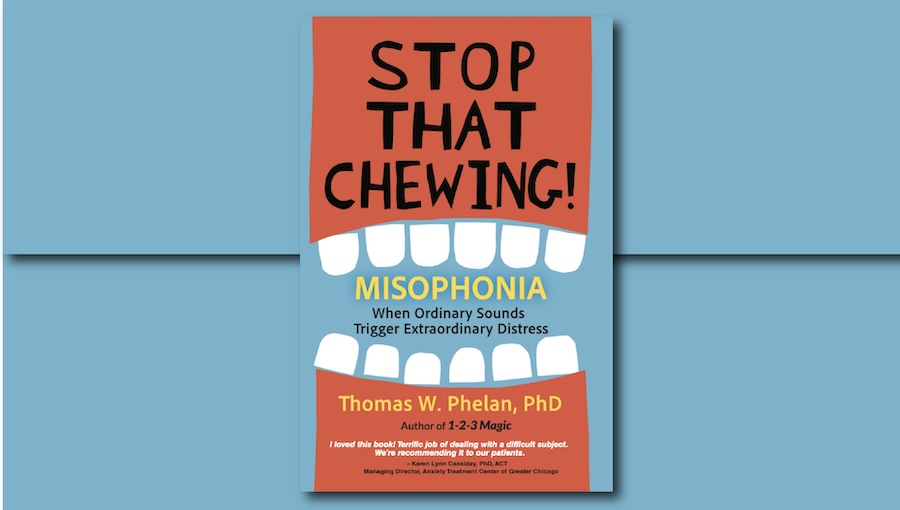
The following is an interview with clinical psychologist, author, filmmaker, and educator Dr. Thomas W. Phelan regarding the recent release of the book, Stop That Chewing! When Ordinary Sounds Trigger Extraordinary Distress, through publisher Parent Magic. In this interview, Fanbase Press Editor-in-Chief Barbra Dillon chats with Phelan about his research and creative processes in building the framework of the book, what readers may take away in their understanding of misophonia and its treatment, and more!
Barbra Dillon, Fanbase Press Editor-in-Chief: Congratulations on the recent release of Stop That Chewing! What can you tell us about the genesis behind this practical guide for those negatively impacted by misophonia?
Dr. Thomas W. Phelan: Stop That Chewing! came from two sources. The first was my personal experience with misophonia during most of my life. It’s been a huge nuisance! The second source, believe it or not, was going to tradeshows for psychologists, pediatricians, and child psychiatrists. There I have talked to hundreds of doctors who either treat misophonia, are misophonic themselves, or who want to learn more about it.
BD: How would you describe your research and creative processes for crafting a helpful framework for those affected by (or loved ones of those affected by) misophonia?
TWP: As far as the parenting side of the problem goes, my years of experience working with families have given me a lot of insight into how misophonia can enter and affect a family—especially with regard to sibling rivalry! As far as developing a treatment process for adults, I have benefitted a lot from experience with CBT (cognitive behavioral therapy) and knowledge about psychotropic medication. There are some medication possibilities with misophonia that should be explored, especially with more severe cases.
BD: At Fanbase Press, our #StoriesMatter initiative endeavors to highlight the impact that stories can have on audiences of various mediums and genres. How do you feel that this book might connect with and impact readers, and what, if any, conversations do you hope that it might inspire?
TWP: The name “misophonia” is probably unfamiliar to most people. But when you describe the disorder, more than one half of everybody falls into the category of “I have it!” or “I know someone who has it.” It’s a problem that impacts large numbers of people. We want to impact these people by saying, “Guess what? It has a name,” and, “Guess what, you can do something about it!”
BD: What makes Parent Magic the perfect publishing partner for Stop That Chewing?
TWP: The parent connection. 1-2-3 Magic has sold over 2.5 million copies, and much of that book is helpful for families dealing with misophonia.
BD: For readers who may be struggling with misophonia, are there any additional resources or advice that you would like to offer?
TWP: First, Duke University has a good research center dealing with misophonia. Second, if you have misophonia, you need to do something immediately (while you’re looking for a therapist) with methods for reducing the aggravation or trauma by using things like white noise generators, earplugs, background music, and so on. And stop criticizing yourself for getting so upset about what you may think of as silly mouth sounds. You’ve got a lot of company! Do something right away!
BD: Are there any other projects – past or current – that you would like to highlight for our readers?
TWP: Our biggest projects in the past have included 1-2-3 Magic which has helped millions of parents of 2-12-year-olds, as well as All About ADHD, a topic which continues to be relevant for large numbers of children and adults.
BD: Lastly, what would you like to tell readers who want to learn more about Stop That Chewing! When Ordinary Sounds Trigger Extraordinary Distress and your other work?
TWP: Our new website, stopthatchewing.com, has lots of information about misophonia. And—happy to say—the book has just gone on sale at Amazon.
