
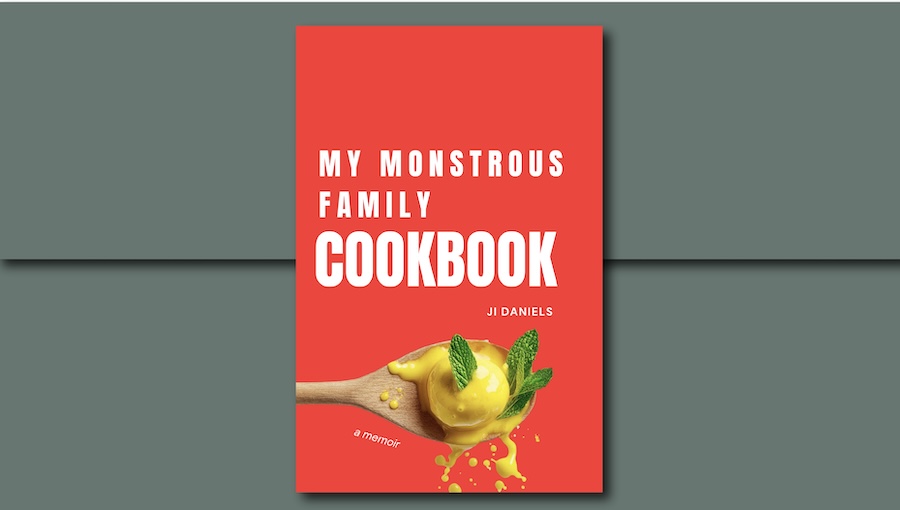
The following is an interview with author and professor JI Daniels regarding the November 24th release of the hybrid memoir, My Monstrous Family Cookbook, through publisher Unsolicited Press. In this interview, Fanbase Press Editor-in-Chief Barbra Dillon chats with Daniels about his creative process in deftly weaving his own story within the format of a cookbook, what readers may take away from its themes, and more!
Barbra Dillon, Fanbase Press Editor-in-Chief: This month will see the release of your new hybrid memoir, My Monstrous Family Cookbook. What can you tell us about the genesis behind this one-of-a-kind project, and what inspired you to share your story with readers?
JI Daniels: I’m someone that came to cooking in the internet age, and so like most everyone, I have a love/hate relationship with cooking blogs. I love the convenience and innovation of them, and I hate having to scroll past their mundane background information before I can get to the recipe I’m there for. I was curious about how to make a hybrid structure where the story behind the recipe was just as important. Not a memoir with recipes, like some other books have done wonderfully, but a cookbook that was about the stories.
And since I have had my own difficult relationship with food, with my body, and with the expectations our culture puts on these things, I knew that it was the perfect blend of possibilities.
BD: In deftly weaving your personal journey within the structure of a cookbook, how would you describe your creative process in not only crafting each recipe but also thoughtfully exploring your own lived experiences?
JID: This book has made the most use of brainstorming and outlines. I sat down and wrote out lists of favorite recipes and I wrote out lists of stories about my life that felt important to the project, and then I sort of went through them both, thinking about what stories connected to what food, and what food connected to what stories.
For instance, my favorite pastry is the Kouign Amann, which is essentially a caramelized croissant. It is light and fluffy and buttery, but also has a caramelized shell that makes it crunchy. I had read bell hook’s book, All About Love, and I had some strong feelings about it, and so I knew I wanted to write about what love meant to me, how it feels important and how I wish we could talk about it differently. When I was looking at the lists of recipes, I understood that even beyond the taste of the Kouign Amann, what I liked about making it for my friends was that because of how long it takes, and how many steps it involves, I had been using it as a signal about how much they meant to me. If I was spending twelve hours making pastries, you better believe I wanted you in my life.
From there, the actual writing process generally went through a few iterations as I thought about the needs of the hermit crab essay, the memoir living in the shape of a recipe, or that of the braided essay, weaving multiple story components together. This meant that there was a lot of experimentation and failure, where sometimes the essay simply got thrown away, or sometimes I used a new food to illustrate the story, or else a new story would be needed for a necessary food.
BD: At Fanbase Press, our #StoriesMatter initiative endeavors to highlight the impact that stories can have on audiences of various mediums. How do you feel that this book – and your willingness to confront topics like family trauma and masculinity – may connect with and impact readers, and what, if any, conversations do you hope that it may inspire?
JID: I think that stories about difficult or complex topics, and I’ll use masculinity here as an example, tend to be too reductive. That they are either aspirations of masculinity, which often quickly degrades into toxic alpha-male nonsense, or else that they are flat-out rejections of it entirely, which can feel like the very act of identifying as male is somehow bad in and of itself. I think that we need stories that weave the more complicated and difficult narratives that are both of rejection and of embrace, so that we are leaving behind toxic representations and holding up positive ones, but—and this feels important to me—making the space for the stories we didn’t know existed until we encountered them. I hope that readers can see that I don’t want to create new definitions or rules—for masculinity or for any for these difficult conversations—but a productive space to acknowledge our traumas and difficulties so that as we move forward, we are doing so deliberately.
BD: What makes Unsolicited Press the perfect home for your story?
JID: Unsolicited Press is the kind of publisher that feels vital to me as a reader. I love all kind of books, and I’m so grateful for the Big 5 presses for getting important literature out into the world en masse, so that more people can read marvelous books, but places like Unsolicited Press are able to push boundaries and make work that you simply didn’t even realize could exist. It was the kind of publisher that I didn’t even know about for a long time, but then I was recommended Jackson Bliss’ incredible memoir, Dream Pop Origami, and I have been in love with them since.
My Monstrous Family Cookbook is the kind of a memoir that doesn’t give you a simple lesson, or clear winners or losers, or a path to financial success, which is what large publishers tend to want, and so it’s only a press like Unsolicited that is willing to spend the time on a book like this that gives us more questions than answers, and more a call to reflection than to action.
BD: Are there any other projects – past or current – that you would like to highlight for our readers?
JID: I’m always happy to promote my novel, Mount Fugue: a mountain climbing disaster told through the lens of a shifting media landscape, and my collection of sci-fi, slipstream, and weird-fiction stories, If You Can. But right now, I’m also working on a fun video game project, Killing Baby Hitler, which is a satiric Wolfenstein-inspired boomer shooter that uses comedy to explore the surprising history of fascism.
BD: Lastly, what is the best way for our readers to find out more about My Monstrous Family Cookbook and your other work?
JID: You can follow my Substack, Devourer, at jidaniels.substack.com, or check me out on Bluesky (@narrativelies.bsky.social), and with both you can feel safe knowing that my social media shyness means you won’t be bombarded with constant updates.
