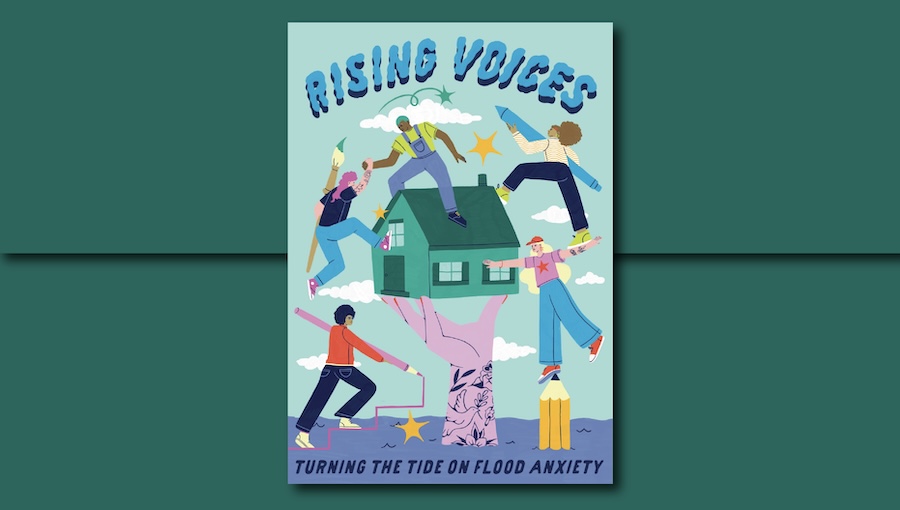
The following is an interview with Sara Kenney (Innovation & Engagement Manager, Environment Agency) and Comics Youth CIC creators Ishleen Kaur, Jem Barnes, and Jasmine Boyd regarding the recent release of the comic book anthology, Rising Voices: Turning the Tide on Flood Anxiety, in collaboration with engineers from the Environment Agency. In this interview, Fanbase Press Editor-in-Chief Barbra Dillon chats with the team about their shared creative process in tackling this important topic through the sequential art medium, why stories like these help to raise awareness and initiate much-needed conversation – especially during Flood Action Week, and more!
Barbra Dillon, Fanbase Press Editor-in-Chief: As part of Flood Action Week, you recently released the comic book anthology, Rising Voices: Turning the Tide on Flood Anxiety. What can you share with us about the genesis behind this groundbreaking project and the creative prompt provided to its participants?
Sara Kenney: I joined the Environment Agency on a six-month contract and three years later I’m still here. I didn’t expect to find comics and arts work inside the EA, but a colleague Jason Dinsdale from the Horizon Scanning and Futures team in the Chief Scientists Office was already working with brilliant comic artist Gareth Sleightholme (based in Hull).
So, I started developing a pilot called ‘Community & Creativity’ using comics, film, arts and creativity to help us all process, understand, challenge and act on the impacts of climate change. Working with Rhiannon Griffiths at Comics Youth and the organisation’s young creatives, we shaped the idea: pay ten artists aged 16 to 25 to work alongside Environment Agency flood engineers for a year, visit real flood defences across the Wirral, and make comics about what they discovered. The brief was not “explain flooding to young people”; it was “what happens when artists get to ask engineers some awkward questions?”
Funded through an Ingenious public engagement grant from the Royal Academy of Engineering, supported by the Department for Science, Innovation and Technology and the Environment Agency’s Sustainability Innovation Fund, Rising Voices brought ten young artists aged 16 to 25 together with twelve Environment Agency engineers over a year. It shows how a comic can carry the science and the feeling in the same panel – and that’s what people remember.
Ishleen Kaur: We started by meeting weekly in Birkenhead, where we discussed ideas, exchanged knowledge with the Environment Agency engineers, and took part in different activities to get our creative juices flowing. I used to travel from Leeds to Merseyside, and enjoyed the journey, which was also in a way, a part of my creative process. I like that I get a chance to build relationships with the new places/cities through creative projects like these. The brief was quite open-ended, which gave me the freedom to explore my ideas without feeling restricted and helped me start my process with a sense of curiosity and willingness to learn.
Jem Barnes: It really began from just applying to interesting design opportunities on Instagram. The first session was getting to know who we were working with and what exactly we’d be doing. The climate aspect was really just a perk initially, but as the project went on, it really did change my perspective on the environmental issues.
BD: How would you describe your shared creative process in bringing these impactful stories to life on the page?
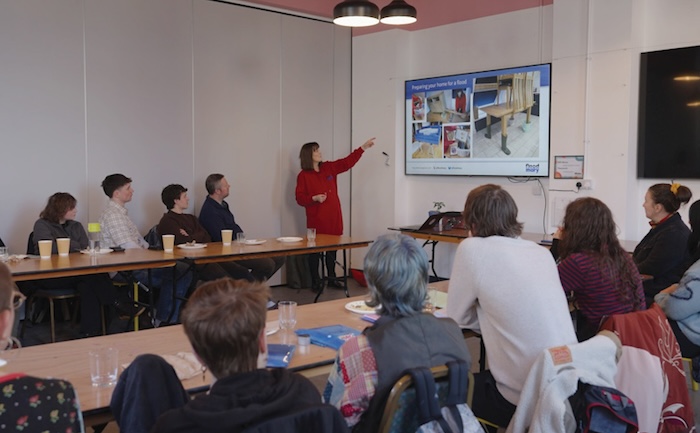
SK: Messy, in the best way. The workshops took place at Callister Gardens, a community garden in Birkenhead, with Rosa Kusabbi from Comics Youth holding the room. One unexpected outcome was that some of the engineers wanted to make comics, too. There was something wonderfully levelling about seeing a senior flood engineer puzzle over animal character designs while young artists used maps to explore the history – and possible future – of flooding in their area.
IK: Creating my zine was very process-led. I let the process unfold naturally, absorbing information and allowing my thoughts and emotions to guide me towards the final outcome. The workshops led by Afroflux and other guest artists were quite valuable in helping me explore new approaches and create something that felt fresh and personal while remaining connected to the wider theme.
For my zine, River of Grief, I wanted to explore a young person’s grief, memories and loss affected by flooding. I researched the subject, spoke to the team, and drew on case studies, insights from Sara and the Environment Agency engineers, and everything I had learnt through the workshops. The open-ended brief gave me the time and space to let abstract thoughts develop into a finished piece without feeling pressured to arrive at an idea quickly. River of Grief is particularly close to my heart, because it helped me refine the kind of art I want to make: work that is narrative-driven, emotional, meaningful and impactful.
The anthology itself was also very participant-led, from start to finish. We were involved in discussions about its sections, layout and other elements, and our feedback was taken into account throughout. Having that autonomy and agency as an artist made me feel valued and gave me a real sense of ownership over the final outcome.
Jasmine Boyd: For me, the creative process started by thinking about things I already knew and was interested in. I created a long list of themes to choose from, such as loss and heritage. From there, I branched out to more concrete ideas, mapping out the story and the number of pages. First, I wrote the text, and then I created the actual comic around those ideas. While it was sad thinking about climate change and flooding, it was also cathartic to create art that reflected how immigration can lead to feelings of loss of identity and heritage. As a social scientist studying evolutionary anthropology at university, objects and culture are of great interest to me.
JB: I have quite a certain design process: simply research followed by experimentation. I use this to eventually develop an idea into a final piece. It was a bit daunting being the only graphic designer on a team of talented illustrators. I didn’t know how best to apply my skills, but I came into the idea of telling a story through historical photos. This kept the medium primarily visual, to keep it in line with comics.
Furthermore, I always want to experiment to interactive designs. And the budget limitations really got me into thinking what was possible. Simply cutting and folding is free and gives the reader a sense they are creating a story. I just like the idea that each book is a bit different now.
BD: In addition to the comics anthology, Rising Voices also includes a short film directed by Mairéad Ruane which follows the young artists and engineers behind the project. In having documented the creative process behind the anthology, were there any elements of the process that you found most interesting or challenging?
SK: Mairéad Ruane’s film deliberately keeps the focus on Comics Youth and the young artists rather than on me or the engineers. The Environment Agency has plenty of ways to tell its own story; the young people do not. Mairéad and I had previously worked together on She Could Fly, a documentary escape game about OCD inspired by the comic of the same name, so I knew she would create a supportive environment for people on camera. The engineers appear in a few short social-media clips – slightly outside their comfort zones and clearly enjoying it – and the anthology’s behind-the-scenes section also documents the process through photographs and designs.
IK: I enjoy documenting my own work and creative process most of the time. It helps me keep track of what I make and reflect on the direction my practice is taking. Having a talented filmmaker like Mairéad document the project was incredibly valuable, as they captured moments and parts of my process that might otherwise have gone undocumented.
Being filmed and sharing my thoughts alongside the other artists and engineers was a really interesting experience. I think the documentary captures the project beautifully in a simple, thoughtful and impactful way. It is also a lovely souvenir of the project that I can share with others and include in my portfolio.
BD: For those who may be abroad, what can you tell us about the import behind Flood Action Week, and what, if any, conversations do you hope that this project may inspire among readers of all ages?
SK: Flood Action Week is the Environment Agency’s annual campaign each October, encouraging people in England to check their flood risk, get flood warnings and make a flood plan. That matters because around 6.3 million homes and businesses in England are currently in areas at risk of flooding, and climate change could increase this to around one in four properties by 2050. American readers are not off the hook: A 2020 First Street analysis estimated that 14.6 million US properties faced substantial flood risk – nearly 70 per cent more than were identified in FEMA’s Special Flood Hazard Areas at the time. Yet only a small minority of US households have flood insurance.
Our Environment Agency engineers already know yours in the US. After Hurricane Katrina the US Army Corps of Engineers went looking for levee expertise in the Netherlands, and in 2014 the Environment Agency joined what’s now the Levee Safety Partnership: three countries’ engineers comparing notes on how to keep flood embankments standing (You say levee, we say embankment.), it’s proper hands-on stuff.
Our head of Flood Coast Risk Management (FCRM), Caroline Douglas wrote about the recent work here: Three nations, one rising tide: how the Environment Agency, the Netherlands and the United States of America work together to keep communities safe – Environment Agency: For homes and habitats.
The engineers are already exchanging ideas across the Atlantic, and the collaboration recognises that community engagement matters alongside technical expertise. Perhaps the artists should swap notes, too. Rising Voices: international edition, anyone? Barbra, you can have the first interview.
IK: I think Rising Voices brings creativity, information and action together in a way that makes people of different ages curious about flooding. The stories and comics make readers interested and fascinated, while the information and resources encourage them to learn more, start conversations and think about what action they can take. At least, that is what the project has done for me.
I also think creative storytelling can help people connect emotionally with experiences that might otherwise feel distant from their own lives. By bringing together different perspectives and personal stories, the anthology can build empathy and encourage readers to think about flooding not just as an environmental issue, but as something that affects people’s lives, memories and communities.
JB: Fundamentally, it’s educating more people of flooding. A lot of people, especially inland, don’t get informed on that, and it’s so easy to be ignorant on the subject.
BD: For readers who would like to learn more and/or get involved in raising awareness for climate change, what, if any, resources would you recommend?
SK: The most important one first: If you’re in England, go to Home – Flood Action, check your long-term flood risk and sign up for free flood warnings. In the US, FloodFactor.com will give you a flood score for your own address. It takes five minutes. Then, read our comic, which is free to view or download here: comicsyouth.co.uk/risingvoices
Next meet “Flood Mary,” Mary Long-Dhonau. Having experienced flooding herself, she tours the country with a FloodMobile full of practical ways to protect a home. The young artists adored her. We are now co-designing a comics-filled Mobile Flood Café with Gabi Putnoki’s Graphic Novel Reading Room, and we are looking for partners and funders. Home – Flood Mary
Support Comics Youth, who do extraordinary work with marginalised young people in Merseyside and aren’t funded by fairy dust. And make something. Draw the flood. Write the zine. Comics let you approach a frightening subject sideways, and sideways is often the only way in.
BD: Lastly, what is the best way for our readers to find more information about Rising Voices: Turning the Tide on Flood Anxiety and your other work?
SK: You can view the film and download the anthology for free at comicsyouth.co.uk/risingvoices
Rhiannon and I wrote about the thinking behind the project for CIWEM: ciwem.org/news/drawing-resilience-comics-helping-young-people-engage-with-flood-risk
IK: I regularly share my work and updates on Instagram at @ishleen.art. You can also explore my portfolio at www.ishleenkaur.art.
I would really appreciate any feedback, thoughts and comments on my zine, River of Grief (or my other work), on Instagram DMs or email: ishleenkaurstudio (at) gmail (dot) com
JB: Keep informed via the Environment Agency on their socials. Fingers crossed on the Flood Cafe, which should be a source of information, if it gets funded.
My Instagram is Jemb_design if people want to see my further work, animations or projects. My website is Jembdesign.co.uk for some more in-depth content.
