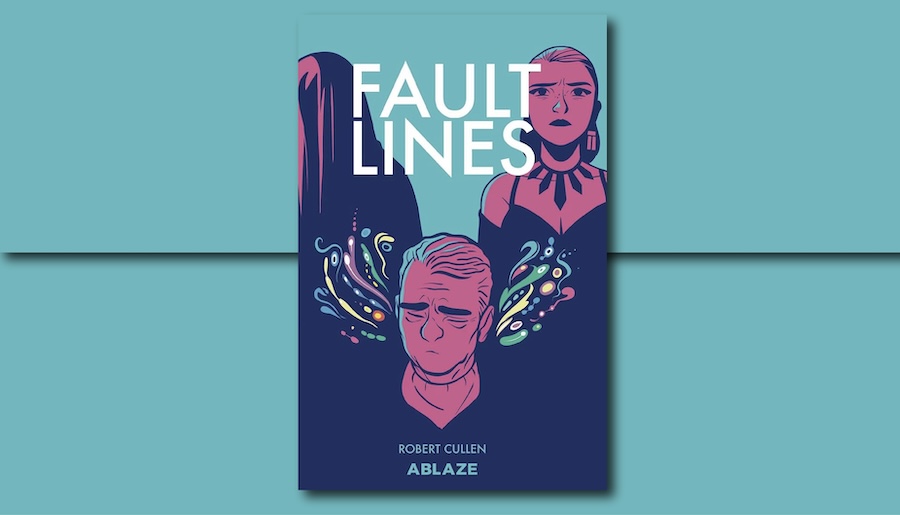
The following is an interview with Emmy-nominated director, writer and artist Robert Cullen regarding the upcoming release of the graphic novel, Fault Lines, with Ablaze. In this interview, Fanbase Press Editor-in-Chief Barbra Dillon chats with Cullen about his creative process of bringing the story to life on the page, what readers may take away from the story’s themes, and more!
Barbra Dillon, Fanbase Press Editor-in-Chief: Congratulations on the upcoming release of Fault Lines With multiple stories interconnected, what can you tell us about the overall premise of the book?
Robert Cullen: Thank you! Fault Lines tells three standalone stories set across three cities and three decades. On the surface they’re very different. A struggling singer-songwriter in Blackpool becomes the Lovely Assistant in an unsettling magic act, a mother in Vancouver reflects on her life after death, and a widower in Edinburgh is forced to confront a childhood memory he’s spent decades trying to bury.
They’re not connected by plot, but by the emotions they explore. Each story looks at loss, memory, regret, and the strange ways our lives can be shaped by a single moment. There are touches of the supernatural throughout, but they’re really there to shine a light on very human experiences.
BD: In light of your extensive body of work in animation, what was your experience in transitioning to the sequential art medium, and do you feel that each medium has its own unique storytelling “toolkit?”
RC: Animation gave me a great foundation in visual storytelling, but making the move to comics was a fascinating shift. Animation is an incredibly collaborative process. Comics are almost the opposite. It’s a much more personal process where every creative decision rests with you, and I found that both challenging and incredibly rewarding.
Each medium definitely has its own storytelling toolkit. In animation/ live action, you can add music, sound design, camera movement, etc. In comics, those tools don’t exist, so you have to find other ways to create the same emotional effect.
Coming from a directing background, I’m always thinking about timing and pacing. I also lean heavily on the language of cinematography—using framing, composition, lighting, and page turns to guide the reader’s eye and build tension—but I try to avoid making it feel like a storyboard. A comic has to work as a comic first, making use of the strengths of the medium rather than simply imitating film.
BD: At Fanbase Press, our #StoriesMatter initiative endeavors to highlight the impact that stories can have on audiences of various mediums—no matter the genre. How do you feel that Fault Lines’ themes may impact readers, and what conversations do you hope they might inspire?
RC: I hope readers see a little of themselves somewhere in the book. We all carry memories, regrets, and moments we’d handle differently if given the chance. Fault Lines isn’t really about the supernatural—it’s about how people live with those things.
If the book starts conversations about grief, forgiveness, or the stories people carry that aren’t always visible, then I’d be delighted. I think fiction is often at its best when it helps us better understand ourselves or someone else.
BD: What makes Ablaze the perfect publishing partner for this project?
RC: From the very beginning, Ablaze understood the kind of book Fault Lines wanted to be. It’s a character-driven graphic novel that doesn’t fit neatly into one genre, and they never asked me to make it something else.
As a first-time graphic novelist, that trust meant a lot. They really embraced the book for what it is, and I couldn’t have asked for a better home for it.
BD: Are there any other projects—past or current—that you would like to highlight for our readers?
RC: Before moving into comics, I spent nearly thirty years in animation working on productions for Disney, Cartoon Network, Nickelodeon, and Netflix. It was an incredible chapter of my career, but these days my focus is entirely on telling original stories through graphic novels.
I’m currently drawing my second graphic novel, Hinterland, a folk horror mystery. Like Fault Lines, it blends grounded human drama with touches of the supernatural, but it’s a much darker, more expansive story. It’s also my first long-form work as both writer and artist, so I’m really excited for readers to eventually see it.
BD: Lastly, what would you like to tell readers who want to learn more about Fault Lines and your other work?
RC: I’d just like to say thank you for taking a chance on an original graphic novel. Fault Lines is a very personal book, and I genuinely hope readers connect with its characters and themes. If it stays with them after they’ve finished it, or sparks a conversation, then I’ll be delighted. If nothing else, I hope they’re entertained.
I regularly share artwork, behind-the-scenes glimpses of my process, and updates on current projects over on Instagram at @robert.cullen.art, so I’d love for readers to follow along. I’m currently hard at work on Hinterland, and I’m looking forward to sharing more of that journey in the months ahead.
