The following is an interview with Bloodline Comics’ David Schrader and Clay Adams regarding their recent Stripe account closure as it relates to their crowdfunding of comic book projects via BackerKit and Kickstarter. In this interview, Fanbase Press Editor-in-Chief Barbra Dillon chats with Schrader and Adams about the timeline of events which resulted in their Stripe account closure, their efforts to seek redress with Stripe, Kickstarter, and BackerKit, their work to ensure that the backers for the A Very Carmilla Christmas Carol campaign were made whole, and their plans for crowdfunding moving forward.
Barbra Dillon, Fanbase Press Editor-in-Chief: David and Clay, first, would you mind telling me about Bloodline Comics and what truly defines a title within your catalog?
David Schrader: Bloodline Comics is a small press publisher. We specialize in handcrafted horror. Clay and I worked on a horror film many years ago. I co-wrote and directed and Clay was the lead. It was called Bloodline and it was released through Lionsgate. So, when we formed the company, we thought that would be a great title because we were going to specialize in horror. The film itself is a cross between Friday the 13th and Memento. It was a low-budget affair, but we treated it seriously and with care, and we tried to tell an interesting story with a fractured timeline and an unreliable narrator.
What defines a Bloodline title is we tell tales of terror in unique ways, pushing boundaries. We utilize satire and dark comedy and we like to take familiar themes or characters and turn them on their head. We joke that we have some of the best taste of the bad taste. And we launched five years ago on Kickstarter with Nightmare Theater: A Cinematic Horror Anthology, and its two follow-ups. One was a space horror one-shot that I did called Cannibals on Mars. And then our most popular series is the latest one, Carmilla Unbound. We released Carmilla Unbound ’73 and ’84. And then our last project, that is now getting into backers’ hands, is A Very Carmilla Christmas Carol.
Barbra Dillon: The focus of our discussion today will be on Carmilla. Would you mind telling us about that title in particular?
David Schrader: Carmilla Unbound is our take on the character from the novella, Carmilla, by Sheridan Le Fanu. That predated Dracula by 26 years. So, when Clay told me about it a while ago, I think this is when we were starting to do Nightmare Theater, he told me about the character and I just hadn’t seen a lot of her. She’s a character in Castlevania, but I thought you would hear more about her because she’s considered one of the first, if not the first, literary vampire.
Doing research for Carmilla, we discovered there’s a few different things. There was a movie that came out that was pretty true to the novella. And the novella is very almost Merchant Ivory-ish. We wanted to take the character and bring her into the modern era. And the reason we chose 1973, and we set it in Los Angeles, was it was kind of the dawn of the modern feminist movement.
Our idea for the character was if you’re going to live forever and you’re going to try to find meaning in life, for her, she became bored and didn’t want to keep just feeding on girls. She thought, well, how can I make a difference in the world? We turned her into a vampire Dexter, where she just kills the bad guys and the longer she lives, the more target rich they become. So her targets are rich, wealthy, powerful, bad guys.
Clay Adams: That made for a perfect adaptation of A Christmas Carol. Dave had the brilliant idea to make it a modern-day satire and it really worked out very well.
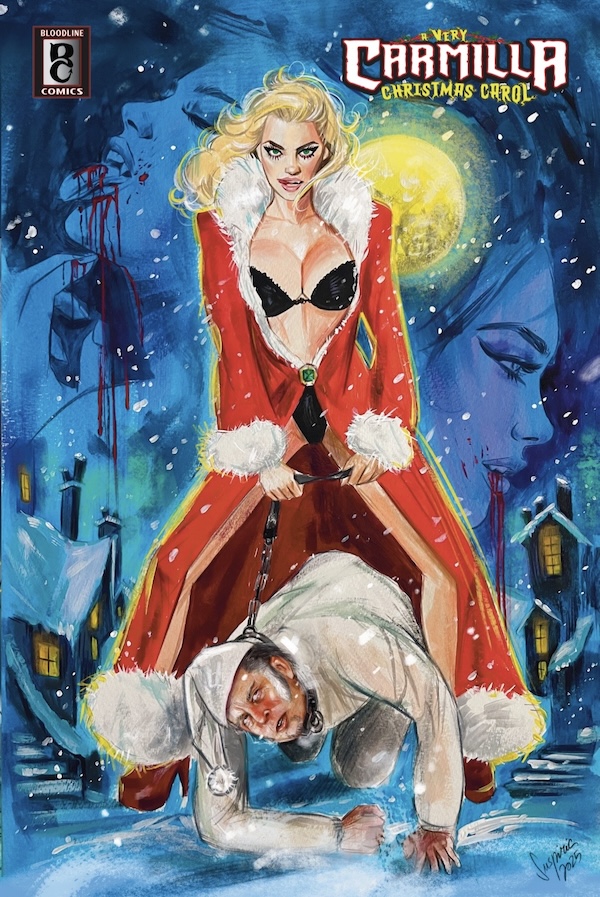
Barbra Dillon: Your Bloodline Comics titles have been crowdfunded through Kickstarter, and you’ve also utilized BackerKit in tandem with that throughout the process. In light of Stripe’s recent revisions to its Adult Content policy for crowdfunding, your campaign for A Very Carmilla Christmas Carol has been impacted. Would you mind sharing with me how your campaign was impacted?
Clay Adams: When we ran the campaign on Kickstarter in November-December 2025, we did get warnings from Kickstarter saying, “Your book contains not-safe-for-work material. It’s possible that while we’ve approved it, Stripe may decide at any time to shut it down.” And we thought, “Okay, well, that’s never been a problem before. There are plenty of not-safe-for-work projects on Kickstarter. We’re not super worried about this.”
And we wrapped up the campaign without a hitch. Stripe charged the [backers’] credit cards and [took] their cut, and everything seemed to go smoothly.
The first I became aware of any kind of change in policy was actually on a different book, one I was doing over at my other company, Fried Comics.
Barbra Dillon: What was the timeline of this occurring, Clay?
Clay Adams: This probably would’ve been late April, end of April [2026].
Barbra Dillon: So, the A Very Carmilla Christmas Carol campaign had been approved by Kickstarter and Stripe in late 2025, and you were at the point where you were funded and received those funds in January 2026. Is that correct?
Clay Adams: Yes, yes. It ended right around Christmas and so we did receive the funds in January [2026]. We did learn that some of the policies were getting stricter, and then Kickstarter sent out a notice about their not-safe-for-work policy.
David Schrader: I think that was May 11th it came out.
Barbra Dillon: After May 11, what occurred?
David Schrader: In general, we were like, “Okay, well, I guess our next campaign will have to follow these rules and figure it out.” But then, when Clay went through BackerKit [to send out a smoke test for backer surveys for A Very Carmilla Christmas Carol], that’s when it kind of hit the fan. [Stripe] must have seen images from our previous campaigns that were on BackerKit. They said, “We are closing your Stripe account.”
We thought, well, if they’re closing our Stripe account, even if it’s approved when it’s on Kickstarter, we won’t be able to collect. We effectively won’t be able to do Kickstarter anymore. And so that started the gears grinding like, “What are we going to do?”
Barbra Dillon: David, just to clarify for folks who may not be as familiar with the backend of the crowdfunding process: In order to have a crowdfunding campaign approved on Kickstarter, you do have to be approved by Kickstarter, and you have to be approved by Stripe to set up an account and to be paid the funds that are being charged to the backers’ credit cards. Where does BackerKit enter into this scenario?
David Schrader: It’s post-campaign when you’re ready to actually give people their rewards and you want to give them a chance to [purchase] add-ons [to the rewards they already selected] and to provide their addresses for the rewards.
When Clay got that notice [from Stripe], he immediately went and changed anything [on our Kickstarter campaign page] that could be considered offensive under the new rules, but [Stripe] just sent us the response, “We reviewed it and your account is still closed.”
Clay Adams: To Dave’s point, I did go through and I followed all of Kickstarter’s guidelines. Now granted, this is on BackerKit, but I followed their guidelines about how you’re supposed to put a page together. I changed all the images, I removed anything that could be offensive theoretically, and then resubmitted. I said, “Hey, take another look at this.” And we started getting responses [from Stripe] that we realized very quickly were AI and not a real human being.
It knew just like a handful of phrases that it could only repeat over and over again. Even though it signed a different name – Shirley, Alex, Lisa – it was clearly the same computer algorithm speaking.
And we said, “What specifically have we violated? What specifically can we do to get into compliance because we’d like to work with you?” And all it could do was say, “Oh, thank you for sending more information about your business. We’ll review this matter and get back to you.” And then we would get a follow-up, the second email in the chain was, “We’re sorry. After further review, we’ve determined you’re an unsupported business. Here’s a link to our unsupported businesses.” And it’s like, “Well, which one are we? What have we violated? Why?”
Barbra Dillon: Just an endless loop.
Clay Adams: We contacted BackerKit and told them what was going on. “Stripe is canceling our account. We can’t go wide with the surveys, because we don’t want to collect credit card information that then we can’t charge.”
BackerKit told us at that point, “Well, if Stripe has decided they’re closing your account, we can’t do anything.”
That’s when we went to Kickstarter because we realized we were just hitting a brick wall with Stripe.
Barbra Dillon: Do you remember about what time this was in the timeline?
Clay Adams: This would’ve been the very next week, the week of May 18th.
David Schrader: Sean Edgar had just taken over their Comics division, but he was at a conference in Vegas when all of this started going down. I know he was getting an influx of worried creators freaking out about this. And so he was responding to us and asking us questions and we were grateful to be dealing with a human being.
Clay Adams: We were definitely dealing with people at BackerKit and Kickstarter. And to Sean’s credit, he was more responsive. He directed us to Kickstarter Trust and Safety who explained to us that with every Kickstarter campaign, you create your own sub-Stripe account. And so that’s different from the Stripe account that you create with BackerKit. We didn’t realize that there were all these sub-accounts, but, ultimately, there was nothing Kickstarter could do, because the problem was the sub-Stripe account with BackerKit.
David Schrader: BackerKit said, “We can do a one-time deal where we switch [the payment processor] to PayPal.”
Even with that, they gave us a warning: “PayPal could do the same thing at any time.”
We wanted to at least get through this campaign and complete it because it was making us look [bad to our backers]. We like to fulfill rewards as soon as possible.
Clay Adams: And we had already told backers that surveys were coming.
Barbra Dillon: In terms of this existing [A Very Carmilla Christmas Carol] campaign, did you decide to confirm with BackerKit that you would utilize PayPal as the payment processor, in order to make your backers whole?
Clay Adams: Yes, we decided, let’s tell BackerKit that we’ll do the PayPal option.
The BackerKit representative came back and said, “Let me reach out to my contact at Stripe. They don’t respond quickly, so let’s go ahead and go with PayPal, but I will let you know what they say.”
BackerKit came back and said, “Good news. They think they can get you approved, but it’s going to take a little more time.” At that point, they sent over a list of what Stripe allows and what they don’t allow. And we felt very strongly that we fell into the what’s allowable category (i.e., artistic nudity is fine). What’s not fine is hardcore explicit sex acts. And so we were like, “I think we’re fine.”
Now, Stripe did make a point of saying, “It doesn’t matter what the creator’s intent is. We know something wrong when we see it,” basically that old definition of, I can’t define pornography, but I know it when I see it. But they said, “We think that they are allowable so let us look into that.”
At that point, we got a message from Stripe that made us really happy. Stripe sent Dave a message saying, “After review, we’ve decided that you can continue using Stripe.”
David Schrader: Clay and I were on the phone talking about how great that was, and then [Stripe] sent another message saying, “Your account’s closed again.”
At that point, we went back to BackerKit and said, “Hey, what happened? We got approved and then we got unapproved.”
We are still in review [with Stripe]. We are still waiting to find out whether we can use Stripe moving forward.
Using PayPal still had some problems because people were still able to enter their credit card information. No matter how many times we asked them, “Please don’t put in your credit card, click the PayPal option,” a sizable number of people ordered Add-Ons and entered their credit card information. We’ve mostly cleared those up [with the backers], but there are still a few remaining.
Barbra Dillon: It sounds like, with regard to the existing campaign, you are making every effort to make your backers whole. You went back to BackerKit and have made an agreement to utilize PayPal for this existing campaign. There may be a few straggler backers that you’re working with to get them to utilize PayPal instead of their credit card, but I’m sure that you will make every effort to make those backers whole, as well.
David Schrader: Yes, the books are going out now.
Clay’s been fulfilling the physical books, all the digital rewards are out. So, we’re kind of on track as to what we promised even with all this nonsense.
Clay Adams: There’s an extra wrinkle, though, with using PayPal because if somebody doesn’t get their goods within 30 days, they can get a full refund from PayPal. We were told by BackerKit, “You got to ship these out immediately,” so I’ve been working like crazy trying to get these packages out.
Barbra Dillon: In the midst of your timeline of working with BackerKit, Stripe, and Kickstarter to try to get your Stripe account re-approved, the COO of Kickstarter did post a public statement noting that Kickstarter was rescinding its own adult content policies, but that Stripe’s policies would still stand. So, even if you might be approved by Kickstarter for your campaign, it could, at any juncture, be shut down based on Stripe’s policies.
Clay Adams: Yeah. Effectively nothing has changed.
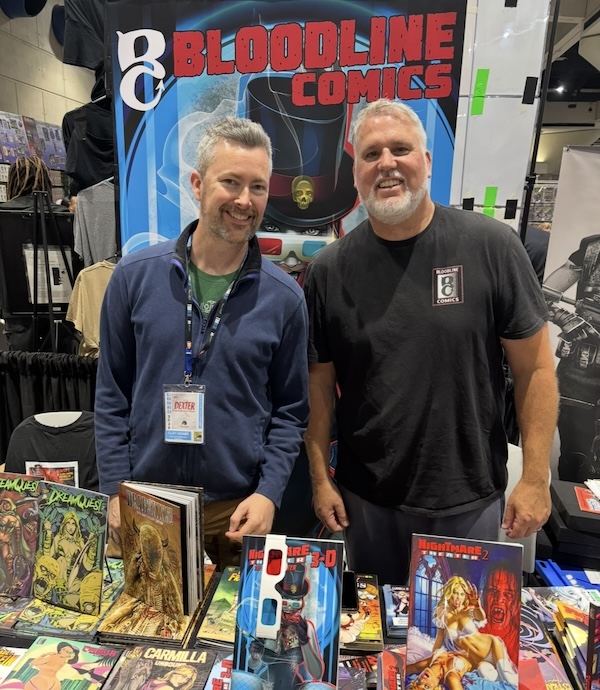
Barbra Dillon: I want to talk about where you go from here. In terms of how you view crowdfunding and how you, as the co-founders of Bloodline Comics, view your business model, where do you stand in terms of crowdfunding? Will you continue to utilize crowdfunding? And if so, which platforms would you utilize? Are you having to diversify your revenue streams to ensure that all of your funding does not solely come from crowdfunding?
David Schrader: Kickstarter is kind of where it’s at and that’s where we built the business and where we wanted to continue to build it. We are in talks with some people to develop some low-budget horror films. Ideally, that’s kind of our background, too, filmmaking, and we would love to take Carmilla as a character and do something with that. We have three or four other screenplays and scripts that we’re developing.
We wanted to transition into Bloodline Comics Pictures. And ideally, that’s what we would do. We would continue to have our home base at Kickstarter, meaning we would crowdfund there, but we’ve met with some other places, including Zoop regarding their soon-to-launch companion site, Dooz, but there are things that hold us back from doing that. I think our next campaign is already generally set up and was approved by Stripe.
Barbra Dillon: And that’s through Kickstarter?
David Schrader: Yeah. We’re going to go forward like we normally do with the new rules in mind. We don’t want to self-censor ourselves, though. I saw what Pat Shand did with Cheeky Comics’ latest campaign — he has the standard cover and then under that, he just lists the other two covers in text. So, he’s not showing anything [that could be deemed as adult content] with sensor bars. And then you are able to link somewhere else if people want to see the covers or even a censored version that doesn’t exist at all now on the campaign site. Maybe that’s what we will have to do and that’s fine.
We want to stay with Kickstarter. We’ve explored other options, but it’s really like we got to cross our fingers and see how it goes because that might change.
We’re a boutique company and we are proud of what we do. It’s R-rated stuff, just like most horror and post-apocalyptic sci-fi. It’s not for kids, but it’s also not what anyone would ever call erotica, but we also support people’s ability to do that and sell it.
We want to make the books that we, and our audience, want and not have to worry about some corporate entity’s tastes being offended somewhere down the line and that causing the whole thing to have to be the plug pulled.
Barbra Dillon: That raises a really good question: What role do you believe a credit card processor has in defining and/or limiting subjective art?
Clay Adams: That’s a really tough question to answer only because it’s yes and no. I mean in the sense that as a corporation, a corporation literally is a collection of people and so those people have the right to associate with and do what they want with their business. On the other hand, as the sole processor (and the 800-pound gorilla) in the crowdfunding space, it does effectively censor.
I know it’s not government, so censor is not the right word, but it chills speech and it chills creativity. And so from that standpoint, I think the bigger answer is no, there has to be some kind of alternative. They have the right to not want to process whatever charge they don’t want to process, but there has to be some other alternative for creators because you are having [corporations] decide what gets made and what doesn’t get made and what people can and can’t see.
David Schrader: Or decide what people can see or what people can buy, what grown adults using a credit card can buy. Now I would say that, to be fair, these corporations, they have some risk involved and certainly they shouldn’t be sponsoring anything that’s illegal or approving anything that’s illegal content, but we’re talking about R-rated books. It’s no different than an R-rated movie or an R-rated graphic novel for mature readers that’s in any bookstore or any comic shop.
Barbra Dillon: You have mentioned that you are putting out an open letter to the comics community, and I’d like you to share who this letter is directed to and what you hope to do with the message.
David Schrader: It’s an open letter to the indie comics and crowdfunding community. We’re not the only ones who are going to be affected by this [Stripe situation].
I want to say that while this [Stripe situation] may start with a risqué comic, but what next? Maybe it goes to, they don’t like your political bent or they don’t like who you’re satirizing. And in our particular case, maybe I’m paranoid, but we are satirizing the world’s wealthiest man in this book and skewering him pretty hard. He is a public figure. It is okay to do this under parody laws.
But if it’s this for now, then it’s going to lead to a lot of other books being chilled. It’s this corporate censorship that is very odd. Whether it’s [Stephen] Colbert or various [newscasters], we just feel like we’re a small part of that and we want to speak out about it and support indie comics and anything that pushes back against the man, as it were.
Clay Adams: I feel like there was a sense among creators that when the COO [of Kickstarter] put out his statement [rescinding their adult content policies] that, poof, everything was fine, and the problem went away. And I feel like people need to know, no, nothing has changed. The problem is still here and I understand Kickstarter is working on their end to resolve it, but until we get some kind of assurances that something has changed [with Stripe], nothing has changed.
People need to proceed with caution. People do need to be looking at other options. Kickstarter is the 800-pound gorilla [in crowdfunding], there’s no other company that can compete with it. And so we could go somewhere else, but we could really impact our revenue streams by doing that.
And so there’s unfortunately not a viable alternative. And whether people use this moment to create a viable alternative or to pressure Kickstarter to move faster on some of these moves, I think those are the things that need to come out of this moment. But we just want to spread the word that these problems are still ongoing, nothing has changed, and you’re at risk, whether it’s sexual content or violent content, they can shut you down.
Barbra Dillon: David and Clay, I appreciate your willingness to share your experience. I think it will be illuminating to folks who either are concerned about what could happen or are going through it and are not sure where to turn. I really value your honesty and candor, and I’m glad that the folks at Kickstarter and BackerKit have worked to make you whole for this specific campaign. I truly hope that whatever the path may be moving forward, that you and Bloodline Comics are successful and that you’re able to share your stories with the world as you intend to.
Clay Adams: Thank you, Barbra. Thanks for giving us a chance to talk to you.
Editor’s Note: Fanbase Press has reached out to Kickstarter for a comment on David and Clay’s situation with Stripe. Efforts were also made to reach representatives for Stripe and BackerKit; however, contact info for both platforms was not readily available without an existing account.
