
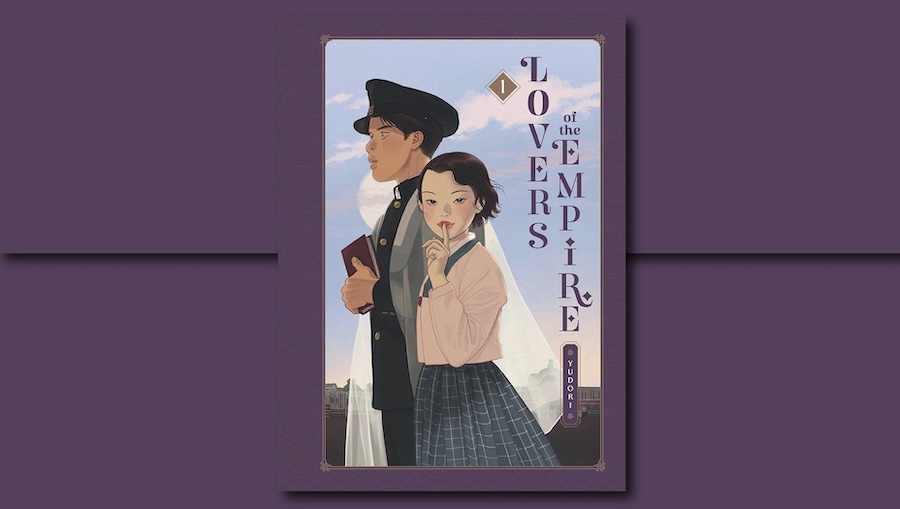
The following is an interview with Eisner Award-nominated cartoonist Yudori (Raging Clouds) regarding the upcoming release of the graphic novel, Lovers of the Empire: Volume 1, which will mark the debut release of Fantagraphics’ new imprint, Takumgraphics, specializing in East Asian comics. In this interview, Fanbase Press Editor-in-Chief Barbra Dillon chats with Yudori about her creative process in bringing the story and characters to life on the page, the themes that she hopes will resonate with readers, and more!
Barbra Dillon, Fanbase Press Editor-in-Chief: What can you share with us about the genesis behind Lovers of the Empire and how would you describe its premise?
Yudori: The initial idea came to my mind when I was maybe 17, 18, but, of course, it took a long time because I tend to have a spark of idea, maybe a scene. And I can’t actually share that scene with you because that would be a spoiler. But it usually starts out with a scene and then I let it almost brew or maybe I have to do a lot of more research or maybe I have to train and improve my art skills to be able to actually execute it. So, that’s how it started. And then as I did more research to be able to make it work, so I can actually do the drawings and everything, I just realized the day-to-day lives of people from the time, 1920s, ’30s Korea, was actually very interesting. And I did feel like it had very contemporary appeal. I felt like I could empathize with them.
That was basically the premise for me: Let’s do this historical fiction, but then let’s focus on the daily lives of people while the country is going through a lot of turbulent times, a lot of traumatizing events. Instead of talking about the big events, let’s talk about the people. That was the main idea.
BD: This is an incredibly palpable coming-of-age story where you’re juxtaposing, as you said, a will-they-won’t-they romance against the backdrop of war. How would you describe your creative process in bringing the world and characters to life on the page?
Yudori: In every book, every story I’ve written, it essentially comes from me or what I can identify with. And certain characters, of course, it cannot be all from me, just the people I’ve met. I just draw inspirations from my own life initially. For instance, Jun, he’s from the countryside and then he goes to this big city. The costumes are different, and it feels like he has to fit in. I think a lot of that actually comes from when I first moved to New York. I’m originally from South Korea. So, maybe it’s different, but I can try to find something that’s similar to me. And of course, a lot of other characters come from people I’ve met, but then also trying to find connection between that, me, and the people I meet, and then the people from 1930s Korea.
A lot of it is just trying to find the connection. I guess you can call that creativity, but then I don’t feel like I ever create, if that makes sense. I just try to find connection between seemingly different things and try to make them make sense.
Barbra Dillon: You’re holding up a mirror not only to your own lived experiences, but to what you’re seeing in the world around you.
Yudori: Right. Yeah.
Barbra Dillon: With regard to your creative process, what can you tell us about the research that you may have conducted in terms of capturing that historical context of 1920s/1930s South Korea?
Yudori: It’s iconic, it’s a big deal for Koreans, the memory of this colonization in the 20th century. If you grew up in Korea, you can’t escape it. You learn about it in schools. So, I know the basics of when the treaties were assigned or the big battles, but then aside from that, I just tried really hard to focus on what people were saying or writing about themselves or what they saw. There’s a newspaper archive that’s available for free on the Korean web. So, I actually just use a lot of the newspaper archives so I can see the real articles and essays. Even just newspaper advertisements. Then, I can see that these products were seen as popular, or these products were maybe not as accessible, but it was aspirational. I can get the feeling of what people really felt like. I read a lot of essays from that time. I don’t really actually read so much of history books. I read just essays and novels and all that actually from that era.
And for clothes, I own a few pieces from that time. And actually for my wedding, I had to wear hanbok, the Korean traditional costume, and I had to commission it from someone. And I thought, I mean, I’m already spending so much money, so might as well make it 1930s hanbok so I can use it as a reference later. I couldn’t use just any hanbok that I can buy from shops in Korea now because the designs are slightly different. I actually own some vintage or antique pieces of clothing and I refer to that sometimes..
BD: At Fanbase Press, our #StoriesMatter initiative endeavors to highlight the impact that stories may have on audiences of various mediums. How do you feel that the characters’ stories may connect with and impact today’s readers? And what, if any, conversations do you hope that the story might inspire?
Yudori: Initially, I wasn’t really… Because when I started working on the first volume, it’s been a few years. I actually think it’s quite similar what I’ve been going through or what we go through and what the two characters go through in the story. A lot of crazy stuff has been happening in the past few years. But the thing is, though, you still buy comic books. You still go on dating apps. You still try to find some sense of-
Barbra Dillon: Normalcy?
Yudori: Yeah. And I think that’s what the characters are doing. And I try not to have an agenda or I try not to have this like, “Oh, all the readers who read my book should learn this from…” I don’t have that. But if anything, life is very complex. It’s never just good and evil except very few cases. A lot of times, it’s very complex. And I think sometimes my characters are not entirely likable, and I am aware of that but it’s important to know as we go through all this crazy stuff that people are always learning and changing. And it’s nice to have that room for forgiveness for myself and for others. And I think I try to see my own characters with that mindset, if that makes sense.
BD: It does, absolutely. We are fallible creatures, and I think that that makes them feel more three-dimensional.
Yudori: Right, right.
BD: This graphic novel will be the debut release of Takumigraphics. I’m curious, what has made the teams at Fantagraphics, and specifically Takumigraphics, the perfect publishing partners for this story?
Yudori: I’ve worked with Fantagraphics before on Raging Clouds. And then when Conrad, my editor, emailed me saying, “Would you mind having your next book published through Takumigraphics?” I was like, “Sure, that sounds great.” Because I try not to worry too much about what they do on the publishing side of things. I just trust my editor; Conrad is great. If he thought my work goes well with Takumigraphics, I leave it to him.
BD: That’s the sign of a great editor. You have your full trust in them. Are there any other projects, whether past or current, that you would like to highlight for our readers?
Yudori: This book is going to be in total five books actually. Lovers of the Empire is the one that I’m working on. I hope the readers stay with me.
