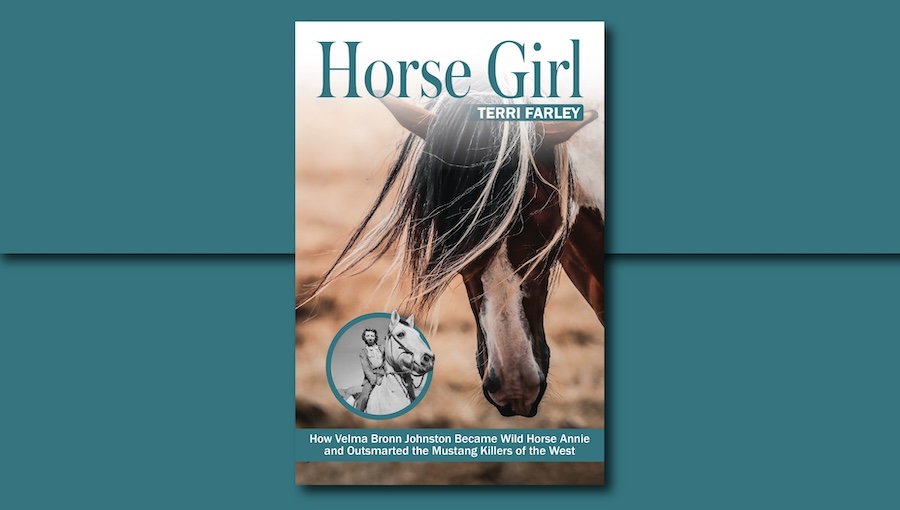
The following is an interview with award-winning author Terri Farley on the recent release of the biography, Horse Girl: How Velma Bronn Johnston Became Wild Horse Annie and Outsmarted the Mustang Killers of the West, with University of Nevada Press. In this interview, Fanbase Press Editor-in-Chief Barbra Dillon chats with Farley about the creative process of bringing Johnston’s powerful story to life on the page, the conversations that the story may inspire with reader, and more!
Barbra Dillon, Fanbase Press Editor-in-Chief: Congratulations on the release of Horse Girl: How Velma Bronn Johnston Became Wild Horse Annie and Outsmarted the Mustang Killers of the West! What can you tell us about the genesis behind this project and your inspiration to share Velma Bronn Johnston’s story with readers?
Terri Farley: I’ve always loved horses, especially wild ones, but I grew up on the outskirts of Los Angeles. As a very allergic kid, all of my wild horse encounters were virtual – books, TV, movies. When I came across real-life stories of Wild Horse Annie, a young woman who saved America’s mustangs from being slaughtered for dog food, I found a heroine. When I moved to Nevada and actually met her, I was astounded by this brainy outsider who was a brilliant, sarcastic crusader for wild horses. No protection existed for wild horses until SHE made it happen in 1971. But she was humble about her accomplishments. That made me want to tell her story.
BD: How would you describe your creative and research processes in bringing Velma’s journey to life on the page, and what did you find to be the most challenging or rewarding aspects of this creative journey?
TF: I was incredibly lucky that Velma’s niece and her best friend’s daughter were not only alive and excited to have coffee dates with me, but willing to share stories, personal papers, and unpublished family photographs. Because I wanted this is to be a book for everyone, not just horse or “herstory” geeks, I used my fiction-writing skills to make HORSE GIRL a story that just happened to be true. I wrote all of the photo captions and sidebars myself and made them as interesting as possible – sort of like bait – because I know once some people get past the front and back covers, they can be lured in to read the book by catchy, bite-sized text.
HORSE GIRL had to do some myth-busting. Those who did know about Velma “Wild Horse Annie” Johnston had usually fallen for some untruths.
Velma wasn’t a brazen cowgirl. Her shyness came across in many of her private writings. The after-effects of childhood polio changed her face and twisted her torso. She could still run and ride and walk, but people stared. Velma described herself as “an awkward girl who tried to conceal her zigzag spine by walking defiantly.”
One myth says Velma grew up on a ranch. In fact, she lived in a neighborhood in Reno, Nevada, within walking distance of a university, banks, stores and restaurants.
The ranch myth extends to the lie that “Charlie married her for the family ranch.’ This not only hints at bias against “imperfect” women, but there was also no family ranch!
Charlie and Velma married for love. In fact, the only personal papers I was denied access to were their love letters.
The Double Lazy Heart Ranch was what they’d both dreamed of and they built it together. They saved money and chose land along the Truckee River, where Velma first saw free-roaming wild horses. Charlie constructed the barn and house while Velma worked in town as a secretary to keep funds flowing.
One research surprise which delighted me was Velma’s physical courage. Asserting that they couldn’t be arrested as horse thieves because America’s mustangs belong to the American people, Velma and Charlie waged night raids to free them from horse killers’ corrals. Velma received numerous threats from the “flyboys” who rounded up wild horses and sold them for a quick, effortless profit to slaughterhouses. Death threats came in the form of verbal vitriol, a mailed “Don’t Tread On Me” flag, and a bullet which caught her in the neck. Still, she persisted.
BD: At Fanbase Press, our #StoriesMatter initiative endeavors to highlight the impact that stories can have on audiences of various mediums. How do you feel that this story may connect with and impact readers, and what, if any, conversations do you hope that it might inspire?
TF: HORSE GIRL is rife with problems we still face today. Clearly, Velma’s life would’ve been different if polio vaccines existed. Because some Americans resist vaccines today, I didn’t spare details of Velma’s disease. Velma was often asked how, as a working woman and rancher, she could write so many convincing letters to legislators, governors, and others. Pain was the honest answer. It kept Velma from sleeping. She stayed up nights typing those letters and opinion papers.
The patriarchy was virtually unquestioned in Velma’s lifetime. For much of her life, women couldn’t vote, couldn’t work if they were married and certainly not if they were pregnant. Velma and Charlie kept their marriage secret for some time. When a Bureau of Land Management staffer chided Velma for not realizing she had a goldmine of wild horses available for slaughter near her ranch, he urged her to have her husband apply for a killing permit.
Personal issues that readers might discuss, too, are Velma’s physical ability not to have children and her fear of public speaking. As a straight-A student, she cut school on days when oral presentations were required. She feared other students would take the opportunity to stare. That fear kept its hold on her until something stronger came along. “To fight for what matters you must have an unshakeable faith in the very rightness of what you are doing,” Velma wrote. She stood up and spoke for the West’s voiceless wild horses in classrooms, boardrooms, secretarial conferences, and Congress.
BD: What makes University of Nevada Press the perfect publishing partner for this story?
TF: The University of Nevada Press was a good publisher for HORSE GIRL because many staffers were already aware of this little-known environmental crusader. I didn’t have to convince them of her importance. The marketing professional there is an equestrian and lives on the edge of wild horse country. In addition, the fact that a university press demands a peer review process underlined the factual credentials of both the book and me, as the author.
BD: Are there any additional projects – past or current – that you would like to highlight for readers?
TF: Although HORSE GIRL doesn’t yet have its own fanbase, my middle grade series, THE PHANTOM STALLION, does. It has sold over 2 million copies internationally. Fanfiction comes and goes and reader art comes to me electronically and via snail mail. My newest project is THE PHANTOM STALLION’S FAMILY picture book series for the youngest readers. It is wild horse science cloaked in pictures and stories. People can’t care if they don’t know, and I am grateful to have wild horse books for readers of all ages. As a recovering high school and middle school teacher, I keep on telling mustang truths.
BD: Lastly, what is the best way for our readers to find out more about Horse Girl and your other work?
TF: Order HORSE GIRL here.
My newsletter https://terrifarley.substack.com/
My website https://terrifarley.com/
Social media:
Instagram https://www.instagram.com/terrifarley/
Facebook https://www.facebook.com/PhantomStallion/
BlueSky https://bsky.app/profile/terrifarley.bsky.social
