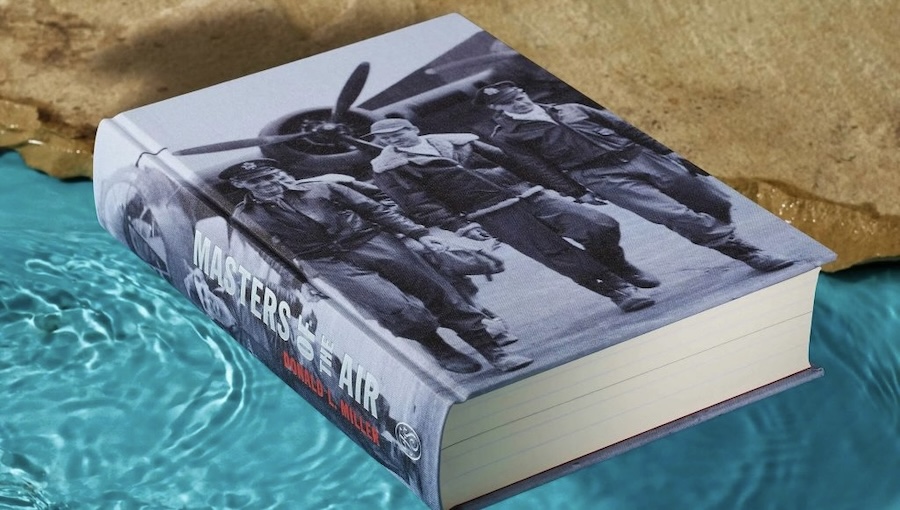
The following is an interview with award-winning author, historical consultant, and John Henry MacCracken Professor of History Emeritus at Lafayette College Donald L. Miller (Vicksburg) regarding the recent release of the deluxe edition of his bestselling novel, Masters of the Air: America’s Bomber Boys Who Fought the Air War Against Nazi Germany, with The Folio Society. In this interview, Fanbase Press Editor-in-Chief Barbra Dillon chats with Miller about his experience in revisiting the pilots’ account in preparation for the deluxe edition, witnessing the continued impact of the pilots’ bravery of future generations, and more!
Barbra Dillon, Fanbase Press Editor-in-Chief: What has been your experience in revisiting Masters of the Air: America’s Bomber Boys Who Fought the Air War Against Nazi Germany in preparation for the hardcover’s release?
Donald L. Miller: What revived the whole thing for me was working on the film, tutoring the actors. I was the only person on our creative team, which included Tom Hanks and one of the co-producers, the only one who actually knew the characters, who actually met them – Crosby and Rosenthal and the whole gang. So, reviving that for them was great for me. I’d go back to old letters and notes and diaries I kept, and it was like reliving the book.
And then, of course, you’d say, “Oh, why did I write that? Or I should have put this in there,” but you’ve got to reign yourself in. I’ve worked on a lot of films and I’ve done quite a few with Tom Hanks, and he doesn’t pressure you. It’s a relaxed atmosphere and he’s just trying to get your best, and the way to get your best, like he always says, just be prepared and just take it at a humane pace.
It was fun to go back to it, it really was. And I was very excited because I had never bought a book from The Folio Society, and I have friends who are book collectors. My brother, for example, is a voracious reader and a tremendous book collector, and he always said, “Buy these books, they’re fantastic,” and that’s when I knew. When they contacted me, I just jumped at the opportunity, because they do such a good job with enhancement.
BD: They truly do. The Folio Society’s work is unmatched.
DLM: It’s not just around the edges, as it were. We did a deep dive back into the book, for example, collecting photographs. It was pretty richly illustrated and with maps, but they wanted to go further and they wanted to go over 60 photographs, and I think I had 40 in the original edition. So we dug out some stuff that hadn’t been published before, mostly base life, photographs largely taken by the guys themselves. When guys would finish their 25th mission, there’d be a big base party and they’d take pictures of that, holding Christmas celebrations for children and having children in for birthday parties, local kids, because the base really is part of a village. It’s a farm, it’s a working farm. They’d bring their clothing over to local wives in the village and for a fee, they’d wash their clothes for them. They got to know the families. It was a great experience just reliving that and going back and talking to some veterans who are still with us, and so it almost became like a different book.
I was so thrilled with the editorial staff at The Folio Society because they became partners in the enterprise. It wasn’t like just, “Hey, Don, send me 20 additional photographs.” They put photographic researchers on this thing and went to the Library of Congress, the National Archives, and they dug out stuff that I hadn’t found.
It’s a great organization. So, that was really exciting. I had a wonderful time working with them on the book, and I went over to England and met Mattie, my editor. She went through it point by point, consulted me at every juncture. Yeah, that was really nice. So, I think we produced something that they’re telling me it’s selling very well.
BD: How do you feel that this new version of the book is being received by readers?
DLM: It was an extra bonus for a lot of the [veterans and their families] because we ran out of hardbacks from the original print run. Veterans or their widows will call me and say, “I want to buy it for my sons. Their dad flew with the Eighth in a B17. Can we get a hardback edition signed of your book?”
Now, you can get this new edition, and many veterans who just had the old Masters of the Air were really excited about getting a hardback edition like this. So, that was a service, I think, to these guys who really, really deserved it. The juices that kept me going on this thing was my love for these guys.
They came to love one another as crews. You can’t have war without love. That sounds strange, but the kind of love that men feel for their unit and for their comrades is very real.
BD: Since you shared that so many veterans and their family approached you, how you feel that these pilots’ story may connect with and impact today’s readers, and what, if any, conversations that you hope that their experience might inspire?
DLM: Well, I’ll give you one example in particular. A high school friend of mine and his wife, we’ve been friends all our lives, and her father flew with the Eighth, and I didn’t even know that until she told me when I was writing the book, so I incorporated him in the story. He was a prisoner, and he kept a series of drawings, beautiful drawings. He was a cartoonist and a newspaper man, and Pat loaned me the book, that’s his wife, and it was a big feature in our prison story. Well, when the book came out, they got a copy, and Pat, their daughter was an army nurse and her husband was flying in trouble over Iraq and Iran with the modern Air Force in a Warthog, a fighter plane.
He didn’t know this story, and it just made him feel that he was not only part of the Air Force, but the Air Force had a real legacy, a heritage that he could draw on.
My computer every morning has a lot of emails in it, I mean a lot, from families who said they hadn’t bought the original book, and now they bought The Folio Society’s book and presented it as gifts to their sons, and it connected them to grandpa, deceased or alive. So, it was a bonding experience. Yeah, it’s really important, and another honor that these guys deserved.
BD: And what a wonderful opportunity that you’ve created that bonding moment for so many generations. Going back to your point about Tom Hank’s advice about being prepared, you are an avid researcher and an educator. What would you offer to folks who are fascinated by topics like this one, who want to get started in their own research, their own education?
DLM: Well, they can’t visit the battlefields. There are no foxholes in the sky, but go to the major museums around the country, and there’s a number of them. Go to the Eighth Air Force Museum in Savannah, Georgia. It’s wonderful, dedicated entirely to the bombers and B-24s and B-17s. They were two big four-engine bombers that we employed in the war, and they’re going gangbusters there. It’s a beautiful museum.
And go to the World War II Museum in New Orleans. It’s one of the largest war museums in the world and was voted the top museum in the United States by a couple of organizations, and internationally, third only to the Louvre and the Metropolitan Museum in New York. There’s eight buildings, a movie theater, a three-star hotel right on campus. It’s just a terrific place. And there and at Savannah, we have research historians and librarians who will help you find the records you’re looking for. We have computers geared just to locating [veterans]. We can identify an airman even if you don’t know his name. If you could give me a street address, that computer will come back with, “On that street lived two guys from the Eighth Air Force, and maybe he’s one of them.”
BD: That’s incredible.
DLM: We’re geared up with some extraordinary librarians. We have a beautiful library and a nice research facility to work in, and you can go in there and look at records and work at the computer and do anything you like. But the big thing, you have the human help to do that sort of stuff, so that becomes really important.
BD: What an incredible level of care that can be provided to those families. Don, I want to be mindful of your time, but I do have one final question for you. If folks have enjoyed your work on Masters of the Air, either in its original release or this new hardcover from The Folio Society, are there any other projects of yours, whether past or current, that you would recommend to our viewers?
DLM: Well, a book I really liked is called The Story of World War II. Ken Burns used that as the basis for a multi-series film he did called The War. That does the Pacific and European Wars. It’s easy to read, it’s mostly on the combat experience itself rather than the politics of the war. And a book I really love is … I’m working on the Civil War right now and I did one on Ulysses Grant and the Battle of Vicksburg, which is his most important battle and probably the most important battle of the war. It’s the one that turned the tide toward the North. So, working on that Vicksburg book was great. That’s been a bestseller, it’s done really well. I’m really proud of the book.
And right now, I’m doing a volume on Lincoln and Grant at the end of the war, where they became very close, and they’re the team that pulls it off, and they knew each other well.
Lincoln would visit Grant at his war camps and talk to the soldiers, and they were together literally up until Lincoln went to the theater and Grant was supposed to join him that night, and instead was visiting his children which were being taken care of by a family member in Baltimore, so they had just left Washington the night of the assassination. But anyway, I’m working on that right now, so I’m about three quarters of the way finished with that. So, Civil War it is right now, but I’m still seeped in this World War II stuff.
BD: Well, again, Don, thank you so much, not only for your time, but for all of the care and effort that you have put into carrying on the legacy of these pilots and connecting future generations with their story. I truly appreciate it.
DLM: It makes me happy to know that they could have a volume like this, and even the pictures and maps will draw their attention. Thank you so much for the interview. I appreciate it.
