From Weyland-Yutani to the Xenomorph Queen hivemind, Alien reveals a future where consumption for profit eats what was left of humanity. Because while Alien so eloquently reminded us that, “In space, no one can hear you scream…” there was something else that was scary. The real terrors are the ones that we choose to live with: the greed, manipulation, and mindless self-indulgence of our vices, operating as normal despite the fact that we know how bad things are, we just choose to let it pass out of convenience.
I think this is a sentiment representing our times: the problems with Late-Stage Capitalism and the desire to maintain corporate profits for the sake of people’s lives. I will share that Fanbase Press’ Bryant Dillon already did an amazing piece on this. This piece is more of an update on what this means today.
The Nostromo Crew are the blue-collar workers for an evil corporation based on real-life examples.
Bryant talked a little about this one already, but I’d like to speak about how this theme rings more relevant to the times right now.
In 2020, we had a global pandemic, with U.S. unemployment rising to nearly 15% at its peak—the highest levels since the Great Depression. Federal intervention followed at an unprecedented scale, with stimulus checks and expanded benefits stabilizing millions of households while entire sectors abruptly shifted to remote work.
What should have been a sharp contraction followed by a measured recovery instead became something far more distorted. An influx of money, fueled by low interest rates and aggressive stimulus printing, all poured in as companies overhired to chase a rapid rebound and prospective growth from digital remote era work–this idea that the nature of work would change with a more digital model that valued family time and work/life balance–became a reality that never fully materialized, as we’re seeing in layoffs in remote sectors and return-to-office demands today.
At the same time, supply constraints led to opportunistic pricing that accelerated the rate of inflation, exposing how quickly a crisis can be converted into leverage.
One of the most enduring outcomes of this period was the explosive growth of the gig economy, which is where this is all related – a platform-based (Uber, DoorDash, Fiver) labor framed as flexibility and autonomy, but structurally defined by precarity.
Workers could earn indefinitely, albeit they were subject to algorithms and social trends, and stripped of benefits and protections. This model absorbed the volatility of the system, placing blame on both worker and consumer, all the while, corporate profits flowed upward, reinforcing a model where risk is decentralized but the reward is not.
Yes, this was a long, boring talk about capitalism of the 2020s, but I stress this became, this is the exact type of runway that set up the world of the characters of the first Alien movie: blue-collar workers with more in common with our modern-day gig workers. People are seen as disposable assets, arguing over contracts and shares over who’s actually getting paid.
Director Ridley Scott described these workers as “Space truckers” but conceptualized them in appearance to look more like oil rig and refinery workers, a brilliant allegory that emboldens the rare black substance these miners were actually digging for: Xenomorphs. These were everyday people struggling to get by; they were essentially coal workers, except the rare black mineral in this case was an alien.
Mind you, profits-over-people was endemic of the ’80s. The Reagan- and Thatcher-era deregulation held corporations less accountable for the loss of human lives. Wall Street was in its “Greed is Good” phase. Even Ford itself was being sued for their explosive fuel tanks, a problem that they’d settled in court rather than fix because it were cheaper. In fact, companies like ExxonMobil–a company long criticized for prioritizing output over safety–mirrored how the crew was treated of that era, always to be disposable so long as the product remained intact.
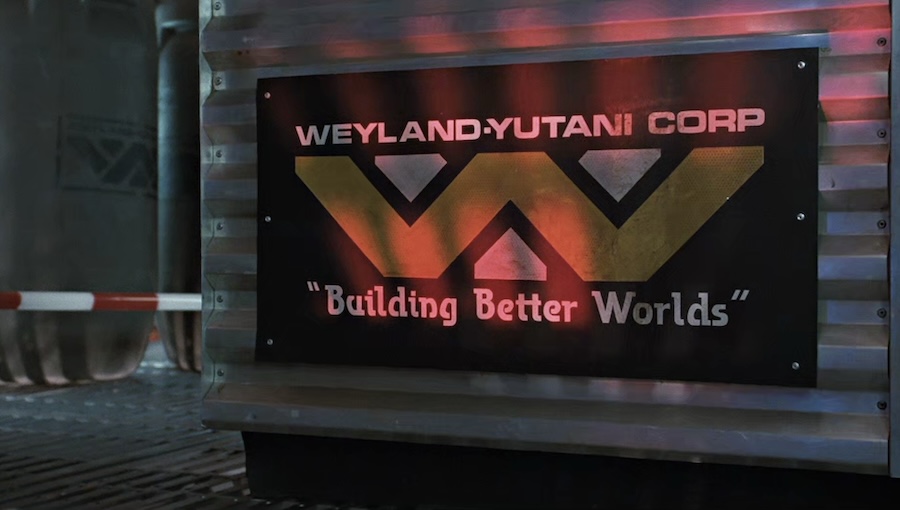
For all intents and purposes, Weyland-Wutani, the company villain in the franchise that was by design, was a commentary of all this corporate greed.
Let’s recap the ship’s AI (MU-TH-UR) orders directives from the company:
“Priority one
Insure return of organism for analysis.
All other considerations secondary.
Crew expendable.”
Here’s the crazy thing: Weyland-Yutani has its DNA rooted in both xenophobia (perfect given xenomorphs, eh?) and corporate anxieties of the 1970s and ’80s—a time when public trust in institutions was collapsing, and multinational corporations became the face of the xenophobic villains of the era. This bizarro idea that America wasn’t just to blame, it was really these companies dominating our businesses from afar.
Because that’s how you create fear. Threaten the ‘American Dream.’ Promise to beat the bad guy and be #1 again. Sound familiar?
Even the name reflects that tension: “Weyland,” evoking Western industrial British Capital-Banking, fused with “Yutani,” a nod to the rising Japanese economic power, particularly with electronics and goods. Think your Sony corporation. Or even in the further East, your Samsungs.
In this world of corporate dominance–seen coinciding with sci-fi series like Blade Runner or with the rise in the Cyberpunk genre–there was an abundance of futuristic dystopias in fiction depicting corporations bigger than life itself, without one nation, and without limits. Whose only pursuit was growth regardless of how it affects society; all of this, mind you, being very prevalent themes of today.
We live in times where, despite rising concerns about climate change, we blow through carbon restrictions for the sake of profit. The costs of AI datacenters, known to toxify our homes and water supply, along with the air, are being ramped up for a product people don’t want to ask for but is being pushed for.
In this sense, we recognize that organizations like Weyland-Yutani and the real-life companies it’s based on, had engineered their own problem: sacrificing human lives for the sake of obtaining the thing (in this case, the xenomorph organism) for its potential exploited own corporate value.
The movie just embodied this idea into a metaphor symbolic of the loss of control of our bodies. The loss of the purpose of our human lives. All sacrifices to maintain the corporate churn. Heck, there’s even an AI android meant as a supreme example of a company man.
Then, there’s the fear-monsters.
Take then the Xenomorph in this instance, often described as the “perfect organism,” not just in its biological nature, but in its systemic nature, as well. The creature is a perfect predator, fit with a strong and durable exoskeleton, acidic blood, and adaptive DNA capable of assimilating the best physical traits to adapt to just about any environment. The hive, ruled by a Queen, operates with ruthless efficiency. No wasted effort. No individuality. Just survival and aggressively violent reproduction.
Weyland-Yutani functions the same way.
The crew are interchangeable parts. Their survival is irrelevant compared to the value of what they can bring back. The organism must be acquired. The system must continue. Both the hive and the corporation reduce life to function. One consumes bodies to reproduce. The other consumes bodies to generate profit.
In reality, it’s humans that are the monsters, not by our nature, but by our decisions, our actions to keep the wheels churning. Because it’s not really about the fear-monster, not the xenomorph, but what it means: a reflection of our worst selves and the threat of a species pursuing infinite growth. A being that’s all-consuming, whether it be material, or in our case, our systemic way we built our lives around. Human transcendence is built around others’ demise.
I like how the creator of Alien: Earth put it in an interview with ComicBook:
“I like that idea of picking a moment in Earth’s history, which is a bit like the Edison, Tesla, Westinghouse moment, where everyone knows that electricity is a thing and everyone’s fighting to control it, so I like this idea that we have artificial intelligence, everyone’s trying to figure out how humanity transcends to the next level. Artificial intelligence, is it enhancing the human body mechanically or is it this transhuman idea? That felt like a really interesting conversation to have, to then bring the monsters into it, because the show and a lot of science fiction is really about the idea of, does humanity deserve to survive? If you remember, Sigourney Weaver in the second movie, she’s like, ‘At least they don’t f-ck each other over for a percentage.’ So to be able to bring in not just the physical or the body horror, but to bring in that moral horror of humanity, the things that we do to each other, was really a driving force.”
We are alone in our cog of doom, but don’t have to be.
Going back to the line, “In space… no one can hear your scream.”
I like this quote because of what it implies. No oversight. No community. The latter of which is how you fight against it – find other people. Fight for them.
In fact, the farther the crew travels in just about all these movies, the less human their situation becomes. That isolation and the emptiness of the vacuum of space create a setting that fully represents the true villain of the series: the isolated greed that left a strand of survivors stuck in the middle of nowhere.
The true horrors aren’t the Alien trying to kill you, it’s the fact that we know someone greedy back home was okay to let it happen so long as they profited. This is the machine that’s late-stage capitalism. A corporation operating like a Xenomorph Queen, stuck in place and willing to kill for its own infinite growth.
It will use you, sacrifice you, and turn your death into data and call that success.
And that’s the real horror of today.
