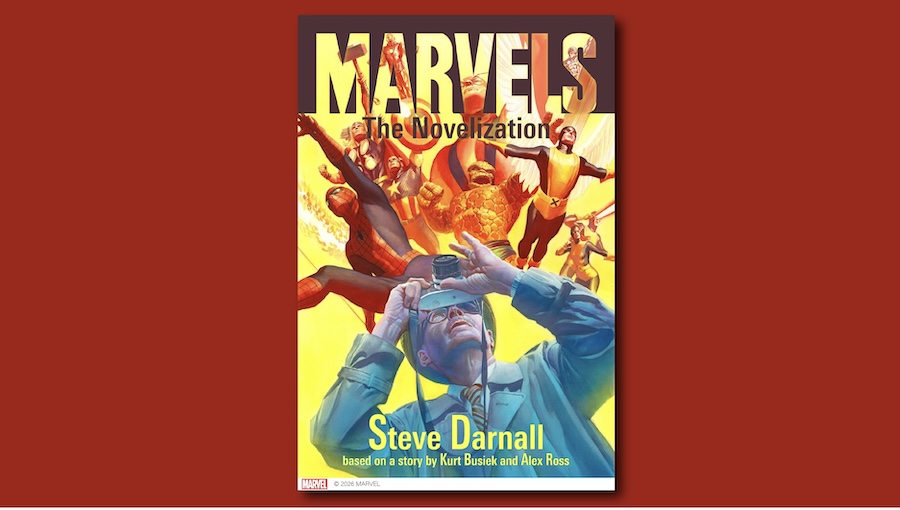
The following is an interview with Steve Darnall (Uncle Sam, Nostalgia Digest) regarding the release of Marvels: The Novelization through Abrams ComicArts. In this interview, Fanbase Press Editor-in-Chief Barbra Dillon chats with Darnall about his approach to adapting the story to a new medium, what he hopes that readers may take away from the story’s themes, and more!
Barbra Dillon, Fanbase Press Editor-in-Chief: Congratulations on the release of Marvels: The Novelization with Abrams ComicArts! What are you most excited for readers to experience with this prose adaptation of Alex Ross and Kurt Busiek’s 1994 miniseries?
Steve Darnall: Thanks very much! I was really delighted for the chance to take Kurt and Alex’s story and tell it in a way that hadn’t been done before. It’s my hope that readers will come away feeling the same sense of wonder and awe they got from the comic-book series, while also getting to know a little bit more about these characters—and the times in which the story takes place—than they did before.
BD: The creative process of approaching an adaptation of a prior work – especially one as well known as Marvels – can be a daunting experience. How would you describe your approach to adapting the story to a new medium, and what did you find to be most rewarding/challenging about the process?
SD: I have to admit I didn’t find the experience of writing Marvels to be daunting at all. I mean, obviously, there was the responsibility to produce something commensurate with the quality of what Kurt and Alex had done, but their original story was pretty solid and that made the path pretty smooth. At the same time, I think everyone involved trusted me enough to avoid subjecting me to any overt acts of micromanagement.
In terms of the process itself… The analogy that comes to mind is the difference between football and baseball. In football, you’ve got four quarters, 15 minutes each quarter, and that’s all you get, whether you score or not. The Marvels miniseries was like that, in that Alex and Kurt had four 48-page issues; if something didn’t fit within that format, it just didn’t happen. With baseball, on the other hand, you can throw as many pitches as you need to get three outs—the same way that in prose fiction, you can have all the words you want or need to tell your story. That flexibility allowed me to take certain moments from the original story and build upon them, while also adding some new scenes that I thought would give readers more context and hopefully of an emotional connection with these characters. That felt pretty rewarding to me.
Q: At Fanbase Press, our #StoriesMatter initiative endeavors to highlight the impact that stories can have on audiences of various mediums. How do you feel that Marvels’ story may connect with and impact today’s readers, and what, if any, conversations do you hope that it may inspire?
SD: Well, in purely selfish terms, I hope it’ll inspire people to say to one another, “Wasn’t that well-written?”
Seriously, one of the things I loved about the original Marvels was the fact that it was a story about human beings in a world that just happens to contain these larger-than-life figures. Kurt’s always been very good at using superheroes as a springboard to tell different kinds of stories about the world. In the case of Marvels, I thought he told a great one about people who are suddenly made to feel that there are circumstances in their lives that are beyond their control—maybe they struggle with that, maybe they learn to co-exist with it. That’s a feeling I suspect might resonate with a lot of people in the 21st Century.
It’s my hope that people will find a lot to talk about concerning Phil Sheldon and how his experiences and encounters and near-encounters with the Marvels—and with the changes that invariably happen over a four-decade period—shape his attitudes and perspectives toward those he loves and toward the world around him.
BD: What makes Abrams ComicArts the perfect publishing partner for this story?
SD: In purely business terms, they seem to know what they’re doing in terms of getting books into stores. As a writer, I really appreciate their enthusiasm; it’s really nice to get to write a story like this one and know your editors and proofreaders are eager to see what you’ve done.
BD: Are there any other projects – past or current – that you would like to highlight for our readers?
SD: Projects of mine?
Oh, sure. I still have fond memories of Uncle Sam, the comic-book series that Alex and I collaborated on some years ago. Abrams was kind enough to reissue that in 2024 and presumably it’s still out there for the world to discover. There’s also Nostalgia Digest, the magazine about the “Golden Age” of entertainment that I have the pleasure of publishing. In fact, I think having an understanding of that era — the era in which the story of Marvels began — helped a lot when it came to writing this story.
BD: Lastly, what is the best way for our readers to find more information about Marvels: The Novelization and your other work?
SD: Luckily, Marvels should be available wherever books or comic books are sold. That said, a visit to nostalgiadigest.com will give folks information about this book and Nostalgia Digest and the stores where I’ll be appearing this Summer and things related to all of those topics.
