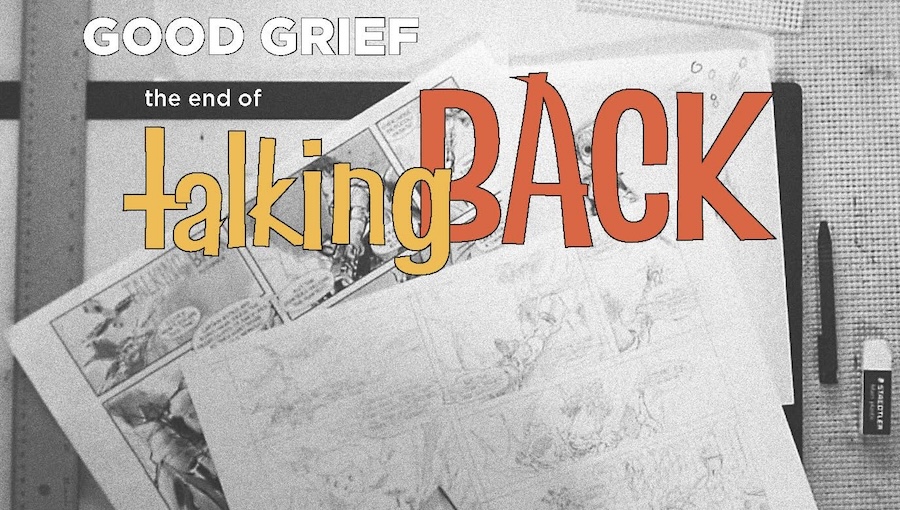
The following is an interview with comics creator Keith Frady regarding the recent Kickstarter campaign launch for the graphic novella, Good Grief: The End of Talking Back. In this interview, Fanbase Press Editor-in-Chief Barbra Dillon chats with Frady about the premise of the narrative on grief and mental health, the backer rewards available to those supporting the campaign, and more!
Barbra Dillon, Fanbase Press Editor-in-Chief: You recently launched a Kickstarter campaign for the graphic novella, Good Grief: The End of Talking Back. What can you share with us about the premise of meta narrative on grief and mental health?
Keith Frady: Metanarratives inherently demand that the reader directly interact with its emotional text. “Isn’t this sad?” They’ll ask you up front. “Doesn’t this make you mad as hell?” For Good Grief, we’re using the titular grief and subsequent breakdown of the cartoonist named Chance following his wife’s passing as our emotional entryway for the reader.
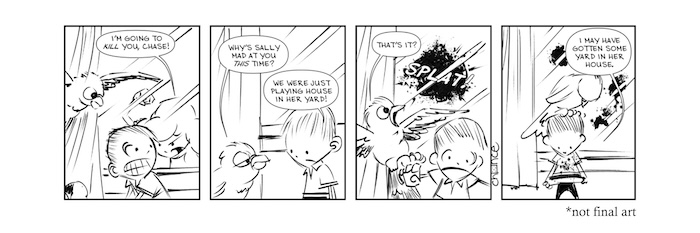
There’s a difficult, but engaging, quality to watching a breakdown unfold. It’s like rubbernecking on the interstate: you want to look away, but can’t. In our instance, it’s seeing a family friendly newspaper comic turn dark and macabre because the cartoonist is going through severe emotional trauma. Such affairs make us question our own wellbeing, our own grasp on reality, as we interrogate ourselves: “Would I do that?” “Is it right that I’m seeing this?”
BD: How would you describe your shared creative process in working with artist Phillip Ginn to bring this story and its characters to life on the page?
KF: Phillip has been a great collaborator who has been passionate about the project since I pitched it to him shortly after HeroesCon back in…2023, I want to say? We have a mutual childhood love of Peanuts and Calvin & Hobbes, so it’s been a treat bringing that love to our shared vision of those comics.
Good Grief actually began as a short, maybe 8 pages at most, but quickly blossomed into a longer endeavor when I realized there was more to the story than met the eye. With Phillip’s feedback and encouragement, I went through a few drafts that added layers to the z until we had this unusual script for an unusual book. And Phillip has since added his flair and inks to the characters so that the book truly started to look like the cousin of its inspirations.
BD: At Fanbase Press, our #StoriesMatter initiative endeavors to highlight the impact that stories can have on audiences of various mediums. How do you feel that this story may connect with or impact readers, and what, if any, conversations do you hope that it may inspire?
KF: Grief seeks help, whether it wants to or not. It needs us to connect with others, to ease this burden and pain with another’s shoulders. I hope the grief represented here specifically asks the reader to consider art’s role in our emotional and mental health, and how it can become those shoulders. How its use as an outlet can be both cathartic and entrapping.
BD: Why do you feel that crowdfunding has been such a valuable resource to ensuring the success of today’s comic book creators?
KF: I can only speak for myself, but I don’t think we’d have gotten Good Grief traditionally published. It’s a little too odd, and too awkward a length to call it a graphic novel. So, that’s what crowdfunding is perfect for: the unusual projects that a creator may otherwise never have been able to complete by appealing directly to the reader.
BD: In light of the crowdfunding campaign, are there any particular backer rewards that you would like to highlight for our readers?
KF: Phillip has agreed to do a limited number of commissions! If you want one of his gorgeous drawings, be sure to hop on before the slots are gone. We’ll also have an early bird special for the first handful of backers, so keep an eye out when we launch.
BD: Are there any other projects – past or current – that you would like to share with our readers?
KF: I recently released my collection of short comics called The Usual Choices after it was crowdfunded on Kickstarter. It’s over 150 pages of various comics that range from existential autobiography to Lovecraftian space cults. If you like Twilight Zone or Black Mirror, you’ll hopefully discover a new favorite short among those pages. You can purchase the pdf on my ko-fi page!
BD: Lastly, what would you like to tell readers who want to learn more about the Good Grief: The End of Talking Back campaign and your other work?
KF: I truly hope you enjoy the experience of reading Good Grief with its story-within-a-story framework. It starts off with us doing our best impression of Calvin & Hobbes, and by the end we’re akin to a newspaper-sanitized version of Vertigo comics. For my work, I’ve always said I want to write things that are rich and strange; that both challenge and entertain. For all the heavy subject matter, the hardest part of writing Good Grief was trying to be funny over and over again in four panels!
