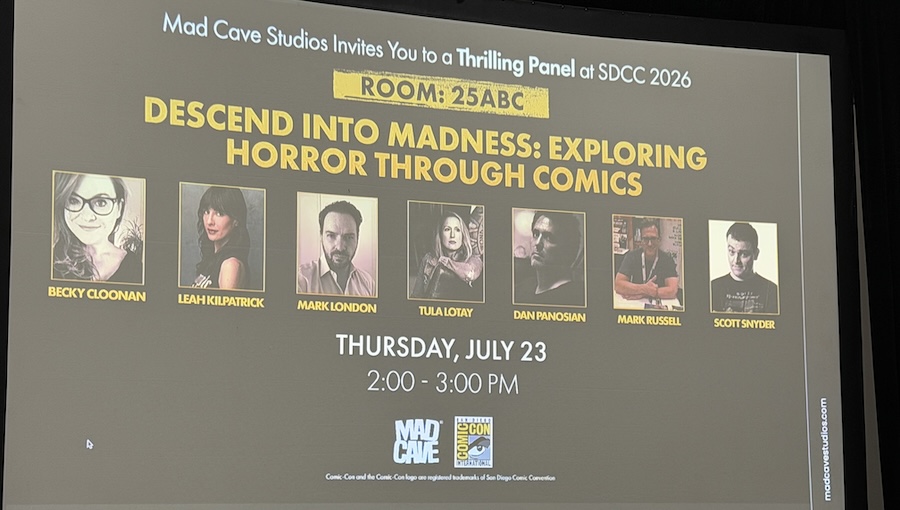
“Help me, I’m scared,” was pretty much the vibe at Mad Cave’s “Descend into Madness: Exploring Horror Through Comics” panel during San Diego Comic-Con 2026. The lineup of creators had a conversation that explored what they were working on now in horror comics. Moderated by Mad Cave Studios Director of Marketing Cara O’Neil, the panel featured a Murderers’ Row of talent with Scott Snyder, Becky Cloonan, Dan Panosian, Tula Lotay, Leah Kilpatrick, Mark London, and Mark Russell, in what was a conversation highlighting their past and current horror works.
Panosian and Cloonan (who’s doing a cover) began by discussing Dirt Beneath the Devil, a horror Western comic book available at the convention, one week ahead of its official release. Written by Panosian with art by David Ferracci, the tale talks about a young woman in 1891 as she journeys the dangerous frontier to claim an inheritance.
In a similar vein, Panosian and Snyder reflected on their series, Canary, and how the Western genre already carries an underlying darkness, becoming a story about power, corruption, and the ugliness hidden beneath the surface. That sentiment of exploring the things that scare you became the thread connecting the rest of the discussion, as each creator shared how their own anxieties often find their way onto the page.
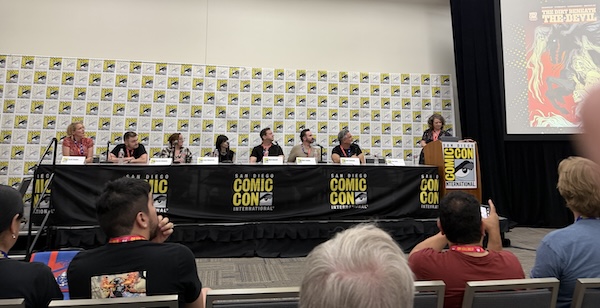
For Snyder, horror succeeds because it asks creators to be honest. Speaking about the collaborative process, Snyder shared:
“Horror is largely about exposing your own vulnerabilities. You’re admitting to the world about what you’re terrified of yourself. Having someone you can really trust as your friend, also, to encourage you to go further with that is the best. So, working with Becky, Tula, and Dan, that’s how it is… The whole point of being caught on the limb is to be vulnerable to say… I’m terrified of this thing. Do you feel that way, too?”
Afterwards, Mark Russell discussed TerrorBytes, an anthology he is creating with Mark London that draws inspiration from modern fears surrounding artificial intelligence, deepfakes, and rapidly evolving technology. Featuring a different artist in each issue, the series explores how contemporary horror has shifted from haunted houses to digital uncertainty.
Meanwhile, Leah Kilpatrick spoke about collaborating with actor and writer David Dastmalchian, whom she’s known for more than 20 years, emphasizing how trust between collaborators allows stories to dig deeper emotionally. Panosian echoed that philosophy, explaining that successful collaborations begin by understanding why a story matters before figuring out how to tell it.
Pivoting topics, Snyder offered insight into collaboration and his writing process, explaining that rather than prescribing every visual detail, he focuses on telling artists what each scene is meant to accomplish emotionally. By giving collaborators a strong creative “North Star,” he said, artists are free to surprise him, often resulting in stronger storytelling.
Collaboration was also central to Becky Cloonan and Tula Lotay’s discussion of Somna. The pair credited their creative chemistry for shaping the acclaimed horror series, while Lotay revealed that certain captions, dialogue, and sound effects were strategically incorporated during production to keep some pages from pushing the book into an adults-only classification.
The panel also offered a glimpse at what fans can expect next. Snyder shared that much of his attention is currently focused on Absolute Batman, whose darker tone embraces many horror sensibilities. He also revealed that Amazon Prime Video’s adaptation of Wytches continues to move forward, with Jock serving as art director while Snyder serves as showrunner. He added that the Wytches comic is expected to return early next year, giving new readers an opportunity to experience the story before the adaptation arrives.
Elsewhere, Cloonan teased her upcoming Karlach, a character-driven series set in the world of Baldur’s Gate for Dark Horse Comics. Lotay celebrated the recent release of Groupies, a horror story centered on the Satanic Panic, before hinting at another publishing announcement on the horizon.
The panel concluded with a discussion about editorial boundaries and finding the right balance for horror. Lotay recalled making strategic adjustments during Somna to meet publishing requirements, while Snyder shared an amusing anecdote about artist Rafael Albuquerque having to redraw a particularly graphic page from American Vampire. And in turn, then getting to stay with his parents for a stint, who grew to love the artist and stayed at his house despite the fact that… well, Rafael was already successful and didn’t need to.
While each creator approached horror from a different perspective, they all arrived at the same conclusion: The genre endures because it reflects our own fears at us. Whether confronting technology, corruption, grief, or the unknown, horror remains one of comics’ most personal genres, inviting readers to stare into the darkness and discover something truthful waiting on the other side.
