
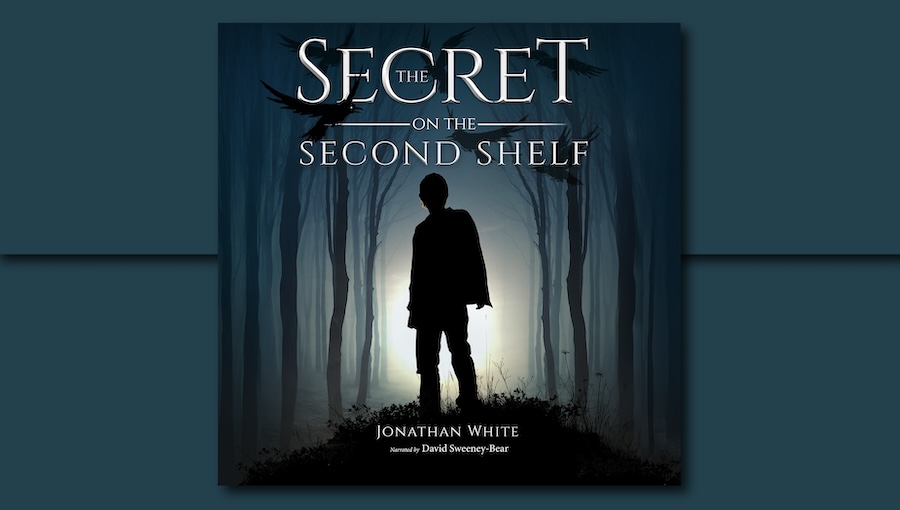
The following is an interview with Jonathan White on the recent release of the supernatural mystery audiobook, The Secret on the Second Shelf. In this interview, Fanbase Press Editor-in-Chief Barbra Dillon chats with White about the creative process of bringing the world and characters to life, the story’s themes which may resonate with listeners, and more!
Barbra Dillon, Fanbase Press Editor-in-Chief: Congratulations on the recent release of The Secret on the Second Shelf! What can you tell us about the genesis behind this project, and how would you describe its overall premise?
Jonathan White: Thank you, it has been a long road, so it is a real thrill to hear the story finally come to life out loud. The Secret on the Second Shelf began as a novel. I spent several years shaping it, working through a number of revisions with the Cornerstones literary consultancy, and finished it in 2015. The Kindle edition was released on Bonfire Night that year, the paperback followed just before Bonfire Night 2016, and the hardback and the audiobook both arrived in 2026.
The idea grew out of my travels, particularly in India and Canada. In India I bought an old bronze compass, and that object, together with those journeys, planted the seed of the story. I have always loved tales where something ordinary, like a book on a library shelf or a parcel through the post, turns out to be the doorway to something extraordinary.
The premise is this: Tim Shaw is fourteen and lives in present-day Cambridge. A year ago, on Bonfire Night, his mum vanished. Everyone around him has accepted that she is gone, but Tim hasn’t. Guided by strange dreams, and joined by Gemma Bowen, his sharp-witted art club tutor, he follows a trail of hidden clues, and ends up 300 years in the past, hunted by the Deceivers, ancient shape-shifting creatures who can shed their human form to reveal something far darker. As Tim tries to find out what happened to his mother, the deeper he goes, the clearer it becomes that this is about far more than one missing person. It’s about the survival of mankind itself…
I usually describe it as The Da Vinci Code meets Stranger Things!
BD: How would you describe your creative process in bringing this story and its characters to life on the page, and what can you share with us in working with narrator David Sweeney-Bear to translate it to an auditory medium?
JW: For me, the story started with Tim’s emotional journey. The mystery, the history, and the monsters only matter because we care about a boy who refuses to accept the easy explanation for his mother’s disappearance. Once that was clear, I built the rest around it. I wanted the book to feel grounded in the real Cambridge, with its colleges, streets and commons, and then let the hidden, supernatural world seep in gradually, so that the reader feels the ordinary world tilt. Getting the balance right took many drafts, and the editorial feedback I received along the way made the book far tighter and more suspenseful than my first attempts.
Filmmaking also shaped how I write. Some years ago I studied practical filmmaking at the Met Film School in Ealing and adapted scenes from the book into a short film, No Such Thing As Monsters, which premiered in 2017. Seeing the story as images, and hearing the dialogue spoken by actors, taught me a great deal about pacing and about what a scene really needs.
Turning the book into an audiobook was the next step in that journey, and David Sweeney-Bear was a joy to work with. David is a SOVAS Voice Arts Award-recognised narrator and an Audible Approved Producer with more than fifty titles to his name, and, as it happens, he grew up in Cambridgeshire, so he already knew the landscape of the story. Before he began recording I put together detailed narrator notes covering the shape of the whole book and each of the characters. The tone needed to move from curious and uneasy at the start, through suspense and the increasingly supernatural, to something adventurous and emotionally intense at the end. Tim needed to sound like a thoughtful, natural British teenager who grows in confidence. The Postman needed quiet authority, more mentor than menace. Daniel, the leader of the Deceivers, needed to sound smooth and dangerously calm rather than like a cartoon villain. We also agreed the British pronunciation of the Cambridge place names, from Trinity College to Midsummer Common.
The process began with an audition and a checkpoint sample of the first fifteen minutes, which let us agree the tone together before the main recording started. Then David brought his own instincts and enormous range of character voices to it. Hearing characters I had lived with for years suddenly speak was very moving, and in several places his performance made me hear my own scenes differently.
BD: At Fanbase Press, our #StoriesMatter initiative endeavors to highlight the impact that stories can have on audiences of various mediums. How do you feel that this story may connect with and impact listeners, and what, if any, conversations do you hope that it might inspire?
JW: At its heart this is a story about a boy who is told, kindly and repeatedly, that the explanation everyone else has accepted must be the true one, and who refuses to accept it. I hope that resonates with young listeners who have ever felt that something did not add up, or that they were seeing the world differently from the people around them. Being different can be isolating, and Tim’s journey is partly about discovering that the very thing that sets you apart can also be your greatest strength.
Curiosity is the other thing I hope it sparks. My school visits reinforced something I have come to believe wholeheartedly – books do not have to provide all the answers to be successful. The very best ones teach children to ask better questions. After I presented the story in classrooms, the questions seemed to come from every corner of the room, and they were rarely just about the book. Children asked about history, science and imagination, and I watched curiosity take hold. One question sparked another, and children began building on each other’s ideas, offering theories, making connections and imagining possibilities. That is exactly the kind of conversation I hope the audiobook inspires, whether at home, in the car or in the classroom – what might really be hiding in a library, what could have happened in Cambridge 300 years ago, what if? Curiosity like that travels into conversations, museums, science, history and, ultimately, life. Sometimes a story’s greatest achievement is encouraging readers to keep asking questions long after they have finished it, and sometimes all it takes is one remarkable book to spark a lifetime of asking, “What if?”
It is also a story about loss. Tim is living with the disappearance of his mother, and the book doesn’t rush past that. I would like it to give young people a safe way into conversations about grief, hope, and holding on to someone you love, and to remind them that it is okay to keep asking questions when the answers you have been given do not feel right.
Another theme that runs through the book is the contrast between kindness and cruelty. The Deceivers thrive on the worst in people, and Tim’s allies are strong because of goodness, courage and friendship. I hope families and classrooms might talk about how the small choices we make, in how we treat one another, add up to the kind of world we live in.
Finally, audiobooks matter in their own right. For reluctant readers, for children who find text a barrier, and for families who want to share a story in the car or at bedtime, listening can open the door to a lifelong love of stories. If this audiobook helps even a handful of young people discover that a good mystery can be an adventure for the ears, I will be delighted.
BD: Do you foresee revisiting this world and characters for future installments if given the opportunity?
JW: Absolutely. The first book tells a complete story, but it deliberately leaves a much larger conflict wide open, and Tim finds himself part of a war that is far older than he is and that no one ever told him about. I have sketched out a longer arc for the world, with Tim growing from the boy who discovers the secret into someone who has to stand up for others, alongside new allies in new places, and a deeper history for the Deceivers and for the people who oppose them.
I am also keen to explore other formats. I have been developing a screenplay adaptation, and the short film showed me how well this world translates to the screen. Whether more books, more audio or something on screen comes next depends on how readers and listeners respond, so I am listening closely.
BD: Are there any other projects – past or current – that you would like to highlight for our readers?
JW: Yes, a few. My short film, No Such Thing As Monsters, adapted from the novel and shot partly at Ealing Studios, is available to watch online, and I have also produced a book trailer and TikTok video shorts that help to paint the wider universe.
I am also developing the screenplay I mentioned and planning the wider world of the series.
Long before any of this, I was a Doctor Who fan who wrote stories for a fanzine and sent story ideas to the BBC as a teenager, so you could say the love of a good adventure has been with me all along.
BD: Lastly, what would you like to tell readers who want to learn more about The Secret on the Second Shelf and your other work?
JW: The best place to start is https://thesecretonthesecondshelf.com
You can listen to a free audio sample, watch the book trailer and my short film, No Such Thing As Monsters, and go behind the scenes of the audiobook recording with David Sweeney-Bear.
The audiobook is available on Audible, Amazon, and Apple Books, and the story is also out as a Kindle eBook, paperback, and hardback, so you can read it, listen to it, or do both.
I share news, behind-the-scenes clips and updates on TikTok at @jonw404 and on Instagram at @jjwhite68, and you can find me on Goodreads, too.
Thank you, Fanbase Press, for having me, and for championing stories that matter.
