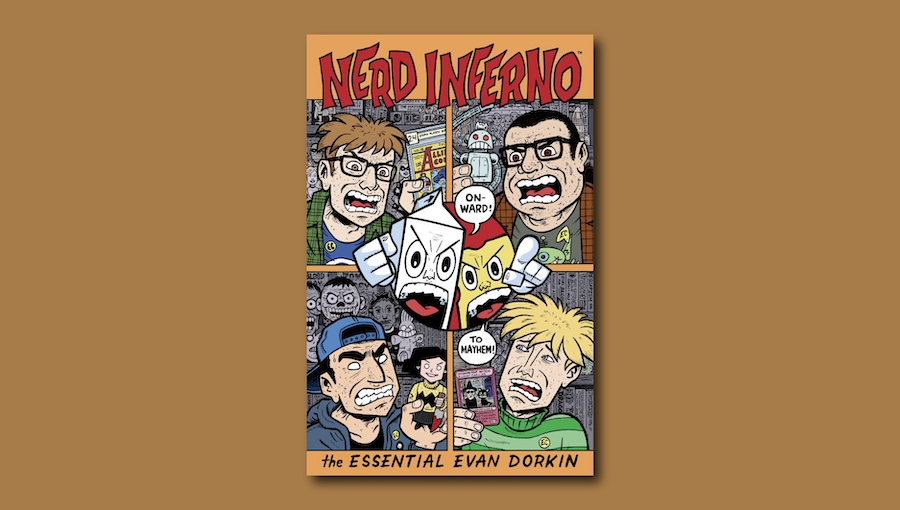
Evan Dorkin’s work is a staple of indie comics, highlighted by a DIY punk attitude regarding the mainstream, but also by his work ethic. Dorkin’s hyperbolized chaos, mixed with a penchant for biting satire, takes influence from both punk rock and the independent creators who came before him. Dorkin released his comic, Dork, an anthologized monthly publication that showcased two of his greatest creations, Milk and Cheese and Welcome to Eltingville, and smaller bits that would set a snarky tone for nerdom. Dark Horse has released a six-hundred-plus-page tome collecting some of his groundbreaking comics, Nerd Inferno: The Essential Evan Dorkin.
This collection starts off with the pure chaos that is Milk and Cheese. Milk and Cheese have always felt like an anthropomorphic representation of punk rock. Dubbed as dairy products gone bad, Milk and Cheese are chaos and anarchy personified. Most of these adventures have a low page count, with a good number of them not going over a page or two, and involve screaming. Some shorts are full of satire and great thought, and others feel like hardcore punk songs that didn’t work out, but work here. However, as time goes on, these stories do get longer, with some breaking from their black-and-white format and into color. Does it take away from the charm of Milk and Cheese? It depends. While it’s a level up, it feels like a less solitary adventure and more like a shift in ambition and polish. Some longer-lasting punk rock acts have been criticized for doing so, as well.
If Milk and Cheese are full id, then Dork is the self-lacerating ego. While it isn’t necessarily a different machine, it is 100% the mind of Evan Dorkin. Here, we are presented with a look into Dorkin’s mind. The issues themselves are anthologies of abrasive satire that skewer a lot of topics and teeter on bad taste, depending on your generation’s thoughts on comedy and understanding of sarcastic irony. The ’90s thrived on shock, and there is no lack of that here. Things like the Murder Family, Fisher-Price Theatre, and small comic strips like Myron, The Living Voodoo Doll are all graphic in their own way. There’s a whole issue dedicated to taking down Gen Xers, but also a strip called Baby in a Microwave which is a comic strip of exactly that.
The ’90s were an era of great satire after a cynical upbringing in the ’80s. Dorkin’s takedowns would come off as cheap if they weren’t written so damn well. There are instances of him pulling back the curtain and being real with his readers about his life and the effect his demanding work schedule had on his mental health, something that was not talked about as often. It’s a breath of fresh air in creativity in general, but also in a comic work that has a tendency to go full throttle. It’s definitely a contrast from the mainstream superheroes that flooded the market.
The last section of the book is reserved for the entire Eltingville Club comics. Eltingville feels representative of externalized satire, continuing with the hyperbolized presentation. Eltingville pivots to four nerds – Bill, Josh, Pete, and Jerry – as they bicker through a series of adventures, criticizing each other and pop culture as they do. Like a good portion of Dorkin’s indie work, Eltingville was meant as satire but has slowly become reality. This became a blueprint for things like gatekeeping, purity tests, and weaponized trivia.
It’s a nerd Idiocracy, as these toxic types of fandoms have grown with no indication of slowing down. It’s by no means bad writing, but it lands and also hits too hard in a culture that spent the last thirty years taking this as gospel rather than a takedown. The collection ends with a look at the Northwest Comix Collective, which Dorkin describes as the bizarro version of the Eltingville Club, but it really feels like just another side of the same coin of cultural prophecy. If you celebrated this rather than laughed at its absurdity, then you are probably the type of person Dorkin was skewering.
Nerd Inferno will appeal to fans of Dorkin who want a good chunk of his work collected in one edition, but its humor is definitely of an era. While someone like me can appreciate the jokes, newer kids may be turned off by the humor and some of the references. That’s no fault of Dorkin or even this collection. As tastes change, so has the barometer of what is considered funny and/or offensive.
It happens in every generation, and at this point, the pendulum is just not hovering over this type of humor. This doesn’t take away from seeing how a great comic writer and artist’s work evolved, not only in experience and skill but also in content and how that content is presented. Dorkin’s work should be as praised as Daniel Clowes and the Hernandez brothers, but there’s this possibility it gets misinterpreted by a generation focused on the surface and not what’s underneath. Whether it’s the dated references or its purposeful abrasiveness, the content will rub kids who find this the wrong way. Sometimes, the truth that satire brings hurts.
I’m sure people will complain that issues of Dork that contained Milk and Cheese and Eltingville stories should have been left intact rather than giving them their own sections. I was in that camp at first, as well. Yet, as I read on, it completely makes sense as to their separation. This is probably the only bit of organization in this collection. Overall, this is a fantastic way to present an important indie writer. While the jokes may not land for everyone, the stories and ambition should. Evan Dorkin’s work stands tall within the community as a way to keep it in check, not elite.
Creative Team: Evan Dorkin (writer, artist, letterer), Sarah Dyer (colorist)
Publisher: Dark Horse Comics
Click here to purchase.
