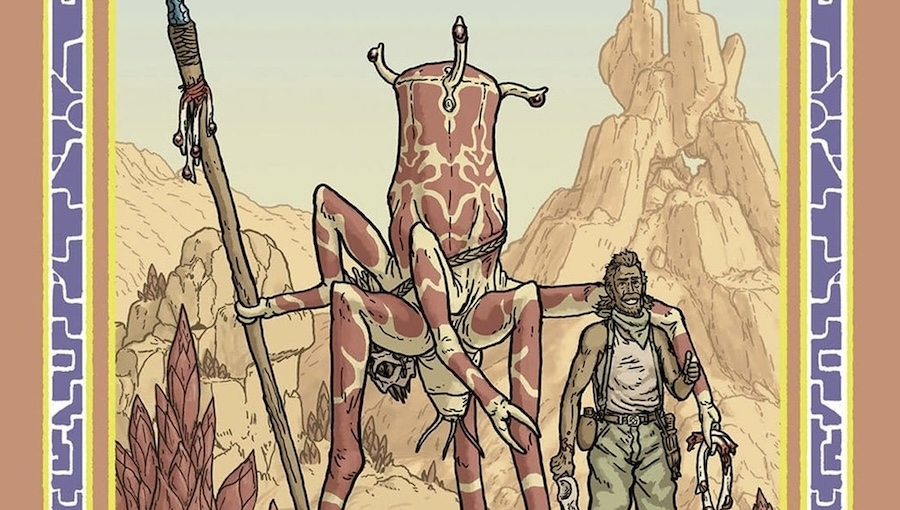
When humankind finally reaches the stars—stretches outward to worlds across the galaxy—what will they find? What kind of worlds will they build? What kind of society, or societies, will develop? Simon Roy has some ideas about that, which he explores in the anthology comic, A Star Called the Sun.
A series of independent, but interconnected, stories, each one builds out the world a bit more, showing us more of the people of these planets, the technology they use, and the aliens they find. Each story also throws you right into the middle of the world, with very little explanation or exposition. This can make it difficult to follow in places, but only just briefly. Overall, the effect is to immerse the reader more fully in the story and the world.
By way of introduction, Roy gives the anthology a bit of a framework, featuring a visual depiction of himself, living on one of the planets in his overarching world. While preparing for an imminent threat in the middle of an active war zone, he explains a bit of the history of these stories and how they were written. Some go back nearly a decade, a couple started off on his Patreon, and one was actually an experiment during Inktober.
The first couple of stories are, for the most part, standalone. First is “Hale-Bopp,” which tells of a colony of humans who have adapted to life on a comet and the parasitic creature that threatens their existence. After that, “The Oxpecker and the Elephant” tells what is, in essence, a very similar story, from a very different perspective.
As the stories go on, though, we get some semblance of an overarching narrative. There are stories of a great war between different factions of humans on different planets, the weapons they built (or found) to help them fight that war, and the efforts of subsequent generations to pick up the pieces.
My favorite story of the bunch is probably “The Ansible.” It’s a great exploration of the technology that can develop in an interstellar society and the myriad ways it can be used—for good or for ill.
“The Ansible” is also a perfect example of how Roy both immerses us immediately in the story and builds it out slowly over time. One character makes an offhanded reference to “Mother Superior,” and it takes a couple of panels to realize that he’s referring to an ancient and powerful robot that he’s trying to repair. Then in the next story, “The Anchoress,” we’re introduced to an actual, human Mother Superior, at a remote convent that has information on similar ancient and powerful robots.
There’s also a ton of supplemental material, which serves to build the world out even further. Before we get to any narrative, including the framework, we’re treated to a series of drawings of different types and roles of people in this society and the uniforms they wear. Later, after a few stories, we get depictions and descriptions of various models of “Man-Amplifiers:” mech-suits that people use for everything from manual labor to, of course, war. A few stories after that, there’s an illustrated guide to the larger machines that their society makes use of.
The stories in this comic are pretty unusual, exploring unique concepts that fire the imagination and make you want to know more. At the same time, they also explore some human universals. No matter how far people get from home, human nature remains the same, in both the good aspects and the bad.
All in all, this was a fascinating collection of space and sci-fi stories, and I really enjoyed reading them. If you like your sci-fi a little off the beaten path, with vast worlds that explore strange but fascinating concepts, then I highly recommend you check out A Star Called the Sun.
Creative Team: Simon Roy (writer, illustrator), Sergey Nazarov (colorist), and Drew Shields (colorist)
Publisher: Image Comics
Click here to purchase.
