
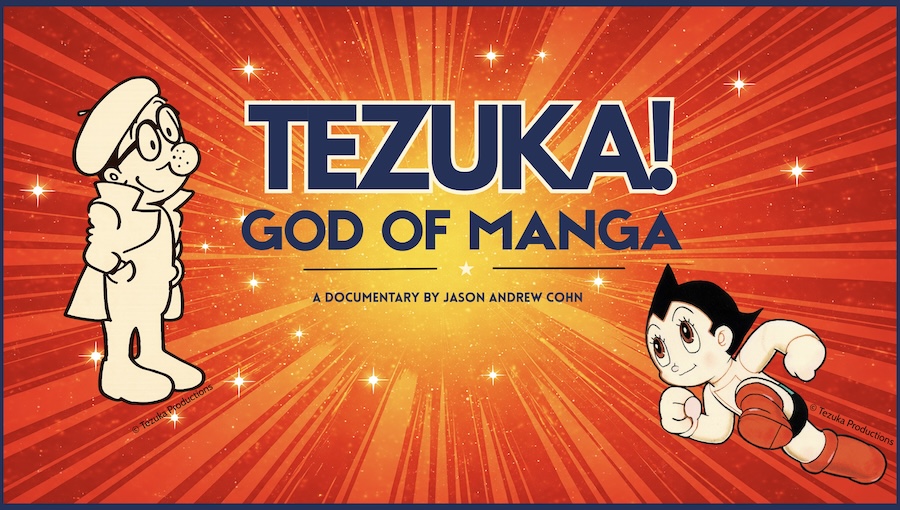
The following is an interview with Peabody Award-winning director Jason Andrew Cohn regarding the recent Kickstarter campaign launch for the documentary, TEZUKA! God of Manga, in collaboration with Bread & Butter Films. In this interview, Fanbase Press Editor-in-Chief Barbra Dillon chats with Cohn about examining the cultural force of legendary manga and anime creator Osamu Tezuka, what audiences may take away from the iconic creator’s work, and more!
Barbra Dillon, Fanbase Press Editor-in-Chief: Congrats on the launch of your Kickstarter campaign for the documentary, TEZUKA! God of Manga! What can you share with us about the genesis behind this production?
Jason Andrew Cohn: It’s been percolating with me for a really long time. I became a fan of Tezuka’s after college when I was living in Sapporo and would read his manga to study Japanese. Later I learned what a major cultural figure he was in Japan and what his career signified in terms of Japan’s postwar identity. So, I guess I started chewing on the idea back in the day and then over the years I saw how Japanese pop culture was taking over America and that sort of sealed it for me. I saw Tezuka as the ultimate source of all this creative energy and creative interaction between Japan and the West and I just thought that more people in the English-speaking world needed to know about this genius.
BD: Tezuka’s work has made an indelible mark on both comics and animation that will last for generations to come. Was there anything that you gleaned from the interview process about Tezuka and his work that you hadn’t anticipated when initially developing the project?
JAC: There are a lot of things but one thing I’d highlight is just the fact that even though Tezuka died before the manga and anime booms really hit in America, that doesn’t mean he wasn’t hugely influential on American artists and artists in other Western countries. Astro Boy, for example, took the idea of limited animation to an extreme and yet it managed to be highly expressive, and I think generations of animators in the West have studied Astro Boy to decode the secrets to that kind of storytelling. Of course, by now most people know the story of how Disney borrowed from Kimba the White Lion to make The Lion King.
And in the world of comics, even though there wasn’t always a lot of Tezuka manga available in translation, comic book artists are always looking for inspiration and many, many artists would hear some lore about Tezuka and get their hands on his books one way or another. Scott McCloud (author of Understanding Comics) told me he would go to Kinokuniya and stand there in the aisles poring through Tezuka books in Japanese even though he couldn’t read a word of it. He just found the visual storytelling so astounding that he wanted to absorb all of it.
BD: When the project is funded, you will be conducting additional interviews with creators including Paul Pope (THB) and Ron Wimberly (Prince of Cats). Is there anything that you’re hoping to learn or garner from these creators in particular to complement the prior interviews?
JAC: I’m always interested in how artists absorb influence and then output it in new and original ways. Paul Pope is interesting because he actually lived and worked in Tokyo for a time as a manga artist. He wasn’t drawing American comics, he was actually drawing manga for a Japanese publishing house. And Tezuka was one of his biggest inspirations. Ronald also counts Tezuka as a major influence. If you look at his work, you don’t necessarily see it, so I think it will be interesting to have him explain the ways that he has absorbed Tezuka. Sometimes, it’s not so much about visual style, it’s more about how an artist thinks about stories or even the way they think about themselves as artists.
BD: The documentary itself will follow Tezuka’s life in three acts. How do you feel that his story and career may connect with and impact today’s viewers, and what, if any, conversations do you hope that they may inspire?
JAC: To me, one of the most fascinating parts of Tezuka’s story is the struggles he faced. Obviously, there’s the story of his early life, which included some harrowing wartime experiences. But also later in his life, after he had become the biggest star in Japanese comics and animation, he had real trials. He was intensely competitive and he was always determined to be on top of that world at all costs, but it was impossible to always be the most popular guy because the trends would change so fast and the audience was always looking for the newest thing. Tezuka went through deep slumps where he was not really very popular and the young artists who grew up reading his books and watching his TV shows all kind of turned against him. So, he had to constantly fight to reinvent himself, which is really hard to do as a middle-aged artist. But there’s remarkable redemption in his story because at the end of his life, his career had really rebounded both creatively and commercially. His series Black Jack was nearly as ubiquitous in the eighties as Astro Boy had been in the sixties. I have a huge respect for that and I hope people take away something inspirational from it.
BD: Lastly, in light of the Kickstarter campaign, are there any particular backer rewards that you would like to highlight for our readers?
JAC: Yeah, I’m super excited about that because Tezuka productions is very protective, obviously, of the Tezuka IP, but they gave us extraordinary permission to work with a bunch of outside artists to create original illustrations based on Tezuka characters. We have Jorge Gutierrez doing Astro Boy, Shinichi Ishizuka doing Acetylene Lamp, Yuko Shimizu doing Black Jack, Jesse Lonergan doing Buddha, etc. So, we’re going to have high-quality offset and giclee prints available of the collab art and they’re really going to be spectacular. I can’t wait to get the prints in, so I can mount them on the wall of my office!
