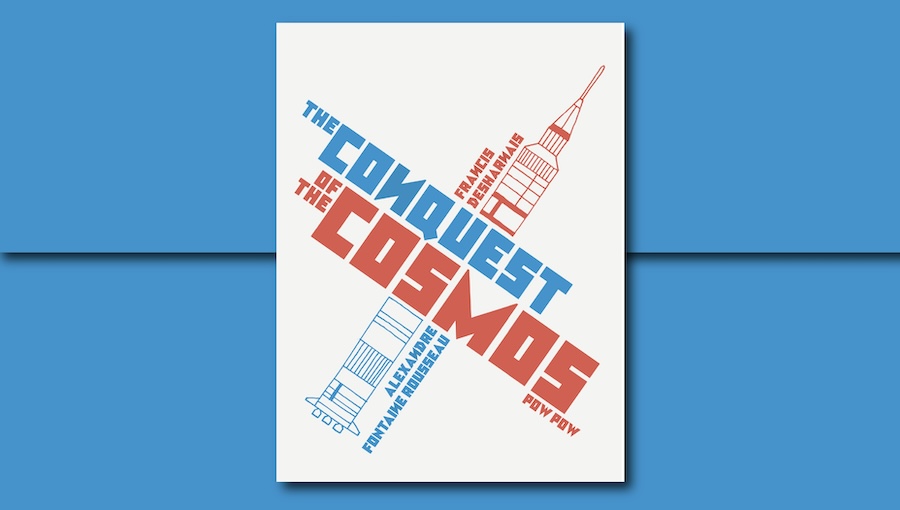
The following is an interview with writer Alexandre Fontaine Rousseau regarding the recent release of the satirical graphic novel, The Conquest of the Cosmos, through Pow Pow Press. In this interview, Fanbase Press Editor-in-Chief Barbra Dillon chats with Rousseau about his shared creative process in working with artist Francis Desharnais to bring the story and characters to life on the page, what readers may take away from the story’s themes, and more!
Barbra Dillon, Fanbase Press Editor-in-Chief: Congratulations on the recent release of The Conquest of the Cosmos! What can you share with us about the genesis behind this project and its overall premise?
Alexandre Fontaine Rousseau: The book actually started out as an exhibit at the Musée national des beaux-arts du Québec. We had been given a series of old jail cells, which we somehow turned into comic panels. You’d go from one room to the next, each cell working as a separate chapter telling the story of the space race in the 1950s and 1960s. The way the cells were divided, we had access to these two corridors. So, from the get go, we had this idea that the first corridor would present the Soviet’s perspective on the events and the second would show the American side of it. To this day, you can still feel that in the structure of the book. The first half, in red, is all about Sputnik, Laika, and Yuri Gagarin. And the second, which is in blue, is about stuff people John F. Kennedy and Neil Armstrong. Oh, and Michael Collins. Let’s not forget about that guy.
But that was back in 2017. And then the project to make a book out of this exhibit was put on hold for a few years, basically until the first months of COVID where all of a sudden it felt so natural to write about people being stuck in these tiny tin cans, all alone in space. Part of the book started being about this existential anxiety which comes with isolation… and the other half, which is more political, is all about the way these opposed ideological systems use scientific progress as a tool for propaganda in the context of the space race. And there are also jokes about putting tiny skates on dogs so they can play hockey in outer space… which, to be clear, I’m still not exactly how these came to be.
BD: How would you describe your shared creative process in bringing this story and its characters to life on the page?
AFR: The creative process behind a book like this is actually pretty unique. Usually, the writer gives a script to the illustrator who then proceeds to draw the book. But, in this case, Francis made a limited set of illustrations which I then had used as these building blocks from which to create scenes. This unusual iterative technique allows us to focus on rhythm and comic timing. And while Francis likes to joke that he’s just being lazy, the truth is that a lot of work goes into making sure everything works just right. Because minimalism makes every potential mistake huge, and in the end a lot of care goes into every detail because every little thing counts. In our previous collaboration, a book about the pioneers of flight, characters were so small as to be totally inexpressive. But in The Conquest of the Cosmos, that’s one of the things Francis really focused on: The characters are just a wee bit closer, and we can actually see some of them move around and show some emotions. We wanted the reader to feel a bit closer to some of these characters, especially the ones whose narrative arc is tragic like poor, old Laika.
BD: What do you feel is the inherent value of satire in storytelling and especially the sequential art medium?
AFR: I think satire cuts through the crap. It’s all about seeing through the facade, applying critical thinking and expressing it in a way that’s funny. And humour is the healing force of the universe. We live in crazy, insane, alienating times. We should at least be able to express our anger and disbelief through satire, irony… and jokes about golf carts on the Moon. We published this book in French back in 2021, and when we came back to it five years later in order to translate it, I was honestly surprised at how accurate it all still felt. I wouldn’t say I was happy about it, per say. But the things that scared and annoyed me back then haven’t gone away. In fact, some of these jokes feel more timely now than they did back then.
BD: At Fanbase Press, our #StoriesMatter initiative endeavors to highlight the impact that stories can have on audiences of various mediums. What do you hope that readers may take away from this story, and what, if any, conversations do you hope that it may inspire?
AFR: Last week, Francis and I were in Washington, D.C. for the Small Press Expo. And right before the festival, we went to the Air and Space Museum. And I did shed a tear before all of these artifacts from the space race. Because there is bravery, beauty, and madness in this whole endeavour, which you can’t help but feel emotional about and even inspired by. But it can both be this incredible story of courage and this weird, politically compromised vanity project for egomaniacal superpowers. These contradictions can coexist, and we need to acknowledge and understand how they operate, interact, and shape the world around us, so we can be more critical about it but also make sillier, sharper jokes about the human experience.
BD: What makes Pow Pow Press the perfect publishing partners for The Conquest of the Cosmos?
AFR: Pow Pow is the best. As Québecois authors, we couldn’t hope for a better publisher. Our books have great visibility at home, they are distributed all throughout French-speaking Europe and when our books are translated in English we get to reach the rest of Canada, as well as the United States. That’s amazing, in and of itself. But then there’s also this incredible sense of freedom. It really is an artist’s first approach to publishing and editing. Genuine support and risk-taking – the kind that allows you, as an author, to to do stuff like a minimalist, experimental political satire based on the cut-and-paste repetition of just a couple of drawings. I hope every creator can find a home like this at some point in their career, because it is the sort of thing which allows you to be yourself and make books which genuinely feel like yours, as well as books you, yourself, never expected to make.
BD: Are there any other projects – past or current – that you would like to highlight for our readers?
AFR: Our next project is based on the same formal concept as The Conquest of the Cosmos, but it will focus on the history of war throughout the ages. So, we’re still going to be exploring some of the topics we’ve alluded to in this book, but delving even further into some of the madness and sadness and absurdity of it all. But you should also check out Francis’ Art Wars, which was the first book he made using only ten different panels. That one feels like the spark that started this whole collaboration, and it is very funny. It’s about these alien invaders who come to Earth and kidnap all of the artists because, back on their planet, beauty and art are the ultimate weapons of mass destruction. So, artists have to deal with the fact that they are being used for this purpose, and Earth has to deal with the fact that artistic expression is gone.
BD: What is the best way for readers to learn more about The Conquest of the Cosmos and your other work?
AFR: I guess the Pow Pow Press website, as well as all its social media, are the most effective ways to learn about the things we do to promote the book… as well as all our upcoming projects in English and a bunch of other cool comics by other creators!
