The following is an interview with Aaron Sammut regarding the recent Kickstarter campaign for the fifth issue of the high-voltage, coming-of-age comic book series, Maurice & The Metal. In this interview, Fanbase Press Editor-in-Chief Barbra Dillon chats with Sammut about the shared creative process of bringing the story and characters to life on the page, what readers may take away from the story’s themes, and more!
Barbra Dillon, Fanbase Press Editor-in-Chief: You recently completed a successful Kickstarter campaign for the fifth issue of the high-voltage, coming-of-age comic book series, Maurice & The Metal. For new readers, how would you describe the overall premise of the series, and where will readers find themselves in this latest installment?
Aaron Sammut: Maurice & The Metal, to me, is about that time in our lives when we start finding ourselves. We start listening to our own soundtrack.
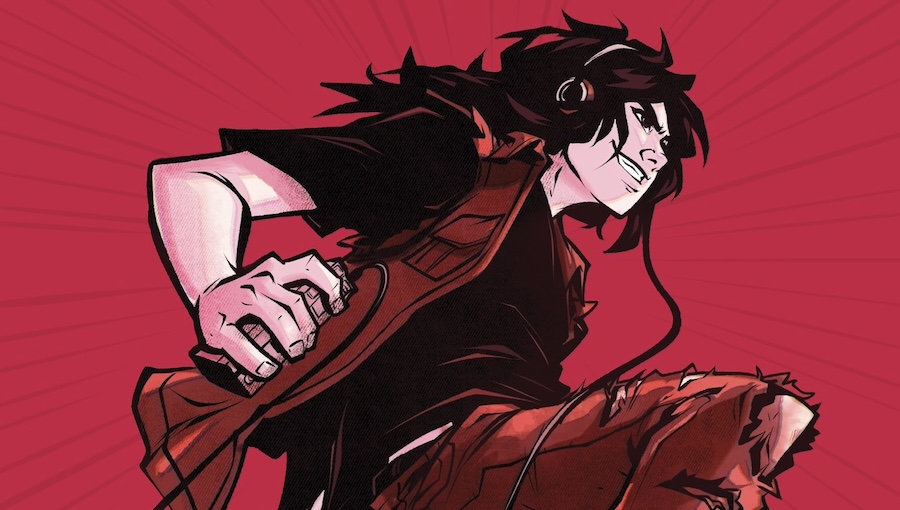
Maurice is me in a way, and I’m sure plenty of readers will see similarities with their own journey growing up. I grew up in the eighties, when arguing over pop versus rock felt incredibly important. That’s really the world this story comes from. It’s an ’80s coming-of-age tale – John Hughes co-directing with Ozzy Osbourne.
The latest issue is Issue 5, Made of Metal, and it really expands Maurice’s world. We meet new characters, deepen some existing relationships, and get to experience a little of the calm before the storm.
Maurice is no longer playing in his band because he destroys basically any drum kit he touches, but he’s starting to find his feet, meet new people, and discover a new purpose. We also get to see more of his connection to the community and even a love interest of sorts – although it is painfully awkward.
I mean, what person in their right mind takes someone to an Exodus gig for a first date?
More importantly, this issue starts showing readers exactly what Maurice is going to be fighting for… and against. It’s self-expression vs conformity.
BD: How would you describe your shared creative process in working with artist Lauren Marshall to bring the story and characters to life on the page?
AS: Communication is key with this kind of work. Pardon the pun, but if we’re not on the same page, then we’re working against each other.
Lauren is on the west coast of Australia and I’m on the east, so it’s not always the easiest thing to coordinate. In the past, our process has gone through sketches, early lettering, pencils, inks, sound effects and tones. This is our second book together, though, so we’ve been able to strip some of that back and work much more organically.
Lauren is great at seeing a scene in a completely different way to me – and often a better way. She brings far more expression to the characters than I might have originally imagined, which is important because this is the story of a heavy metal superhero. It needs to feel loud.
At each stage we try to step back and look at the comic with fresh eyes. How would a reader see this? Does the page still make sense without us knowing everything behind it?
I heard somewhere years ago that a comic should work with just the dialogue, and it should also work with just the visuals. Obviously, you lose some of the nuances, but the flow and basic story should still be there.
I also managed to make things difficult for myself by writing a comic that is so heavily connected to sound. The Walkman talks to Maurice, for example. If someone opens the comic to a random page and sees Maurice sitting in his bedroom talking to thin air, we’ve got a problem. So, Lauren and I developed little visual cues, like Maurice gesturing towards the Walkman while he speaks. Within a couple of panels, even a new reader should be able to understand what’s happening.
BD: What has been your experience in sharing this series with new and returning readers, and what are you excited for them to experience as the story continues?
AS: This is genuinely one of the best parts of publishing a comic.
At a Comic Con, I can give someone the quick pitch – “a superhero drummer who gets stronger whenever he listens to heavy metal,” “a Walkman possessed by a Black Sabbath roadie,” and “pop music is basically his kryptonite” – and you immediately see their face light up or at least crack a smile.
In all the time I’ve been pitching Maurice & The Metal, I don’t think I’ve ever had someone just stare blankly at me. Even if it isn’t their thing, they understand the idea straight away.
Then, you get to see people become invested in the story. I’ve had someone buy the first comic on one day of a convention and come back the next day to buy the rest of the series. I’ve had people make me a custom LEGO Maurice minifigure, give me artwork from their own booth or drag their friends over because they want them to discover the comic, too.
That stuff means a lot.
The returning readers are really what keeps the whole crazy thing going. I’m also pretty open with people about how books are progressing. If someone asks me how the next issue is going, I’ll tell them. Making an independent comic is a slow slog sometimes, but the fact that people keep coming back makes it worthwhile.
BD: Why do you feel that crowdfunding has been such a valuable resource for indie comics creators and publishers?
AS: Crowdfunding is a great avenue for independent comics, but I don’t think it should be seen as the only avenue.
For me, Kickstarter has become a really useful way to run an organised marketing campaign, reconnect with existing readers, and hopefully introduce the comic to new ones. It gives a campaign a beginning and an end, which is helpful for someone like me who can be fairly unorganised without a deadline staring me in the face.
It also gives readers an easy way to ask questions, follow the progress of the project and feel involved in what you’re making.
Another big benefit is that you can test new ideas before committing to producing them in large numbers. On the most recent campaign, for example, I introduced custom LEGO Maurice minifigures as a reward tier. Kickstarter gave me a way to gauge whether people actually wanted something like that before I went too far down the production rabbit hole.
But crowdfunding is only part of the overall picture for Maurice & The Metal. Kickstarter covers roughly a quarter of the funding for me. I put in the rest of the production costs and then continue selling the books through conventions, retailers and the website.
So, I see crowdfunding as one part of the indie comics ecosystem rather than the entire business model.
BD: Do you foresee revisiting this world and characters for future story arcs?
AS: For sure.
The metal world is so dense, ridiculous, and wonderfully over the top that I can see myself playing in it for a long time.
I’ve only got the bones of Volume 2 at the moment, but they’re pretty crazy bones. Maurice goes overseas on a huge metal festival tour based around the 1988 Monsters of Rock era, working as head of security for a Metallica-level band – hopefully Metallica, if they ever happen to read this!
The tour eventually takes him to Russia, where Maurice uncovers a plot to stop the whole thing.
I also love the idea of introducing his European counterpart: someone who gets their strength from huge, rousing pieces of classical music like Ride of the Valkyries.
That’s about as far as I’ve got right now, but give me a few solid writing sessions and those bones will start getting some flesh on them – and probably some muscles as well.
BD: Lastly, what is the best way for readers to learn more about Maurice & The Metal and your other work?
AS: The best place to start is the Maurice & The Metal website: www.maurice-and-the-metal.com.
But I also genuinely welcome people to get in touch. If you want to know more about the comic, ask about the process, or even learn from some of the mistakes I’ve made while figuring out how to put an independent comic together, reach out.
I’m also active on Instagram, so that’s usually where you’ll see artwork, updates and whatever strange Maurice-related thing we’re working on next.
