
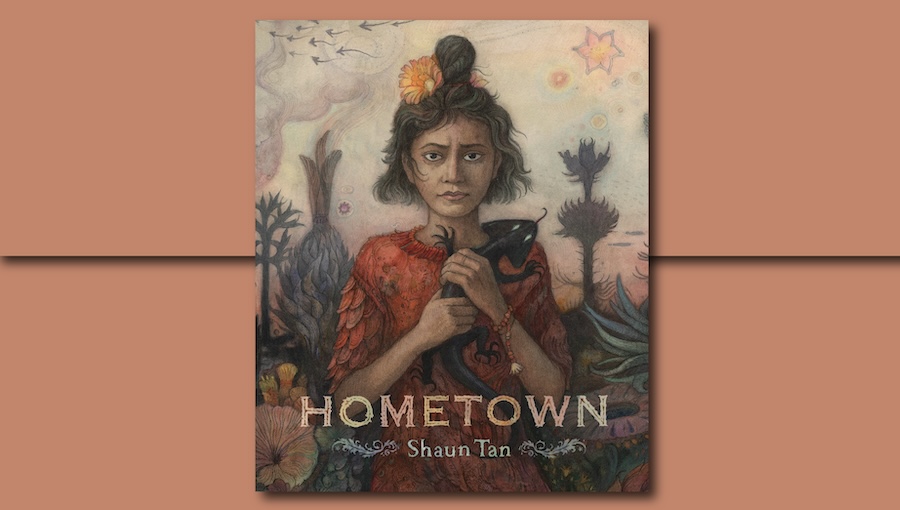
The following is an interview with New York Times bestselling and Academy Award-winning author/artist Shaun Tan regarding the upcoming release of the graphic novel, Hometown, with Levine Querido. In this interview, Fanbase Press Editor-in-Chief Barbra Dillon chats with Tan about the genesis of bringing the story and characters to life on the page, the themes which may resonate with readers, and more!
Barbra Dillon, Fanbase Press Editor-in-Chief: Congratulations on the upcoming release of Hometown! What can you share with us about the genesis behind this project and its overall premise?
Shaun Tan: Whew, there’s a lot to discuss, as I’ve been working on this book for nearly a decade, with many revisions along the way. I rarely have a single originating idea or experience, but rather several things that come together over time, like floating space dust forming into a planet. A few sources of inspiration I can point to: an article about missionaries cutting down Haida totem poles in the Pacific Northwest (a bit shocking to me as a fan of Haida art); a weird children’s TV show I saw one morning while travelling with my family in Spain, in which there was only one human actor surrounded by unsettling puppets; a drawing I made of a girl standing in a wide, lyrical landscape, but looking very worried, for no discernible reason. There were plenty of other things, but it was more or less a combination of these three, unrelated elements that kicked off the chemical reaction, resulting in this book many years later.
The overall premise: A girl lives happily in a world she knows and loves, but it is not a world familiar to the reader. Her family is an assortment of strange creatures – loving, but very strange – and she is unaware of being the only human in her neighbourhood. Until one day, when another human arrives, with the intention of rescuing her. Only she doesn’t want to be rescued. That’s the basic premise of the whole story. Ever since becoming enamoured of the original late ‘50s Twilight Zone series on TV as a twelve-year-old, I’ve loved these kinds of stories, where a character’s understanding of their universe suddenly unravels, and they must make a decision about how to proceed, how to adapt. Add to this a ton of other influences, from fine art, comics, TV, movies, cartoons, science, history, religion, dreams, family life and daily news, and you have this weird-looking book, Hometown.
BD: At Fanbase Press, our #StoriesMatter initiative endeavors to highlight the impact that stories can have on audiences of various mediums. How do you feel that Hometown’s story may connect with and impact readers, and what, if any, conversations do you hope that it may inspire regarding the themes of identity and community?
ST: I tend not to speculate about this very much, as I’ve come to understand how difficult it is to anticipate other people’s interpretations, let alone plan for a connection or anything like consensus meaning. You do hope something like that might happen, if a story is interesting enough, I’m just not sure how. I just try to make the most interesting story I can, and hope others find some truth in it.
On the matter of identity and community, though, I did think about that a whole lot while writing and drawing. I thought about my own home, my nationality, my education, how strange and arbitrary these things can be, how little control I really have over my identity to a large extent. Everybody’s world is quite a strange, accidental thing that nevertheless builds strong emotional attachment over time. If anything, I would like readers to come away from this story with a similar perspective on their own lives, a slightly altered view of the ordinary, that maybe there is no such thing as normal. To think about how we might then navigate cultural differences in our dealings with others, or the better yet, question the very idea of otherness. It’s not always what you think.
BD: Your impactful graphic novel, The Arrival, likewise (and thoughtfully) tackles the mix of emotions that may be part of an individual’s lived experience when they are displaced and in search of belonging. How do you feel that Hometown may serve as a complementary narrative to The Arrival?
ST: Quite a few people have mentioned the parallels, which to be honest, I’ve only thought about recently. The similarities are more to do with stylistic habits and thematic obsessions than anything intentional. That is, I did not plan the books to be so complementary. In some respects, the two books are also neat opposites. One is about a character who must leave their disintegrating home, the other is about a character wanting to stay in their thoroughly integrated one. There is a much deeper questioning of self-identity in Hometown, about trying to understand one’s own nature once the kind of peaceful home life – the kind yearned for and so elusive in The Arrival – have been finally established. The Arrival has no particular voice, no words at all. Hometown is full of voice and conversational speculation.
I suppose the question of belonging does not end with its resolution, the finding of a home, it just goes from being a practical search to a philosophical one, drilling ever deeper. Who am I and why do I love the things that I love? What part of my identity is private and secret, and what part is distributed throughout a broader landscape and community? Which memories are uniquely mine and which are shared? Which beliefs are correct, which false? I love all these questions, which I think really get to the root of why we write, draw, and tell stories, and why we want to read them. Not just to be entertained, but to be surprised and challenged. Even to take delight in being a little confused.
BD: What makes Levine Querido the perfect publishing partner for this story?
ST: I’ve had a relationship with editor Arthur Levine that goes back 26 years now, literally half a lifetime ago for me, to a first meeting at a children’s literature conference in Canberra (interestingly, an Indigenous word that means ‘meeting place’). Arthur has been behind virtually every publication of my work in the United States since, always a kind and judicious supporter, a very thoughtful editor, and a good friend. More broadly, Levine Querido is a perfect publisher for Hometown given their collective interest in a strong, truthful representation of often marginalised voices, upholding the most sensible of all principles on this particular planet: diversity. I grew up in Australia as part of an Asian cultural minority, and while I don’t think of my voice marginal, I’m certainly attracted to stories about people who feel different, overlooked, and sometimes forced to comply with ideologies and social fashions that don’t feel emotionally right. There are no simple questions and simple answers – nor should there be. I think LQ is very much on the same page in this regard (literally).
BD: Are there any other projects – past or current – that you would like to highlight for our readers?
ST: I recently worked on an animated TV series, an adaptation of an older book of mine Tales from Outer Suburbia which was beautifully realised for the small screen, freely accessible in the US. This was a very interesting and unusual project for me, being highly collaborative, working in the style of other artists and writers, and being quite experimental in its narrative. I certainly recommend it to anyone looking for a children’s show that is unique, weird and doesn’t tell you what to think or feel.
BD: Lastly, what is the best way for our readers to find more information about Hometown and your other work?
ST: Probably via my website, shauntan.net, where I typically write background notes for each project, along with sketches and developmental work. I’m very much about sharing the things I’ve learned as an artist and writer, given that I benefited so much myself from other artists’ documentation of process. I’ll also post sketches and notes relating to Hometown over the remainder of the year on Instagram (@shauncytan).
