
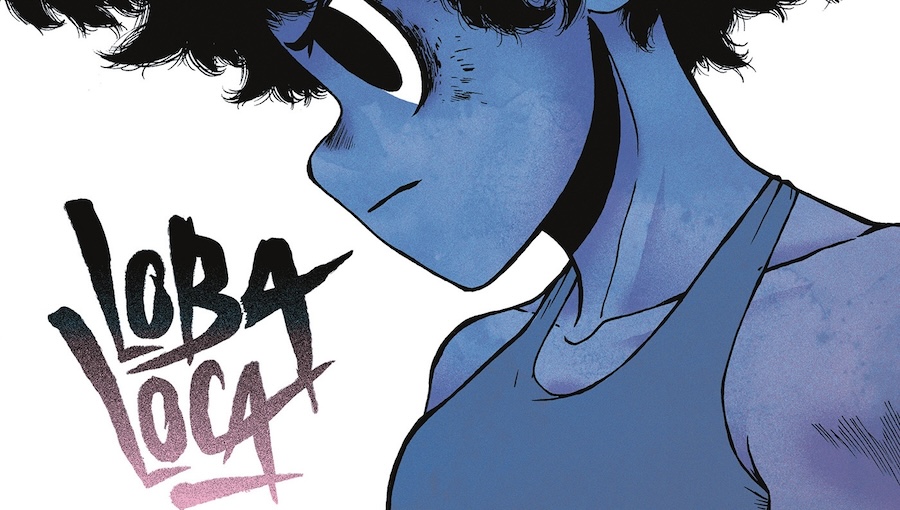
The following is an interview with world-renowned cartoonist and animator Run and celebrated artist Guillaume Singelin (PTSD, Shin Zero) regarding the recent launch of a Kickstarter campaign for the MFKZ-based graphic novel, Loba Loca, in collaboration with Magnetic Press, Oni Press, and Label 619. In this interview, Fanbase Press Editor-in-Chief Barbra Dillon chats with Run and Singelin about their shared creative process in bringing this road trip adventure to life within the MFKZ universe, the exciting rewards available to backers of the campaign, and more!
Barbra Dillon, Fanbase Press Editor-in-Chief: Congratulations on the launch of your Kickstarter campaign for Loba Loca! What can you share with us about the genesis behind your collaboration for this new road trip adventure set within the MFKZ universe?
Guillaume Singelin: It would take too long to explain the project’s origins because RUN and I have known each other for years!
But basically, I was a fan of Mutafukaz from the start of the first short film and the first volume of the series. A few years later, I had the chance to meet RUN and do a student internship at Label 619. That’s where I really immersed myself in the universe, working on a trailer for volume 0, but also through the fantastic experience of working on the Mutafukaz film. And it was during this period that I learned a lot from RUN, and we became friends.
The Mutafukaz universe was already starting to expand with other spin-offs, and RUN had suggested the idea of a story set in Japan. I was a bit too busy (and under a bit of pressure, I have to admit, hehe), so I passed on the opportunity. But a few years later, RUN proposed this road-movie idea, about El Diablo’s daughter, with a lighter tone. He really thought of me while writing it, to create a story that suited me, and he was right. I loved the idea, and we quickly started working on it.
Run: For me, Loba Loca was born from the desire to find the right story to tell with Guillaume, because I wanted to work with him on a comic book. Since we had shared a similar experience in Japan (during the pre-production of the film, MFKZ), I initially planned a spin-off about one of the luchadores, Feliz, who had gone to Japan to pursue a professional MMA career, hoping to humorously depict the cultural differences we had encountered. But during that same pre-production, Guillaume had drawn several graphic versions of the luchadores, including El Diablo. He had drawn him younger, slimmer. Almost a toreador. I really liked the feel of his drawing, and the idea of telling a story about El Diablo’s descendants gradually took hold.
I imagined the sudden appearance in the life of a disillusioned wrestler, Tigre, of a secret son of his former partner, after the events of MFKZ. And when I became a father to a little girl, the idea of a son became a daughter (which was perfect timing, as the MFKZ universe was sorely lacking in female characters). What could have been a simple adventure within the MFKZ universe became a more intimate story about the search for identity and legacy, through the encounter of two characters who, at first glance, had no reason to cross paths.
BD: You each bring such unique creative signatures to your work. How would you describe your shared creative process in bringing this story and characters to life on the page?
GS: We already knew each other well and had worked together, so we were familiar with each other’s strengths and affinities. RUN really wrote characters that I liked, with a softer, more luminous tone that I appreciate. And so I was really able to bring my drawing style to this story, really thinking about the character, the fluidity of the narrative, and trying to capture the emotion in the staging.
But as I said, it’s hard to summarize simply. When you’ve known each other for years, there’s a kind of instinctive and natural collaboration that develops very quickly. There was no friction or complexity in the production because we were truly on the same wavelength.
Run: I have a fairly simple philosophy: I adapt to the artist I’m writing for, and I don’t try to over-direct their work. The best collaborations are when the artist makes the writer’s world their own, and for that to work, you have to give them some leeway in the staging, even if it means adapting their own way of telling stories. Guillaume brought his own sensibility to Loba Loca, and that’s precisely why I sought him out. Having been his editor for some time at the 619 label, I was intimately familiar with his work, his strengths, his sense of rhythm, and his way of bringing characters to life, including through non-verbal cues. Even though my script was very specific in certain aspects of the story, I gave Guillaume ample freedom in the direction. Without him, I simply wouldn’t have written Loba Loca.
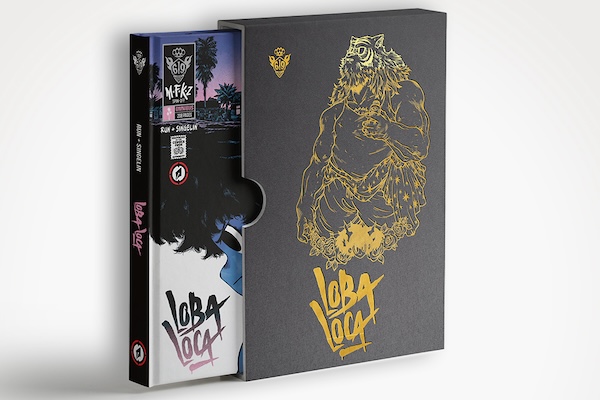
BD: Run, you have previously collaborated with Magnetic for an MFKZ hardcover collection. Why do you feel that they continue to be the ideal publishing partner for the MFKZ universe?
Run: Magnetic has a culture of beautiful books and attention to the object itself, which is also one of our hallmarks for our publications in France, and they respect authors. So, they’re an obvious partner. For Label 619, it was essential to work with an American publisher who doesn’t try to “Americanize” our books, but who understands what makes them unique and knows how to present them as they were conceived. And beyond that, they understood our DNA, this blend of European, American, and Japanese influences, which doesn’t necessarily fit into traditional market categories. It’s a true relationship of trust; they’re our preferred partner for Label 619 in the USA.
BD: Guillaume, your work has spanned various entertainment mediums, from comics to animation. Given your work on graphic novels like PTSD and Loba Loca, what do you find to be most creatively rewarding as a storyteller working within the sequential art medium?
GS: I think that telling stories, whether alone or with someone else, is really about bringing characters to life. And when readers come up to you and tell you they felt close to the characters, it’s extremely rewarding. It’s a kind of two-way conversation with the readers; I want to immerse them in a world (hence the extensive work on the backgrounds, for example) and make them experience emotions.
BD: Are there any other projects – past or current – that you would like to highlight for our readers?
GS: Right now, Magnetic Press and Le Label are releasing Shin Zero, which I’m illustrating with Mathieu Bablet. It’s a fantastic collaboration.
It’s also a kind of coming-of-age story, but with sentient beings and a large cast of characters. It’s very different from Loba Loca, but there are lots of connections, and if you like one, you’ll like the other, I’m sure of it, hehe.
Run: MFKZ is an expanded universe, and Loba Loca is—in a way—a sequel to a previous spin-off called Puta Madre, which is harder and more violent. Magnetic chose to publish Loba Loca first, and that’s perfectly fine. But I’d like readers to be able to discover Puta Madre soon, as well.
On a different note, there’s also a reboot of the MFKZ universe set in the Wild West, called MFKZ 1886. A reimagining of MFKZ in the era of cowboys, but also a European perspective on US history.
BD: Lastly, are there any particular backer rewards that you are most excited about within the Kickstarter campaign?
GS: The sketchbook is a really great reward. Personally, I love seeing the preliminary sketches, the different iterations an author goes through before arriving at the final result, so I hope the backers will appreciate it, too!
