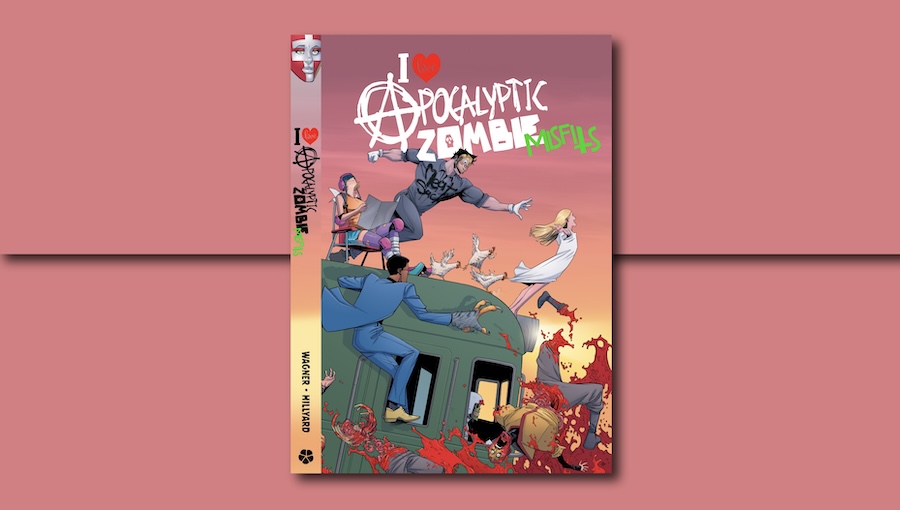
The following is an interview with writer Doug Wagner and artist Daniel Hillyard (Narco, I Was a Fashion School Serial Killer) regarding the recent launch of their Kickstarter campaign for the graphic novel, I Love Apocalyptic Zombie Misfits, in collaboration with Clover Press’ new creator-owned imprint, The Fourth Leaf. In this interview, Fanbase Press Editor-in-Chief Barbra Dillon chats with Wagner and Hillyard about the creative shorthand that they have developed as long-standing creative partners, the incredible reward tiers available to backers, and more!
Barbra Dillon, Fanbase Press Editor-in-Chief: Congratulations on the Kickstarter campaign launch for I Love Apocalyptic Zombie Misfits! What can you share with us about the genesis behind this dark comedy, as well as its overall premise?
Daniel Hillyard: Thanks so much for having us and thank you! I’m really excited that I Love AZM is finally being…birthed [laughs]. Or is resurrected the better pun here? I think it started when Doug asked me what I would like to draw next. I threw out that something supernatural could be pretty cool and that we hadn’t really ventured there yet.
Doug Wagner: Yeah, Daniel’s downplaying that a bit. This one is absolutely Daniel’s fault. When I asked what he wanted to draw next, he didn’t just say supernatural. He started giving me a wish list – slashers like Michael Myers, angels, ghosts, vampires, all this stuff he’d love to sink his teeth into.
I let that simmer in my brain for a few days until I had this wonderfully stupid thought… Why not ALL of it?
That’s really where AZM started. I began figuring out how all these different pieces could exist in the same world, and slowly this supernatural road trip started taking shape. The real breakthrough came during San Diego Comic-Con in 2024. I had driven from Salt Lake City to San Diego for the first time, and somewhere in that long stretch of strange, desolate desert I realized I was driving through the perfect landscape for the world of AZM. Then, on the twelve-hour drive home, surrounded by this environment, I basically worked out the entire story in my head.
As for the premise, at the center of all this insanity is Cecil. He’s a nerdy pacifist from 1985 who’s resurrected in the present day inside the body of an infamous serial killer. He ends up on the road with this wonderfully dysfunctional group of supernatural misfits while the forces of Heaven and Hell are both closing in on them.
There are skinwalkers, psychics, archangels, cults, a zombie-driven death truck, and, of course, immortal murder chickens. It’s big and ridiculous and occasionally horrifying, but underneath all of that, it’s really about a bunch of people who don’t belong anywhere discovering that maybe they belong with each other.
BD: As longtime collaborators, do you find that you have developed a creative shorthand in working together on each new project, and how, if at all, has that dynamic evolved over time?
DH: At this point we’ve been working together for so long I think Doug and I could finish…
DW: …each other’s sentences.
DH: See! [laughs]
DW: It really has become almost instinctive at this point. We’ve been doing this together for almost two decades now, so I know what Daniel loves to draw, I know where he’s going to push something further, and I know when I can give him very little direction and just get the hell out of his way.
I think the biggest evolution is how early Daniel is involved now. I’ll send him the one-paragraph idea first, then the scene-by-scene breakdown, and eventually the scripts one scene at a time. We’re bouncing things back and forth throughout the entire process. It’s less like passing a baton and more like we’re constantly handing the story back and forth.
And neither of us is precious about whose idea is whose. If Daniel comes up with something better, that’s what we do. If I see something in his layouts that sparks a new idea, I’ll change what I’m writing. We’re always pushing and amplifying what the other person is doing.
After all these years, it really feels less like two people collaborating and more like one long creative conversation that’s been going on for two decades.
DH: When Doug sends me a scene, we work together coming up with the layouts and figuring out the beats and character acting stuff. Once everything is fleshed out and all the ideas are in, the inking comes together pretty quickly. We tend to fly through our stories like that just having fun with each scene until a book is finished and we’re left wondering how it all went by so fast.
BD: At Fanbase Press, we believe in the power of storytelling to connect with and impact readers – no matter the genre of the story. (Even ones with homicidal chickens.) How do you feel that this story may connect with readers, and what, if any, conversations do you hope that it might inspire?
DH: For me AZM really struck this nerve of self-acceptance. I think it’s important to really own who you are, and a lot of the characters’ internal conflicts come from their own self-perceptions. The more they embrace the things that make them unapologetically them the better they are for it.
I would hope that if any serious conversations are borne from people reading AZM, that it would be the kinder ones they have with themselves.
DH: I love that answer. I’d probably take it one step further and say that acceptance is also the key to finding redemption.
Every one of these characters is carrying something. Some of it they’ve done. Some of it was done to them. Some of it is simply who they are, and they’re terrified the rest of the world won’t accept it. None of them can change the past but finding people who see all of that baggage and say, “You’re still one of us,” gives them a chance to become something more.
That’s probably the part of AZM that means the most to me. This is a group that makes absolutely no sense together on paper. They don’t look like a family. They certainly don’t act like one most of the time. But when the meat meets the bone, they show up for each other.
So, if Daniel hopes readers have kinder conversations with themselves, I hope maybe the book also makes them think about the people around them a little differently. Sometimes, the thing that allows someone to finally accept themselves is discovering that somebody else already has.
BD: In light of the Kickstarter campaign, are there any particular backer rewards that you would like to highlight for our readers?
DH: I think this is where Doug and I fight over which ones we get to say first [laughs]. For me, it’s got to be the companion book! It’s a fully printed book containing all the scripts and layouts/pencils for the graphic novel. If you’re into all the behind-the-scenes stuff then this is one to look out for.
DW: CURSE YOU, DANIEL! He took the companion book from me. Fine! Then I’m claiming the Murder Chickens card game.
I still can’t believe that’s a real sentence I get to say. The murder chickens started as something ridiculous I did in a D&D campaign years ago, somehow found their way into AZM, and now they’ve escaped the comic completely and become their own actual card game. That’s pretty cool.
Honestly, that’s what I love about the entire campaign. Hank and the Clover Press team kept coming to us with ways to make the project more special, and somehow, we ended up with this collection of things that feel like extensions of the story rather than random rewards.
BD: Are there any other projects – past or current – that you would like to highlight for our readers?
DW: Oh, there’s a lot going on right now, but, unfortunately, most of it falls into the category of “things I’m not allowed to talk about yet.”
Obviously, AZM is taking up a huge amount of our attention at the moment, but I also have YUMI: 00EX coming from Image Comics. It’s my take on an anti-spy thriller about a woman hunting for her missing MI-6 boyfriend who, along the way, steals an AI Lamborghini and teaches it to talk like Cardi B. So… apparently, I’m incapable of writing anything normal anymore.
Daniel and I also have something pretty special planned for Halloween that we’re both dying to talk about but can’t just yet. And there may – or may not – be something unexpected coming next March.
That’s it. I’m stopping there before a publisher calls me.
DH: Hey, don’t look at me to be spilling the tea… oh, okay then, I can say that we have something brewing. That’s the only hint I’m giving.
BD: Lastly, what is the best way for readers to lend their support to the I Love Apocalyptic Zombie Misfits Kickstarter campaign and your other work?
DH: Sharing the Kickstarter on social media, sending it to people you think would get a kick out of it, and interacting with posts online would be amazing. Every like, share, and comment can turn the tide of the algorithms in our favour and help so much…Pledging on the Kickstarter would be amazing, too.
DW: I completely agree with Daniel. Obviously, backing the Kickstarter is incredible, and we’re ridiculously grateful to everyone who does, but you don’t have to spend a dime to help this book.
Share a post. Leave a comment. Tell that one friend you know is going to love immortal murder chickens. All of those little things matter more than people realize. Every time someone interacts with a post, it helps put the book in front of somebody who might never have discovered us otherwise.
And I’d extend that beyond AZM. If there’s a creator whose work you love, talk about it. Recommend their book to a friend. Ask your comic shop about it. Follow them online. Sign up for their newsletter. Creators can scream about our own books all day long, but there’s something infinitely more powerful about a reader saying, “I loved this. You need to read it.”
That’s really how careers like ours survive – one reader telling another reader, “Hey, you’ve got to check this out.”
DH: And if that conversation happens to begin with, “Okay, so there are these murder chickens…”
DW: Even better. [Laughs.]
