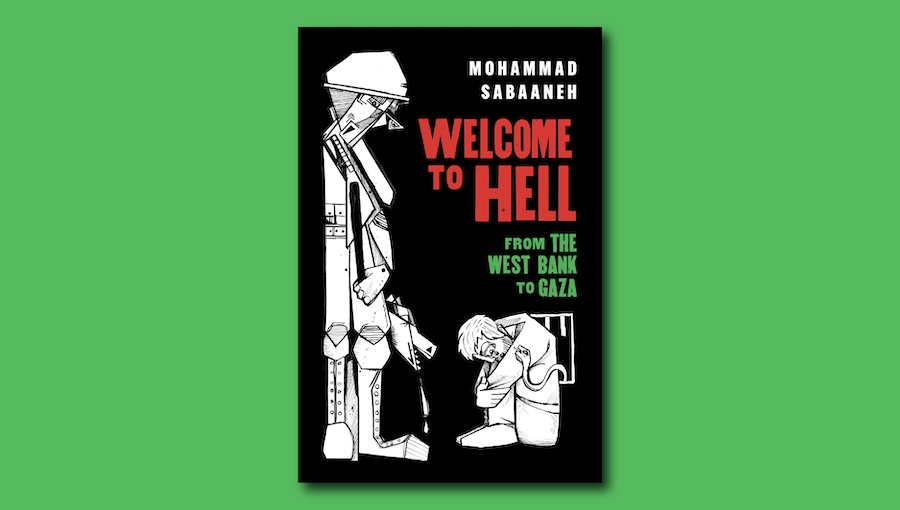
The following is an interview with award-winning cartoonist Mohammad Sabaaneh regarding the upcoming release of his graphic memoir, Welcome to Hell: From the West Bank to Gaza, with Street Noise Books. In this interview, Fanbase Press Editor-in-Chief Barbra Dillon chats with Sabaaneh about his creative process in bringing his personal story to life on the page, the themes that he hopes may resonate with readers and the conversations that they might inspire, and more!
Barbra Dillon, Fanbase Press Editor-in-Chief: Your new graphic memoir, Welcome to Hell, will be releasing this month through Street Noise Books. What can you tell us about your decision to share your story with readers?
Mohammad Sabaaneh: The artwork I do outside of daily political cartoons can be considered an artistic practice distant from market and publisher demands. I do it because I choose to. Welcome to Hell was created this way. Even so, I try to ensure all my work explores the theme of deconstructing the tools and patterns of domination in Palestine.
A few years ago, I created Power Born of Dreams, the first book in this series which examined life for Palestinians inside and outside occupation prisons. The occupation transforms cities, villages, and camps into places of isolation or prisons in order to fragment identity and cut communication between Palestinian cities. The reader of that book eventually discovers that all Palestinians are prisoners in one form or another.
When we examine the work of both of the books in this series, through the lens of settler colonialism, we understand that the occupation operates on what Patrick Wolfe has termed a logic of elimination. This framework seeks to extinguish the Indigenous collective and its political autonomy, using spatial reordering and the multi-dimensional erasure of social life to permanently replace the population and build a new identity on the land.
BD: In balancing the writing and illustrative duties of the project, what can you tell us about your creative process in bringing this personal narrative to life on the page?
MS: My path into comics was primarily academic, mostly developed as I was studying in a Master’s program in the UK. This has given me a precise understanding of the mechanics of writing and drawing comics. Yet, I choose, for my personal projects like this book, to skip the storyboarding phase, and instead work instinctively from sketches, because these are scenes I know intimately and feel deeply.
BD: At Fanbase Press, our #StoriesMatter initiative endeavors to highlight the impact that stories can have on audiences of various mediums. How do you feel that your story – and your first-hand account of life in Palestine today – may connect with and impact today’s readers, and what, if any, conversations do you hope that it may inspire?
MS: The medium of comic arts is just beginning to develop in Palestine. However, we are actively working to cultivate this visual language through dedicated workshops and exhibitions. A significant milestone was the collective exhibition I was part of with the municipality of Ramallah three years ago, which helped introduce this art form to a wider audience. Because this was the first exhibition of its kind, many attendees, including journalists and fellow artists, were unfamiliar with the unique language and methodology of comics. We recognized a crucial need to elevate the understanding of the medium’s styles and history, viewing the exhibition not just as a showcase, but as a platform for artistic and public education. That is a profoundly important mission.
When addressing an international audience, my primary objective has been to illuminate the humanity of the Palestinian people, who endure systemic hardships within an occupied land. Historically, narratives and comics regarding Palestine have largely been crafted by external international artists—such as Joe Sacco or French creators. While their work is important, it often lacks the intimate, lived perspective of someone experiencing this reality firsthand. By depicting the daily rhythms and personal struggles of Palestinian life under these conditions, I try to not only share authentic, deeply human stories, but also effectively dismantle the distorted propaganda that often portrays our people through harmful stereotypes. Conveying these truths is essential to fostering genuine empathy and understanding on a global scale.
BD: What makes Street Noise Books the perfect publishing partner for this graphic novel?
MS: In the fall of 2019, Liz Frances came to Palestine and asked to meet with me. We met in a coffee shop in Ramallah, and I showed her some of my new work. We had never worked together and I didn’t know her. So, I was surprised to see her so excited about my work. A year later, when I was ready, I sent her what I had been working on, and Power Born of Dreams became our first Palestinian graphic novel. I believe it should be considered the first Palestinian graphic novel to actually come out of Palestine. And Liz and Street Noise had a big role in its publication. Liz is always searching and thinking about projects related to the Palestinian cause, not only with me, but with other artists. She deserves a lot of credit for encouraging my work in comics. And so, when I decided to create the next book in the series Welcome to Hell, of course, I came to Liz at Street Noise.
BD: If readers are interested in learning more about what life is like in Palestine right now and how they can best lend their support, where would you advise them to begin?
MS: Gaining a comprehensive understanding of Palestine definitely involves engaging with multiple forms of expression. Beyond texts, I suggest people look at the powerful visual art of figures like Sliman Mansour, Nabil Anani, Amer Shomali, and Samira Harb. For historical context, texts by Ilan Pappé, such as The Ethnic Cleansing of Palestine, or The General’s Son by Miko Peled offer critical perspectives, given their backgrounds. And of course, Joe Sacco’s work in comics provides an essential look at daily realities.
BD: Lastly, what is the best way for our readers to find more information about Welcome to Hell and your other work?
MS: Welcome to Hell is a new book launching this month, and the English language version is available from Street Noise for pre-order from any bookseller. Readers can explore the book by checking out the multiple interviews I’ve been doing about the book, which are available online. The best way to keep up with me, is to follow me on Instagram (@sabaaneh).
