
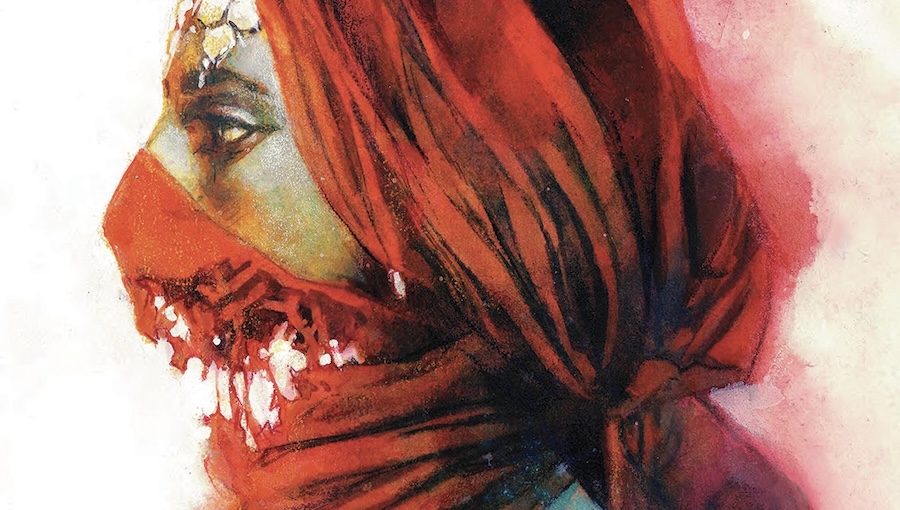
The following is an interview with Nihaarika Negi (Labours of (An)Other Solipsist, The Threshold) regarding the upcoming release of the historical fiction horror graphic novel, Hunger, through The Lab Press. In this interview, Fanbase Press Editor-in-Chief Barbra Dillon chats with Negi about her shared creative process in working with artist Joe Bocardo to bring the story and characters to life on the page, what she hopes that readers may take away from the story’s themes, and more!
Barbra Dillon, Fanbase Press Editor-in-Chief: Congratulations on the upcoming release of Hunger! What can you share with us about the premise of this impactful story?
Nihaarika Negi: Thank you so much. Yes. So, Hunger is a historical fiction horror set inside a detention camp in 1896 Bombay under the British rule – during a time when a plague and famine coincided. It is about Izna, a young plague-infected famine-survivor who is medically experimented on. When the experiments turn her and a few others into mutants, the British officers bring in a renowned famine photographer – Hooper – to document the exotic beasts.
What they don’t know is that Hooper is under the control of a Pisach – a shape-shifting, flesh-eating vampire that injects an insatiable hunger into its prey that slowly drives them insane. And under its influence, Hooper and the British officers give into their darkest desires – ultimately compelling Izna to give way to an ancient rage. She makes a deal with the Pisach vampire – becoming one herself – and together, they go about hunting well-fed colonizers and the Indian elite in a revenge rampage. The book explores how trauma travels through generations, cultures, and bodies, fusing an untenable bond between the oppressed and the oppressor.
BD: The story deftly weaves the very real impacts of oppression and trauma within a captivating and haunting supernatural drama. How would you describe your creative process in working with artist Joe Bocardo to bring the story and characters to life on the page?
NN: Joe is an exceptional artist and has this incredible ability to understand your core intentions and then make them entirely his own – breathing whole new life into the words. At my end, the task was to be as clear in my intentions and visions as possible. So, the script was very detailed especially with regard to the visual imagery and evolving language. I created a beat sheet with reference images to map how the book’s visual and color language would shift, along with a bank of historical and artistic images, detailed character notes and including all the things the book should not be. Joe read everything and came back with sharp, thoughtful questions that really aligned us. From there, the collaboration flowed. He sent early character and world sketches that were incredible, and our workflow became very fluid. I’d give minimal notes (His work was stunning from the start.), and we’d move forward. This version of the book wouldn’t exist without him.
BD: At Fanbase Press, our #StoriesMatter initiative endeavors to highlight the impact that stories can have on audiences of various mediums – no matter the genre. How do you feel that Izna’s story may connect with and impact readers, and what, if any, conversations do you hope that it may inspire?
NN: Izna’s story is a story about famine. From 1765 to 1947, India experienced 31 man-made famines under the British rule. Each costing about 1 – 11 million lives and creating over time a class of landless laborers primed to feed the industrial supply-chain. And the legacy of this is very much alive in the country and in the Global South today.
And Izna is a young girl who comes from such a place. Losing her family to hunger and being subjected to medical experiments – awakens within her an ancient rage that her life of submission had somehow erased. And this story is about her, reclaiming that connection with her lost self.
Her journey reflects the experience of anyone who has been forced to deny their truth for the sake of a dominant culture. Through the lens of horror, the story explores the discomfort that comes with facing our inner monsters – and the radical transformation that occurs when we finally accept them.
Given where we are in the world right now, stories that push us to reflect on our collective pasts, and confront and embrace our shadows, feel more vital than ever. Because I think understanding our histories allows us to shape a more conscious future. And I hope these are the conversations that the book inspires.
BD: What makes The Lab Press the perfect home for this story?
NN: Everyone at The Lab Press approaches their work like an Entrepreneurial Artist – encouraging you to take creative risks, giving you the exact support and guidance you need through the process and helping protect and nurture the vision from start to finish. That kind of partnership is rare and I think a book like Hunger exists because of it. So, more than being the perfect home for it, I think they are the co-initiators and alchemists of making this project a reality.
BD: Are there any additional projects – past or current – that you would like to highlight for our readers?
NN: I’ve just finished a short-film called Tenfa, which was grant funded by The Storiculture Company and ONI (India), and is about cultural erasure and climate change in my home town in the indigenous region of Kinnaur (Himalayas). And I am in post-production for my first feature, Birds Of A Feather, an absurdist film about grief, dysfunctional families and intergenerational trauma.
BD: Lastly, what is the best way for our readers to find more information about Hunger and your other work?
NN: You can order Hunger online – all major sites are listed on The Lab Press’s website here. You can find my work on my website at www.nihaarikanegi.com and follow me on Instagram for updates (@nihaarikan).
*Cover by: Bill Sienkiewicz
