The following is an interview with writer/editor/publisher Chris Ryall (The Marvel Calendar Book: A Visual History) regarding the release of Megalopolis: An Original Graphic Novel through Abrams ComicArts. In this interview, Fanbase Press Editor-in-Chief Barbra Dillon chats with Ryall about his approach to adapting Francis Ford Coppola’s film to the sequential art medium, what he hopes that readers may take away from the story’s themes, and more!
Barbra Dillon, Fanbase Press Editor-in-Chief: Congratulations on the release of Megalopolis! The creative process of adapting a prior work can be a daunting experience. How would you describe your approach to bringing this story to the sequential art medium, and what did you find to be most rewarding/challenging about the process?
Chris Ryall: Once I got over the presumptuousness of knowing I’d need to trim some scenes, add others, revise some dialogue, and work sequences all written by a multiple Oscar-winner, I set about just trying to make this story work in graphic novel form as well as possible without having that thought in my head. Successfully adapting anything from one form to another, if it’s going to be successful and stand on its own, necessitates making those changes no matter the source of the original story.
It all became way less daunting after Francis gave us full freedom to make the book its own thing and not feel we had to hew too closely to the movie itself. When he said he wanted the graphic novel to be a sibling to the film rather than a copy, it was about the best thing he could have said to us, since it allowed us to fully focus on our story rather than being overly beholden to the movie.
BD: With regard to your shared creative process, you previously noted that, “Francis [Ford Coppola] and I served as city planners and Jacob [Phillips] the sole builder of the city.” What can you tell us about your collaboration with Phillips for this project?
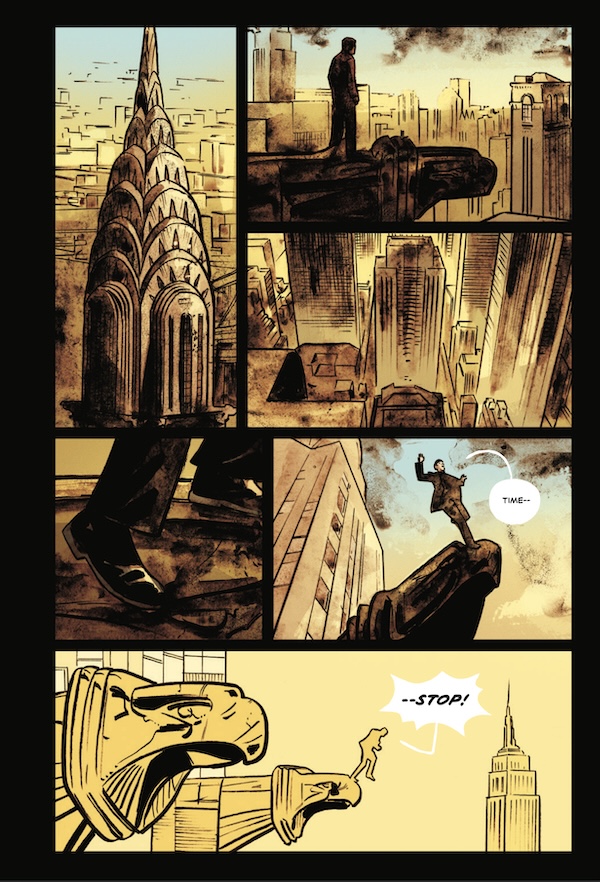
CR: I can say that I was in constant awe of the way Jacob, while striving to make this book its own thing, also managed to really nail many scenes as they looked in the final cut of the film, despite never having seen one frame of the movie during the development process.
I’ve long admired and wanted to work with Jacob, as his work on series like Newburn and The Enfield Gang Massacre had such amazing senses of place; and his sublime color work on top of his pencils, ink, and greywashes on this one really gives the book a uniquely gorgeous look and feel.
BD: At Fanbase Press, our #StoriesMatter initiative endeavors to highlight the impact that stories can have on audiences of various mediums. How do you feel that Megalopolis’ themes may connect with readers, and what, if any, conversations do you hope that they may initiate?
CR: As much as the film is a fable in lots of ways, the real through-line that resonated with me is the lead character, Cesar Catalina, and his efforts to push back against the status quo. Cesar is an architect, so he does deal with precise form and shape, but he’s also an artist and a dreamer who envisions a better world, who wants more from humanity, and who strives to break free from existing power structures and help forge a new path. So in that way, not only is he an obvious stand-in for Coppola, who also sees the world through positive and humanist eyes despite our current struggles to life up to those expectations, he’s also pointing the way for all of us to strive to do the same.
BD: What makes Abrams ComicArts the perfect home for this project?
CR: Abrams has been doing a number of award-winning prestige graphic novel adaptations, like Octavia Butler’s Parable of the Sower and Parable of the Talents, and Cormac McCarthy’s The Road, so this one fit nicely on their list. And considering that same group, Abrams ComicArts, is also launching a high-profile graphic novel series created by Darren Aronofsky (Human Nature), it also made sense for that reason, too, as part of a burgeoning line of graphic novel forays by high-profile filmmakers.
BD: Are there any other projects – past or current – that you would like to highlight for our readers?
CR: My first book as writer with Abrams ComicArts was last year’s The Marvel Calendar Book: A Visual History; I’m working on another book now that similarly mines a unique part of comic book history; but I’m also excited about books like Human Nature and John Byrne’s X-Men Elsewhen graphic novel series, both of which I’m running editorial point on, and both of which are coming next spring.
Outside the Abrams ComicArts walls, I’ve got a coming book from Bloomsbury (Daredevil: Born Again, releasing in November as part of the launch of their Marvel Age of Comics line); and I’m part of the incredibly fun-to-work-on Dread the Halls holiday horror anthology coming from Image this December, and some other fun things I can’t yet talk about. Basically just finding all possible ways to live and breathe comics for as long as I can…
BD: Lastly, what would you like to tell fans who want to learn more about Megalopolis: An Original Graphic Novel and your other work?
CR: I think the above books, coming soon or recently released, are a fine place to start; it’s been very fun to tackle such a wide array of material, both fiction and non-fiction/historian kinds of projects, too. I’ve always tried to keep a hand in both sides over my two decades in comics, and that remains the plan going forward, too.
I’ve certainly been less active on social media since, you know, all of this, but I’m on BlueSky, Threads, IG, FB… and have a weekly-ish newsletter where I talk up all of these projects and other parts of the comic industry’s past and present, too.
