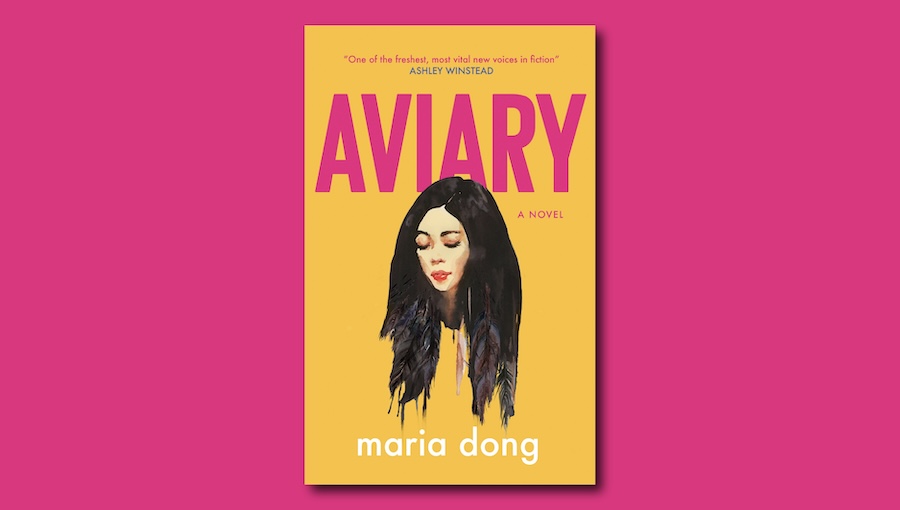
The following is an interview with critically acclaimed author Maria Dong (Liar, Dreamer, Thief) regarding the recent release of her latest novel, Aviary, with Severn House. In this interview, Fanbase Press Editor-in-Chief Barbra Dillon chats with Dong about her creative process in bringing the world and characters to life on the page, the themes that she hopes may resonate with readers, and more!
Barbra Dillon, Fanbase Press Editor-in-Chief: Congratulations on the release of Aviary! For those who may be unfamiliar, how would you describe the book’s premise, and what inspired you to tell this story?
Maria Dong: Thank you so much! I have such a hard time describing my own work, but I would say this book is a kind of horror-thriller; it combines a thriller plot engine (An undocumented woman in South Korea finds a passport and a plane ticket to the United States in the pocket of her sister’s body.) with horror elements, like a creeping, uncomfortable ambiance, fever-dream hallucinations, and body transformation. It’s also steeped in Korean history and folktales, as well as western fairy tales.
As for the inspirations, they’re kind of all over the place. The initial plot seed actually came from an episode of 90-Day Fiance! But there are also obvious threads from Du Marier’s Rebecca, and Devil in the White City, and probably Mona Awad’s work. I was also very influenced by the Atlanta spa shootings. If you’re interested, I go in a bit more depth in this interview with Michigan Public Radio.
BD: The novel deftly weaves the aforementioned Korean folklore with a very powerful depiction of a woman’s struggle for a better life. What can you share with us about your creative process in weaving these narratives together?
MD: I wish I had something profound to say, but the truth is that I’m an inveterate pantser. I will plot when forced to, but, especially in the early phases, I really like letting the book pull me around in random directions and down rabbit holes.
This is going to sound so random, but I think my early process is a bit like the video game Raft. If you’ve never played it: You’re essentially floating on a raft in the middle of the ocean, and random debris washes by you. When you can, you try to catch the debris and assemble it into something useful, building up your raft. Over time, you wind up making, like, this huge super-structure—but you’re also mapping the area as you go, learning the story of how things came to be and unlocking the story of why the world you’re in is the way it is.
I think it’s a lot like that. An idea sticks in my brain, and then I have a net out, and every interaction I have, every piece of media I consume, every fact I learn, it gets caught in the net and assimilated into the structure I’m building in some way. Some of it I really gravitate toward without knowing why. But I think folktales, fairy tales—they made so much sense for this book, for the assertions it makes about power and abuse in our society.
Maria Tatar has some lovely academic work on children’s stories and the way they reflect the acceptable moral values of the time (like the way the Grimm brothers sanitized the stories they were collecting by removing sexual references and swapping out villain parents for step-parents.) The stories we create for children represent these unique distillations of our collective fears and wisdoms, and it makes them so powerful.
BD: At Fanbase Press, our #StoriesMatter initiative endeavors to highlight the impact that stories can have on audiences of various mediums. How do you feel that Hee-Jin’s story may connect with and impact readers?
MD: I think, at its core, Hee-Jin’s (and Callie’s) story is about the nature of power. It’s about the decisions people make when the systems around you have removed all but a few bad ones. It’s about the way women, and particularly marginalized women, are preyed upon by those systems—but also about how easy it is to become a collaborator in that process.
I think one thing I wanted to understand and explore was our popular understanding of evil, and monsters, and how that differs from real-life manifestations. Although I’m not an academic, I read a lot of philosophy and history to that effect during the writing process, and what I uncovered was that, for the most part, monsters aren’t a special category we can separate ourselves from. The people that do the most evil in the world are often just normal-ish people with flexible morals and a close proximity to power—and that they often start with small evil acts, and, if not checked by society, they learn from that lack of response and grow into bigger evil acts. In other words, evil grows over time.
So, with that in mind, one group of people that may connect with this story is people that have experienced abuse—domestic, familial, or societal. People that have been impacted by evil—especially those who weren’t supported by the systems that were supposed to protect them.
The story is also a queer story (although that isn’t the main thrust of the book)—but I think it very much epitomizes a specific kind of queer longing.
BD: What makes Severn House the perfect publishing partner for Aviary?
MD: I have had, just, the most amazing time working with Severn House.
When my agent and I were shopping this book, there were a lot of publishers we were in conversation with that waffled because the book wasn’t squarely enough in one genre to make it an easy sell to bookstores, or because the topics in it felt taboo, or too connected to current events. And I was really quite panicked by that, because the book was so personal, and the topics were so delicate. Handling them right, and this story’s inspirations—that meant finding the right partner, one that would be sensitive and intelligent about how we handled this material, but that was also bold enough to throw themselves behind the project even when the subject matter might be divisive.
It was clear from jump that Severn House really, really cared about the quality of the book, and they’ve been absolutely amazing at every step of the process: really intentional editing, enthusiastic community outreach, and look at that amazing cover. (Seriously, look at it!) I’ve had a really wonderful experience and can’t recommend working with them enough.
BD: Are there any other projects – past or current – that you would like to highlight for our readers?
MD: Aviary is my third book, and it’s taken me this long to realize that I do, in fact, have a “brand:” literary-leaning, mystery-driven, emotional books where the protagonists almost certainly need psychological help. If that sounds like it might be up your alley, my debut, Liar, Dreamer, Thief, is a psychological thriller with magical realism elements about a young woman who is platonically stalking her coworker, and my sophomore novel, Psychopomp, is a science-fiction thriller about a space miner that uncovers a deadly conspiracy (while also battling her own psychological demons.)
I’ve also done a fair amount of short fiction; you can find some of my pieces in the Best American Science Fiction and Fantasy (2022 and 2023), or listed here.
Finally, I do have another book with Severn House in the pipeline. It’s tentatively titled Pastiche, and it’s a steampunk adult fantasy-mystery with a hint of queer romance, in which a hermit-like, middle-aged dressmaker assumes her dead father’s identity to prevent his magical opera costume shop from being shut down by a society that doesn’t allow women to own property—only to team up with the ravishing milliner next door when a blackmailer threatens to take everything. I believe we’re scheduled for March 2027, although that could always change.
BD: Lastly, what is the best way for our readers to find more information about Aviary and your other work?
MD: My website is a good starting place (MariaDong.com). I have a mailing list there where I very occasionally send out updates (usually “I sold a book!” or “The book I sold is Now Coming Out!”). (Or, more realistically, hi, this book came out three days ago.)
I’m also on bluesky (@mariadongwrites.bsky.social), instagram (@maria_dong_writes), and tiktok (@mariadongwrites).
