
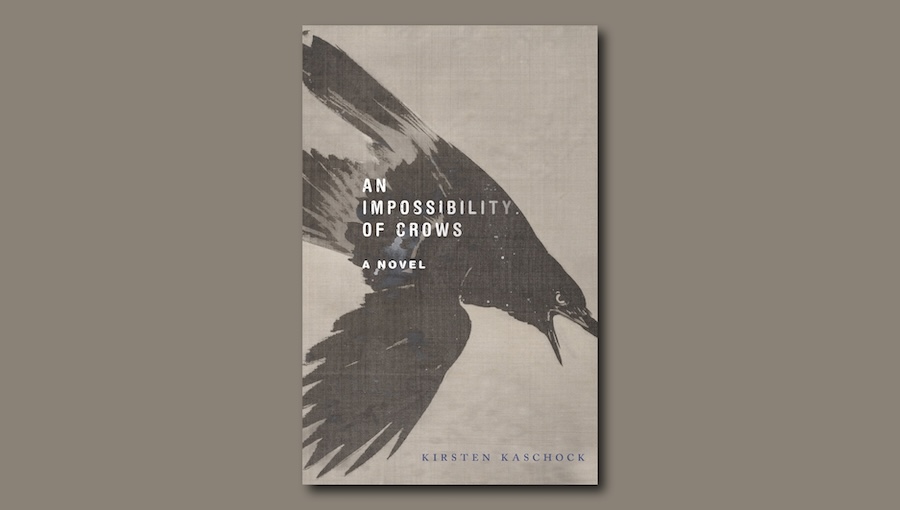
The following is an interview with author Kirsten Kaschock regarding the recent release of the evocative, new novel, An Impossibility of Crows, through publisher UMass Amherst Publishing. In this interview, Fanbase Press Editor-in-Chief Barbra Dillon chats with Kaschock about her creative process in researching and bringing the story and characters to life on the page, how she hopes that the story’s themes may connect with readers, and more!
Barbra Dillon, Fanbase Press Editor-in-Chief: Congratulations on the release of An Impossibility of Crows! How would you describe the genesis behind this project, and what can you tell us about the story’s overall premise?
Kirsten Kaschock: I have never had a project come to me in a dream before—this one did. An enormous crow. Solo (as I named him later) started haunting my waking hours and insisting that he be dealt with. The beginning pages came slowly… I was building the world as his mad scientist was building him. The premise of the novel is fairly straightforward: An ex-chemist returns to her family farm and there builds a crow the size of a horse—and things do not go to plan. The longer version of the story gets deeper into the history of the region and reveals the toxicity that can lurk in the soil of both farm and family.
BD: How would you describe your creative process in both researching the more scientific elements of your story, as well as crafting its gripping narrative and characters to come alive on the page?
KK: I’m interstitial. What I mean by that is that I tend to get deeply engrossed in things between and among my studies of other things. Like a crow itself… I like the shiny. So, my research tends to be down-the-rabbit-hole types of adventures. I have books on Corvids I consulted. I’ve also watched endless YouTube clips of Corvid movement and behavior. I took a long weekend in South Central Pennsylvania to gather pamphlets and visit places that I had known in my youth but hadn’t been to more recently. Life is research, I think, when it’s properly lived. Because the world is curiouser and curiouser. As I write, I go back and re-read and tinker constantly, so I am always feeling my way through the pace and momentum of earlier sections. I hope I built a slowly mounting dread in this book. I certainly felt that throughout my time writing it.
BD: At Fanbase Press, our #StoriesMatter initiative endeavors to highlight the impact that stories can have on audiences of various mediums – no matter the genre. How do you feel that Agnes’ story may connect with and impact readers, and what, if any, conversations do you hope that it might inspire?
KK: The biggest impact I hope to have is to show what happens when we deny trauma—be it personal, familial, or historical. What is kept in the dark tends to grow beyond reason. Trauma is fungal. Agnes is a faulty narrator: The way she sees things (most especially her own daughter) is warped, and her decisions are poor. But I really believe that when you live an unexamined life, when you believe that you are in full control of your world (or in Agnes’s case—that her world is her fault and her fault only), you miss the chance to connect dots, to see the big picture. I hope the book inspires people to reach out to each other and their pasts and grapple with them honestly in the ways Agnes cannot.
BD: What makes UMass Amherst Publishing the perfect publishing partner for this story?
KK: I cannot say enough about the careful editing, the beautiful cover design, and the wonderful support I have had from UMass Amherst Publishing. To a one, the team understood the vision of the book and worked with me to bring it to its audience. Special shout-out to Ben Kimball, who helped me articulate my own wishes for the book more clearly.
BD: Are there any projects – past or current – that you would like to highlight for our readers?
KK: I have two books of poetry coming out later this year. Docenture: A Tale of Hue Told by the Estate won the Michael Waters Prize from South Indiana Review Press—it’s a narrative about three old friends who decide to turn a crumbling industrial-age mansion into “a museum of color.” And Autoportrait (as flotsam), from Tupelo Press, is a gallery-walk through a poet’s mind: enter at your own risk!
BD: Lastly, what is the best way for our readers to find more information about An Impossibility of Crows?
KK: Please head to the UMass Press website to order, and check out their other books while you are at it—amazing stuff going on there. Here’s a recent review, and an essay I wrote for LitHub’s CrimeReads on the setting of the story. Thank you so much for talking with me!
