The following is an interview with author Nicholas Keating Casbarro regarding the release of the sci-fi novel, Vitalerium – Descent into the Void. In this interview, Fanbase Press Editor-in-Chief Barbra Dillon chats with Keating Casbarro about his creative process in bringing the story and characters to life on the page, what readers may take away from the story’s themes, and more!
Barbra Dillon, Fanbase Press Editor-in-Chief: Congratulations on the release of Vitalerium! For those who may be unfamiliar, what can you share with us about the story’s premise?
Nicholas Keating Casbarro: Vitalerium – Descent into the Void follows humanity after the discovery of Vitalerium, a valuable exotic material allowing for faster than light travel. Jump into the novel and you’ll be transported to the year 2701, where we’ve colonized seven plants in the galaxy. On the seventh planet, Deorum, you’ll be dropped into the front seat of your protagonist: Roman Matthews. In the neon glow of Deorum’s high tech slums, Roman has been forged into a hardened freelancer—essentially, a gun for hire. Roman’s knowledge of Deorum’s untamed jungles, mountains, and dangerous fauna makes him effective, and his training from the Wibetani Militia gives him a talent for violence. He’s certainly the definition of a morally gray protagonist. When you first meet Roman as an adult, he’s doing odd jobs for local gangs and searching for answers at the bottom of the bottle.
When Roman accepts a job from his old mentor, his path will divert in a way he could never have expected. It embroils him in a massive conspiracy that has the totalitarian government of his planet, the Coalition for Prosperity, hunting him. A near death experience involving Vitalerium, now the most precious, and regulated element in the known Galaxy, will catalyze his rediscovery of purpose. Banding together with allies both in the seedy underworld of Kairus, and in the public eye, Roman will begin his journey to become the most important person in future history. As the reader, you’re not just tagging along for any old adventure; you’re in for a futuristic odyssey that goes far beyond the limits of humanity alone. You will bear witness to the rise of a future mythological hero, and all the brave souls who help him along his journey. In Vitalerium, prepare yourself for a dark, cyberpunk dive into the future’s gritty trials, tribulations, and triumphs. High-stakes action and adventure, conspiracy, mystery, political intrigue, philosophical exploration, love and loss, and cosmic horror—all wrapped up in one high-adrenaline tale.
BD: How would you describe your creative process in bringing this story and its characters to life on the page?
NKC: The entire first book, as well as the story board for the series as a whole, was written and created at 36,000 feet. At my last job, I found myself on a plane three to five days a week. That is…a lot of plane time. Eventually, you run out of things to watch on Netflix. On one particularly long flight, I decided it was time to shift my focus to something more constructive. I started writing, and I never stopped. That day, the plane became my writing office.
I have been a sci-fi fan for as long as I can remember, so it made sense for me to write science fiction. It’s what I love, and it’s what drives my continued obsession with the story to this day. Perhaps it stems from my own desire to explore the cosmos and all that it has to offer. Although I may not get to do that in my lifetime, there is something incredibly cathartic about bringing that world to life on the page.
As far as inspiration is concerned, I pull from a very diverse set of sources. I base my love of sci-fi literature in the classics: the short stories of Isaac Asimov, Frank Herbert’s Dune, the works of Orwell and Huxley, throw in some William Gibson and Arthur C. Clark, and many more. However, my life for sci-fi supersedes literature. I enjoy everything sci-fi. Star Wars and Star Trek brought these worlds to life on screen and engrossed my attention as a kid. Films like Starship Troopers, Minority Report, and The Matrix were staples in my home (just to name a few). And if I’m spending the money (and time) to play a video game, you had better believe it’s going to be sci-fi.
Some of the ideas that went into creating the narrative go as far back as my high school days, whereas other conflicts and story elements stem from current events and recent discoveries in modern physics and cosmology. And then, of course, there are my dreams. I experience sleep paralysis on a regular basis, which is not only terrifying, but it also accounts for the cosmic horror themes that rear their heads amidst this cyberpunk odyssey. There are also certain vivid, recurring dreams with cosmically oriented aspects that played a role in forming the storyline. I’m talkin’ the types of dreams that burn an image on the inside of your skull that never leaves you.
Many of the characters you meet in Vitalerium are based on people that I know or have met in real life. I find that it adds an extra breath of life into each character because I know what they would do in any particular situation. In some instances, I’ve even seen it happen. This component also makes the story much closer to home for me—I care about what happens to the characters, so I can better gauge when the writing feels real to the reader.
BD: At Fanbase Press, our #StoriesMatter initiative endeavors to highlight the impact that stories can have on audiences of various mediums. How do you feel that Roman’s story may connect with and impact readers?
NKC: Roman, despite the hard life he has had, and despite his rough edges, maintains the moral compass he was raised with when it counts. Don’t get me wrong, he certainly does things that fall into the “morally gray” category. Depending on how you look at it, he could certainly be categorized as an antihero at times. But his story is one of growth, and rediscovery of purpose. Readers won’t just see Roman as the hardened freelancer doing odd jobs for local gangs in this story; they’ll get to see what led him down the dark path, and how he eventually pulls himself out of it. And without a doubt, when the chips are down and it really counts, he tends to do the right thing. You get to see the humanity in someone who has lost it all, and lives with the consequences.
By the way, that doesn’t stop at the end of book one. Roman will continue to evolve throughout the series in response to new, impending conflicts that arise. There is no shortage of hardships that will shape him, and no dearth of revelations he will make upon overcoming them. Myths are crafted over time, like carbon being compressed into diamonds. As the series stands, Roman remains an incredible talent in its most raw form, yet his potential is limitless.
BD: If given the opportunity, do you foresee revisiting the Vitalerium world or characters for additional story arcs – whether in prose or other mediums?
NKC: Ab.So.Lutely. As I mentioned, Vitalerium – Descent into the Void is only the first installation in a seven-book series I have planned. Book two is nearly complete and should be out next year. I felt it was important that I start with novels, because they are, without a doubt, the best way for me to flesh out my ideas in long form. It forced me to build the entire universe down to the very last detail, and I continue to build upon it every day. However, full-length novels are not the full extent of the Vitalerium series even in its current, budding form.
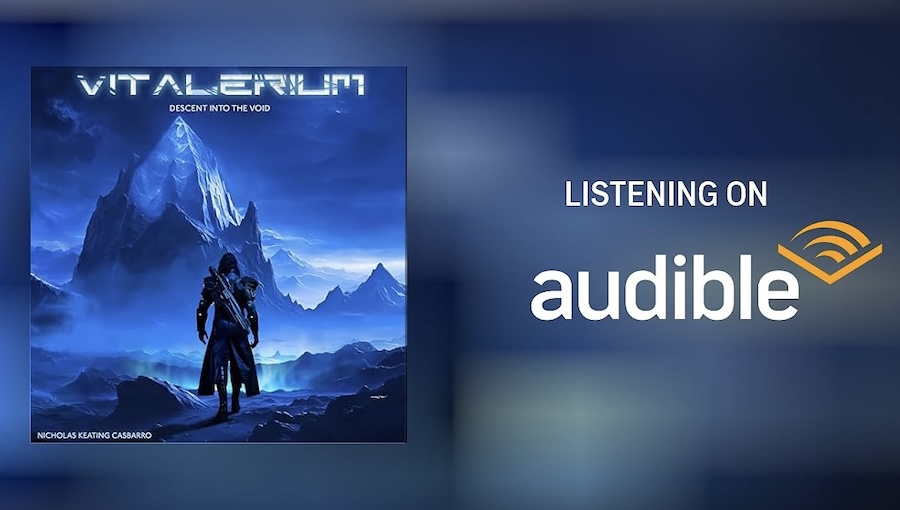
Since publishing the book, I’ve also expanded into audiobooks, and comic books to reach new audiences. The audiobook is a production, read by talented voice actor Michael Neeb. Michael understood the assignment when I said I wanted an “immersive audio experience”. He took Vitalerium, added his movie-trailer voice, and mixed in background music, sound effects, voice modulation where appropriate, and suspenseful tones. Add it all up, and you’ve got an audiobook that will glue your ears to the speaker. The first Vitalerium audiobook is available on Amazon & Audible.
The comic books were also a fun project to dive into. They were my first logical step toward bringing the Vitalerium Universe to life in pictorial form. With a narrative that I wrote and directed, illustrator Francisco A. Hnilo and colorist Chandran Ponnusamy created visual graphic works of art straight from planet Deorum. Their talent is unmatched, and it shows before you even open to the first page of these comics. Currently, there are two episodes in production with a third episode to be released any day now. The cannon I have created for Vitalerium Comics is nothing short of expansive, and I have virtually endless content to continue making new ones.
As far as long-term goals for the series, I admit my goals are ambitious, if not unrealistic. I fully intend to turn Vitalerium into an animated series, a live-action streaming series, and even a videogame down the line. I am already beginning to make in-roads to these markets, albeit incrementally. As I release more books in the series, and Vitalerium’s reach continues to expand, more effort will be put into bringing Vitalerium to life in all media outlets.
BD: Are there any other projects – past or current – that you would like to highlight for our readers?
NKC: Yes, the Vitalerium Universe Comic Series! Working by myself allowed me the focus to create original concepts and narratives the drive the books forward. However, working with a team to take those concepts and bring them to life pictorially? That’s been pure fun. I’ve enjoyed the collaborative process between myself, my illustrator, and my colorist. Simply put, the three of us just mesh well. After a years-long period of stewing on all these ideas post-release, getting to work with a team to hone them into colorful, yet brutal artwork has been an absolute joy. However, this was another learning curve I had to overcome in the beginning.
Creating a comic script and directing its creation is not unlike honing a screenplay (another feat I eventually endeavor to accomplish). You need to account for everything: the clothes the characters are wearing, the expressions on their faces, the details of the environment they are in, even the camera position and angle! That was certainly new, and it took some trial and error to get it right. I also needed to condense the precious dialogue I had spent so long on writing for the book. You can’t be too wordy in comics, otherwise there won’t be any room in the panel for the artwork!
Transitioning from books to comics wasn’t particularly easy; it was actually quite tedious at times. But when the spark of inspiration connects with the right fuel, it can hit hard enough to change your life goals. I’ve had more fun writing and building this universe than doing any other professional work in my life. Creating this series has been incredibly fulfilling, and I don’t intend to let that feeling dwindle.
BD: Lastly, what would you like to tell fans who want to learn more about Vitalerium and your other work?
NKC: Strap in, gear up, and prepare to enjoy. My goal in creating this series was to make content that feels fresh, and new—reminiscent of the themes you love but original in its presentation. I also wanted to give readers, comic book fans, and eventually all fans of sci-fi some content they could sink their teeth into. The world building is expansive and detailed. You could get lost in the lore of just the first book alone, and we’re only just past the starting line. The characters you meet will bring you on an adventure that will have you on the edge of your seat. And finally, I can assure you now, there is so much more to come…
