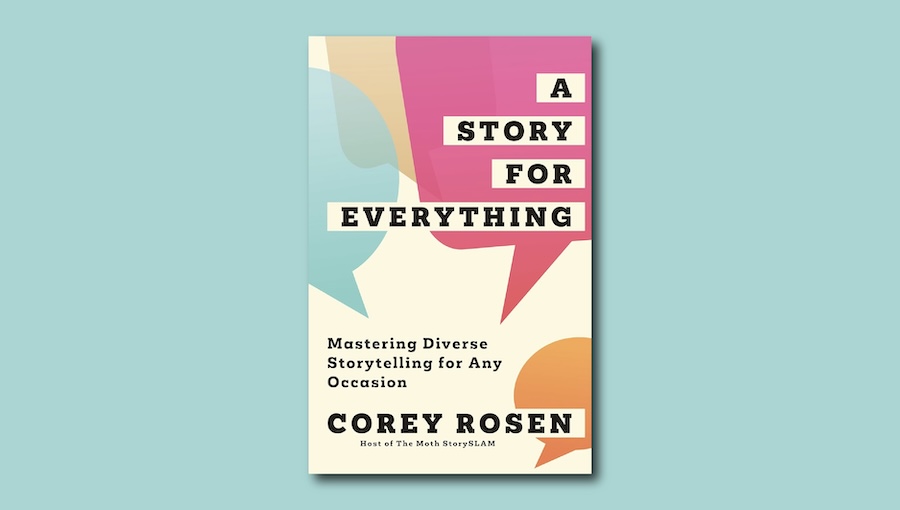
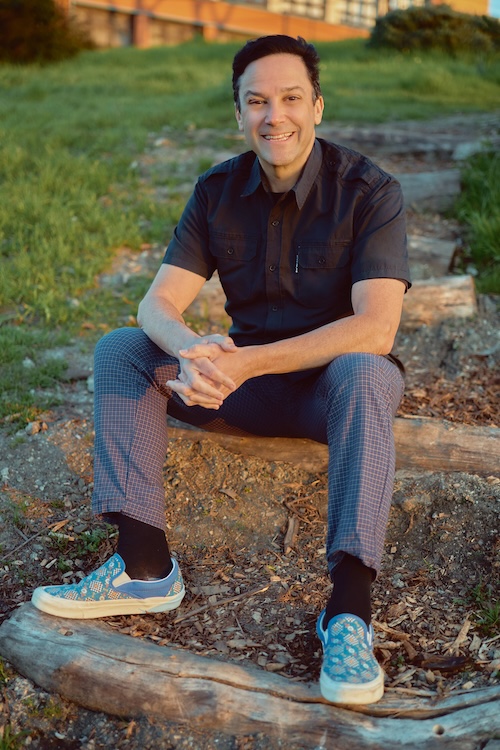
The following is an interview with writer, actor, visual effects producer, and storytelling teacher Corey Rosen regarding the recent release of the book, A Story for Everything: Mastering Diverse Storytelling for Any Occasion, through TMA Press. In this interview, Fanbase Press Editor-in-Chief Barbra Dillon chats with Rosen about his creative process for bringing the storytelling guide to life on the page, the conversations that he hopes that book may inspire, and more!
Barbra Dillon, Fanbase Press Editor-in-Chief: Congratulations on the recent release of your book, A Story for Everything: Mastering Diverse Storytelling for Any Occasion, through TMA Press! As a companion to your book, Your Story, Well Told, what can you share with us about the premise of this how-to guide?
Corey Rosen: Thank you so much! I have written using other people’s voices for much of my life and career. In writing fiction and screenplays, I enjoyed embodying other characters and perspectives (or masking my own in the voices of others). When I started attending and hosting storytelling shows like The Moth, I found such joy and freedom in developing and sharing my own voice with others. Framing my experiences as stories and connecting with others in the process helped us both find common ground and learn how different life paths can converge with shared humanity.
Performing led to teaching and coaching others to do the same. It allowed me to utilize their voices to frame their experiences in ways that could translate their lived experiences in ways that were humorous, moving, touching, terrifying, or uplifting. I created communities of storytellers and marveled as they took their skills on stages, applying structures and processes that blended creative writing with improvisation. It allowed us to capture that presence and then translate the immediacy of telling a story in front of others. It encouraged others to marry thoughtful and careful preparation with the comfort to read the room where they stood. In this way, every telling of a story, even a repeat telling, would become something special that could only exist in that moment.
This became the basis for my first book, Your Story, Well Told. In it, I use stories from both my own experience and my students to illustrate and encourage ideation, shaping/structuring/editing and performance of creative non-fiction narratives.
“But what if I’m not a storyteller? Why would I want to read your book?”
A question I’ve heard again and again at various events around the country. I thought that was funny. I’m not a rower, but I read The Boys in the Boat.
It made me reconsider what a “storyteller” is in the first place. The man sitting next to me on the plane as I am writing right now introduced himself to me as “I’m a storyteller,” before telling me about his career as a professional umpire and (later a) technology executive.
We are all telling stories, all the time. It’s how we connect and communicate. I wrote this book to address that observation, with examples and tools for people in any line of work – how we use stories at work, at school, and in our daily lives. Making toasts and wedding vows. Writing college application essays. Giving performance reviews to our co-workers. The book has examples and tools that anyone can use to bring out the natural storyteller in them. So, whether you’re standing on a stage or sitting in a job interview, there is something for you in A Story For Everything.
BD: How would you describe your creative process for bringing this guide to life on the page, and was there anything unique or surprising that you took away from documenting your own narrative storytelling process?
CR: I do have a tendency to second guess my writing and occasionally experience a kind of writer’s block. In the process of writing this book, I had to walk the walk and use my own advice for getting unstuck. One of those methods is to develop my ideas verbally before writing them down. What I’ve noticed is that when I try to craft words on the page, they sit there as soon as I’ve written them and stare back at me, as if challenging me to re-write, edit, or delete that pile of dreck I’ve just written down. The critic lives right there on my shoulder, analyzing and assessing, when I really just want to punch out the idea that is in there, separate the creating from the calibrating, the generating from the assessing.
So, I write out loud. Not necessarily speaking, then transcribing my speech, but verbalizing the ideas – sometimes to myself, sometimes to others.
What I find is that, when I am telling a story to someone else (or even out loud to my voice memos app), I am less self-critical. The story emerges as it emerges. In doing so, the ideas are formed and take shape in a natural way. Not calling them good or bad is helpful for me. Allowing them to be in some state helps the story to manifest and clarify.
This all feels like a long-winded way of saying that my creative process is to verbalize ideas before committing them to paper.
BD: Do you feel that there is an ideal audience for this guide, and is it accessible to both new and seasoned storytellers?
CR: I believe that there is something in this book for everyone; both beginners and experts. It’s full of stories from my life, and the lives of others I have crossed paths with. In comparison to my first book, I’m a bit more vulnerable, using my own foibles (and triumphs!) as fodder for teachable moments that can be translated into usable skills and lessons in various situations.
One I’m particularly proud of involves a recording I discovered at my parents’ house. It was a reel-to-reel recording my father (a pediatric dentist) made during a consultation with a patient’s mother after a particularly challenging dental procedure. The discussion is carried out using stories, telling anecdotes and lessons learned from other patients and situations he has experienced, which do not so much tell the mother what to do as illustrate, through example, what he has learned. In doing so, the mother herself comes to conclusions (which she verbalizes), showing the power these stories have to influence and transform another’s thinking.
When we lecture or use data, those facts and figures are easily forgettable. When we use stories to teach or explain, we create memories people relate to and are influenced by.
BD: What makes TMA Press the perfect publishing partner for this book?
CR: I was so happy with the support and encouragement I got from TMA Press throughout the process of writing and editing this book! I got great notes and feedback about how and where and why to change or expand on certain areas. I feel my team there really got behind the book and I am enormously grateful for the time they put into helping craft it into the book that it became.
BD: Are there any projects – past or current – that you would like to highlight for our readers?
CR: After hosting shows for The Moth for more than 14 years, I’ve been working with a number of community and business organizations, including schools and synagogues, to help them create their own community storytelling showcases! Bringing the members of their own community up to share personal stories creates lasting memories for everyone, and stimulates conversations and brings out the stories in all of us. To find out about some of those shows, and for tools to create your own, check out www.YourStoryWellTold.com.
BD: Lastly, what is the best way for our readers to find more information about A Story for Everything: Mastering Diverse Storytelling for Any Occasion and your other work?
CR: YourStoryWellTold.com is my website and the hub for all of my work. In it, I provide free resources for getting your own stories unstuck, shaping them and telling them, whether on stages, boardrooms, or in filmed/projected and even experiential media contexts. Subscribe to my monthly newsletter to get valuable and useful tools in your mailbox.
