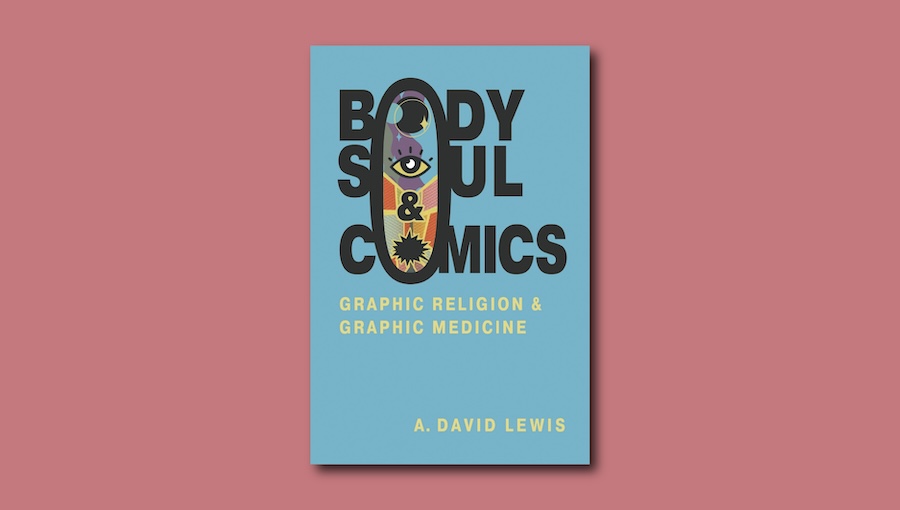
The following is an interview with professor and author A. David Lewis regarding the recent release of the Graphic Medicine-focused book, Body, Soul & Comics, with University Press of Mississippi. In this interview, Fanbase Press Editor-in-Chief Barbra Dillon chats with Lewis about his creative process for bringing the project to life, the conversations that he hopes that book may inspire, and more!
Barbra Dillon, Fanbase Press Editor-in-Chief: Congratulations on the release of Body, Soul & Comics! What can you tell us about the genesis behind this endeavor, and how would you describe its overall premise?
A. David Lewis: Thank you! I kind of can’t believe it is seeing print. I mean, the project started off with the working name Comics Is (which is now the title for a much more fitting book by my friend, editor Martin Lund), and it was originally going to be an attempt to echo Bart Beaty and Benjamin Woo’s The Greatest Comic Book of All Time but more for comics scholarship. That, at least, was my thought back in 2016 – before a lot of things changed.
Of course, the presidential election that year did not go as expected. Things in Syria got worse, the Pulse nightclub shooting was horrifying, Brexit, Bowie…it was a lot. Soon, my health was waning, my job was changing, and my marriage was ending. I had to focus my energies in new and perhaps unexpected ways. This included launching the Comics for Youth Refugees Incorporated Collective nonprofit and producing the first full volume of Kismet, Man of Fate.
However, by late 2019, I felt finally restabilized and ready to tackle a different approach. I was getting more and more immersed in Graphic Medicine, my work had returned to Boston, and I thought I saw the path forward. (I didn’t know about COVID, January 6th, or many of the changes coming in my family.) Therefore, I proposed Body, Soul, and Comics for a late 2020 submission and a 2021 publication. Obviously, that didn’t happen.
And perhaps that was for the best. Not only did I get to take a deeper dive into Graphic Medicine and its global community, but I also had the chance to think more about what this book was intended to accomplish. I had the opportunity to strengthen its raison d’être, the fancy French term that I teach my students, meaning “uh, so what?” I had thought that I was providing an explanation for why I switched from the study of religion and comics to the study of medicine and comics. What I came to realize, ultimately, is that I hadn’t switched: Religion and medicine can occupy a shared space, and comics is (heh) what can help reveal that.
BD: For those who may be unfamiliar with the term/genre, how would you describe Graphic Medicine and its application in this book?
ADL: The standard, shorthand definition for Graphic Medicine tends to be “the intersection of comics and healthcare.” This suggests any number of trajectories, really. Comics about a health condition or patient experience, comics used therapeutically, comics’ effects on wellness, comics as instructional tools, etc. Naturally, I believed in the versatility and power of comics already, as well as what they can do for any variety of subjects, from history to philosophy to you-name-it.
But in addition to definitively helping people and acknowledging their pain, Graphic Medicine accomplishes what I felt comics were always designed to do: to give a voice to the voiceless. The DNA of comics is subversive and fringe. As much as I love seeing a fully stocked “graphic novel” section at Barnes and Noble or comics classes in a college catalogue (which I get to teach!), the medium was built for outsiders, oddballs, visionaries, and fighters.
The Graphic Medicine Manifesto said that right in its Introduction: an individual in a wheelchair holds a sign saying Nihil nobis sine nobis: “nothing about us without us.” The superhero genre was largely an able-bodied, white, straight cishet boys’ club, and sci-fi, horror, and fantasy, to name three, weren’t much better. With Graphic Medicine, I found people with stories that needed to be told, and I feel so much more energized in supporting that.
BD: As a comics scholar, educator, and creator, how would you describe your creative process in bringing this personal narrative to life on the page?
ADL: A long time ago, I said I would never do such a thing, honestly. I even wrote about it at one point, I think, about how I did not see the point of most autobiography, more often interpreting it as self-centered and egotistical than earned. My life had no part in the original Comics Is notion of this project.
However, I made some peace with that perspective in recent years, especially as I have come to see autobiography as more welcoming, empathic, and vulnerable to readers than worldbuilding might be. I already saw aspects of my politics and identity leaking into works like my early Mortal Coils scripts or, with artist Marv Mann, my Lone and Level Sands skew of Exodus and my awkward environmentalism in Some New Kind of Slaughter. By the time I was writing Kismet, Man of Fate, I was also penning pointed articles about Islamophobia and, amusingly, Joe Biden.
I suppose that when it comes to either an instructional, creative, or research project, I look first for what personally intrigues me – an idea or a notion that I cannot shake – then let my pursuit of it reach a critical mass. And Body, Soul, and Comics is a result of that process; after writing about religion, then medicine, and then religion & medicine, I couldn’t erase myself from that course. I neither felt I could nor should deliver a sterile, third-person monograph on what was, in many ways, a personal passion. My hope, honestly, is that people are more attracted to acquiring the book and more engaged in reading it with my voice kept intact than had I silenced it.
BD: At Fanbase Press, our #StoriesMatter initiative endeavors to highlight the impact that stories can have on audiences of various mediums. How do you feel that this book may connect with and impact readers, and what, if any, conversations do you hope that it may inspire?
ADL: To follow on the previous question, I fully recognize that I am extremely privileged. My early antipathy towards autobiography likely came from a place of embarrassment. I know that too many of my own demographic have taken up undue space – and even suppressed the representation of others. So, that hope I just mentioned is actually compounded by the wish that Body, Soul, and Comics encourages others to share their stories and views, as well.
One goal for this book would be for it to fashion more of a permission structure either for those who started in one field then were drawn to another or for those whose scholarship cannot be neatly (or fairly) disentangled from their real-life experiences. I mean, it would be wonderful if this created a bridge between disciplines, allowing all sort of researchers and creators to engage with each other. And it would be great if it spurred greater interest in either Graphic Religion or Graphic Medicine. But, really, the best impact it could have is in leading to even better books to be written, hybrid books whose blend of subjects mirror the multimodality of the comics medium itself.
BD: What makes University Press of Mississippi the perfect home for Body, Soul & Comics?
ADL: UPM really stuck by this project, especially after I chose to reinvent the scope of the manuscript following the pandemic. They never asked me to simplify it or to target one narrow audience. For all of its growing pains, I appreciate the space they left me and the trust they showed me in developing this long-gestating endeavor. Their catalogue of comics studies titles was already an invaluable resource, so I trusted that they would signal if the quality of my work was at all poor. Instead, they supplied me both with freedom and a boost of confidence, for which I am grateful.
BD: Are there any other projects – past or current – that you would like to highlight for our readers?
ADL: I don’t know that I would have found my voice or even my energy for Body, Soul, and Comics if it hadn’t been for my experiences working on Kismet, Man of Fate with Noel Tuazon (whose sketches grace the new book), Rob Croonenborghs, and Taylor Esposito and on the graphic adaptation of Kahlil Gibran’s The Prophet with Justin Rentería. Whether it was the pandemic or my divorce or the state of the world or reestablishing my own sense of identity, those books helped to keep me going. In fact, I’m hoping we can deliver more of Kismet in the next few years, as I see just as much need for the character now as I did in 2016.
I will say, though, that the Graphic Medicine Review would be a wonderful legacy to leave behind someday. As the first peer-reviewed journal on the subject of Graphic Medicine, I would be delighted if we built something there that endured, eventually passing to even more capable hands. The same goes for the New England Graphic Medicine (NEGM) Summit. My modus operandi, it appears, is to initiate things and then to look and see who could take it even farther if I passed it along.
BD: Lastly, what is the best way for our readers to find out more about Body, Soul & Comics and your other work?
ADL: Of course, I have a Substack, and most of my books are on Amazon, while even those that are out of print pop up on eBay. But, as much as I enjoy watching the sales rankings ebb and flow or user stats spike, I would encourage people either to buy from the University Press of Mississippi directly or, better yet, to get a copy of Body, Soul & Comics through Bookshop.org (bit.ly/BSC-GMIC), where a portion of the proceeds can go to the Graphic Medicine community itself.
