
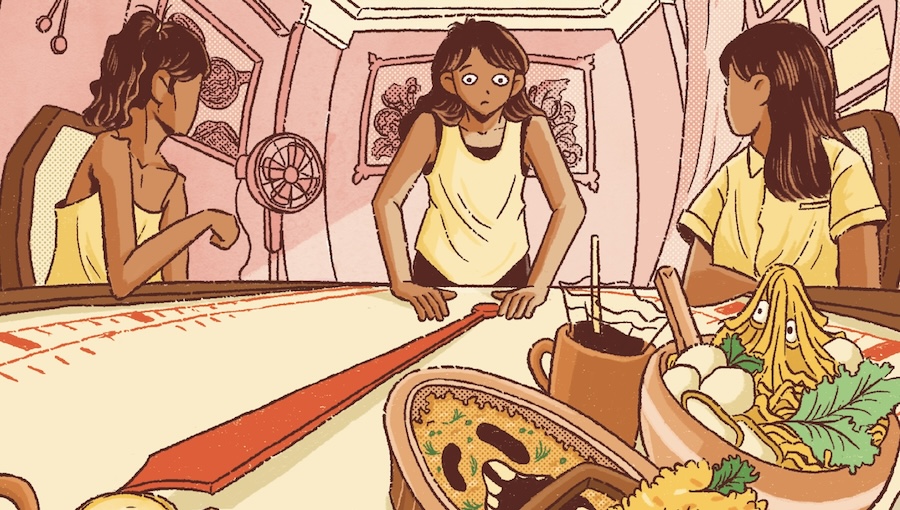
The following is an interview with Shreya Davies and Vanessa Wong regarding the recent release of their graphic novel, To the Last Gram, with publisher Difference Engine. In this interview, Fanbase Press Editor-in-Chief Barbra Dillon chats with Davies and Wong about their shared creative process in bringing the Graphic Medicine story and characters to life on the page, the themes that they hope may resonate with readers, and more!
Barbra Dillon, Fanbase Press Editor-in-Chief: Congratulations on the release of To the Last Gram! What can you tell us about the premise of this impactful story?
Shreya Davies: Thank you, and for your kind words! To the Last Gram is a story about a young woman’s experience growing up with an eating disorder, and her journey on this elusive path of a perfect recovery and finding home – whether in family, community, or body.
Vanessa Wong: Thank you very much! We’re incredibly grateful for the support To the Last Gram has been receiving, and we’re glad that the story has resonated with people from different walks of life. We wanted the story to adopt a surrealist art style, as it allowed us to experiment more freely with imagery and panels, and it gave us room to incorporate recurring visual motifs. Ultimately, we felt that this was the most fitting way to represent Divya’s experiences, capturing her feelings in a way that feels more immersive.
BD: How would you describe your shared creative process in bringing this story and its characters to life on the page?
SD: I first wrote To the Last Gram as a short story, but I had always envisioned it as a comic. I’d been a big fan of Vanessa’s surrealist style and work, so it was magical when the stars aligned and she was interested to come onboard, too. It was doubly magical that we had overlapping interests and visions – that made for a lot of fun (like playing with the names and merch designs of bands Divya grew up listening to!), but also meant that we saw eye-to-eye throughout the creative process.
Comics creation is a huge team effort, and Vanessa and I worked very closely with our editor Adan Jimenez, as well as the Difference Engine team, all the way from script to print. Adan was a godsend throughout the production of the book, and for me especially during the scripting process. Here, Vanessa was coming up with character designs and moodboards for us to go back and forth on. She was also incredible with filling the gaps on the pages in the script I couldn’t visualise.
Difference Engine also arranged for the work to be sensitivity read, and some of the feedback and suggestions from the team really helped us identify and navigate any blind spots. All of these factors helped us in creating very real, layered characters in a world living lives that are familiar, beautiful, and sometimes cruel all at once.
VW: Overall, it was one of those rare instances where it was a straightforward collaboration with just a few hiccups along the way. Alongside the usual feedback process, we’d go through after each illustration round, Shreya and I worked closely together to develop the visuals when any one of us were uncertain. If she was unsure of how to visually represent certain text, I would suggest some possible ideas, and we would refine them together. This was especially so when it came to sensitive or graphic scenes. For instance, when depicting the female genitalia metaphorically, I explored references and proposed ideas that we then further developed together.
BD: Vanessa, when tackling each new project, is there anything that guides or propels your approach to the artwork?
VW: It’s a mix of excitement in trying new ideas, exploring the project’s themes, and working within constraints. The requirements of a project (usually its objectives, target audience, tone, and timelines) often shape my approach and determine if there is room for experimentation. However, despite these limitations, I always try to find ways to enjoy the process and add my own twists!
In To the Last Gram, the target audience and timelines were pre-determined, so I worked with a style that I was already familiar with. That said, I was still able to practise character designs and explore more visual storytelling through surrealist elements like unconventional panel layouts and subverting everyday objects and emotions. On a personal level, having moments in the story and a character that I resonated with made the process more intuitive and meaningful, and helped me approach the project with greater ease.
BD: Graphic Medicine is an emerging genre that combines the field of medicine with the medium of comics. How do you feel that Graphic Medicine stories like this one can allow readers to understand the lived experience of someone – or process their own experience with – an eating disorder?
SW: Eating disorders are often misunderstood, and I wanted to show how it can be intertwined with race, gender, and can affect even those from a diet-free household. I felt that it was important to also show it through the lens of a minority living in Southeast Asia and the layers of stigma growing up as someone who is made conscious of how they take up space in the world – whether it is because of the colour of your skin or the size of your body.
Vanessa and I hope to share through To the Last Gram a perspective that is grounded in truth and accessible at the same time, through a story that isn’t about recovery from an eating disorder but about living with one, and to show that joyful moments can also exist alongside difficult ones – either for a reader processing their own experience with, or for someone who might be trying to understand what their child, sibling, or friend is going through.
VW: I feel that Graphic Medicine makes complex issues like eating disorders more accessible as it presents them in a less clinical way. From my own experience, I had little knowledge of eating disorders before To the Last Gram, but I learned a great deal about diagnosis and the recovery process through it. By combining visual storytelling, narratives, and medicine, it also creates more space for understanding and empathy. Experiencing a character’s thoughts and emotions visually, rather than through words alone, allows for deeper emotional connection and a clearer idea of their lived experiences and perspectives.
BD: What makes Difference Engine the perfect home for To the Last Gram?
SD: I think that Difference Engine is doing important work, especially with their DE Shorts imprint (which To the Last Gram is part of) by making difficult topics more digestible and accessible, especially for younger audiences. The support and guidance received from the whole team was also unparalleled, and I felt seen and heard every step of the way.
VW: I’m grateful my first experience with a publisher was with Difference Engine, and for the effort they’ve put in for To the Last Gram. Working with Shreya, our editor Adan, and our designer May Thu, was a collaborative and rewarding experience! I especially appreciated the creative freedom, as well as their thoughtful feedback and fresh ideas. Overall, it was an enjoyable process that made all the late nights worthwhile.
BD: Are there any other projects – past or current – that you would like to highlight for our readers?
SD: Nothing formal at the moment, however the discussions and talks that are stemming from To the Last Gram and how people are responding to the book have been shaping some new ideas!
VW: I don’t have anything to highlight at the moment, but there are some exciting collaborations in the works that I’m not able to share details about just yet! For now, I’ve just been focusing on personal projects and continuing to experiment with different styles and mediums.
BD: Lastly, what is the best way for our readers to find out more about To the Last Gram and your other work?
SD: Thank you once again for having us! I post and share about To the Last Gram (and sometimes other musings) on Instagram at @shreydavies.
VW: You can find me on Instagram at @tradervans, where I mostly document and announce any upcoming projects! Thank you, too!
