
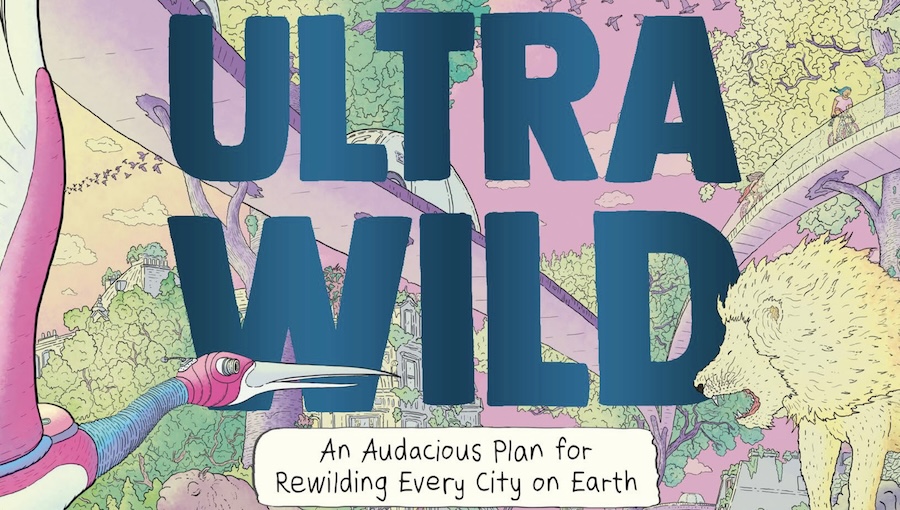
The following is an interview with industrial designer, artist, and inventor Steve Mushin regarding the upcoming release of his graphic novel, Ultrawild: An Audacious Plan for Rewilding Every City on Earth, Lerner Publishing’s Graphic Universe. In this interview, Fanbase Press Editor-in-Chief Barbra Dillon chats with Mushin about his creative process in crafting the unique designs found within the book, what he hopes that readers may take away from Ultrawild in terms of their ability to positively impact the world around them, and more!
Barbra Dillon, Fanbase Press Editor-in-Chief: Congratulations on the upcoming release of Ultrawild! What can you share with us about the genesis behind this incredibly exciting book?
Steve Mushin: Thank you! Ultrawild is a science comedy of absurd sounding, but theoretically possible, inventions for rewilding cities. It contains over 100 inventions, all based on real science and engineering.
I’m an industrial designer, and I began Ultrawild while working on ecological-engineering projects in Australia. In Ultrawild, the biogas-powered compost cannons, concentrating solar dishes, rooftop gardens have all spun-out of real projects I’ve been lucky enough to work on.
BD: Your work has often been in collaboration with scientists and engineers to solve real-world problems with “design thought experiments.” When tackling inventions like those found in this book, is there anything that guides or propels your approach to crafting the designs?
SM: Brainstorming wild ideas with scientists and engineers is what I love – and every collaboration has been different. Take The Flying Bike Project in Ultrawild – this is a collaboration with my mechanical engineer friends Neil Faragher and Michael Santin. They helped me with the physics of designing mountain bikes for gliding between rewilded skyscrapers. Here’s where we got to:
Flying bikes powered by your legs are completely possible. Soon, we’ll all be riding them. But we’ll need ultrathermals – skyscraper cones that collect waste heat from buildings for launching bikes. Nine city blocks of New York City would give us enough heat to launch flying bikes 2.5 miles high, and from there we could glide for 25 miles – or even further with a tailwind.
BD: Ultrawild deftly weaves your phenomenally crafted inventions with a palpable encouragement for young readers to embrace their imagination and learn how they can make an impact on our world. How do you feel that your work may encourage readers to look at climate change with fresh eyes and create their own plausible inventions to effect change?
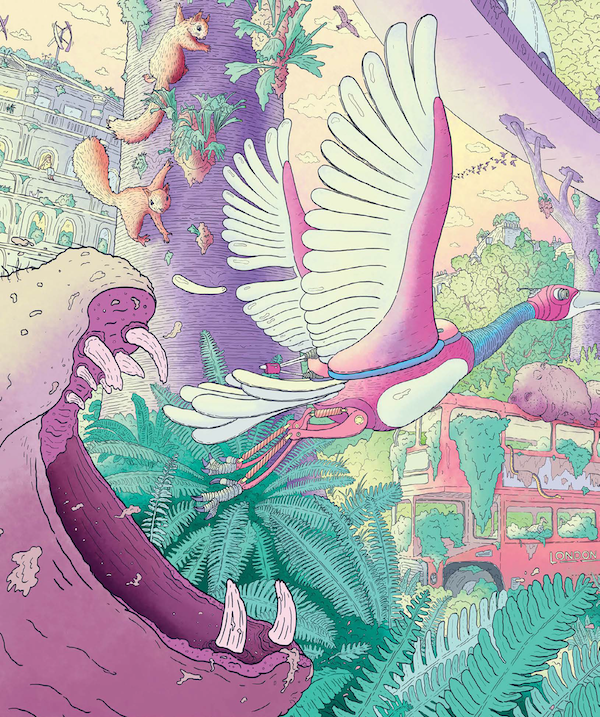
SM: I’ve taught STEM at schools and universities for many years, and I wanted Ultrawild to showcase the coolest real technologies that could actually be used to rewild cities. Take the 3D Printer Bird Project in Ultrawild – a project about 3D printing animals habitats with bio plastics:
The world’s 2.5 billion lampposts, utility poles, traffic lights, street signs are ‘nearly trees’ – they’re perfect for 3D printing into armored luxury habitats for native animals. We’ll need to 3D print these as fast as possible to house the billions of animals and insects we need to welcome back to help with ultrawilding – for pollination, seed dispersal, and soil fertilizing. And to do that we’ll need a trillion or so 3D printer birds.
3D printer birds are flying tree-printing robots. They 3D scan trees – with all their hollows and other animal habitat features included. Then they 3D print lampposts and other ‘nearly trees’ into fake trees that are perfect animal homes. 3D printer birds print using recycled plastic which they melt by concentrating heat from the sun using mirrors on their wings. They can also 3D print copies of themselves, or self-replicate. It would take roughly ten months for 3D printer birds to multiply to one trillion if we started with just one self-replicating 3D printer bird today. And it would take 1,000 3D printer birds roughly one month to 3D print an LA lamppost into a maple tree.
BD: Are there any other projects – past or current – that you would like to highlight for our readers?
SM: The Chicken Castles Project in Ultrawild seems to resonate with a lot of kids. It’s about collaborating with all species to re-build our biosphere. Here’s my thinking:
According to experts, chickens have dreams, do basic math, and can solve simple problems by anticipating future events. They’re also the perfect soil-making engineers to help us transform the world’s roughly 2 billion roofs into vertical gardens. Even better, according to the latest science, chicken poo is perfect for growing algae, which can be used to make algae-based bioplastics for 3D printing almost anything – like rooftop gardens with Chicken Castles.
The idea is obvious: Humans should collaborate with the world’s 33 billion chickens to transform buildings into vertical jungles. All we need to do is give chickens their freedom, sovereignty over the world’s roofs, and all of our food scraps (launched up to them using compostapults), and then they could technically transform the world’s 2 billion roofs into jungles in just a few years (with the help of chicken poo collecting robot beetles, algae-plastic making bioreactors, and building-modifying 3D printer chickens).
BD: Lastly, what would you like to tell fans who want to learn more about Ultrawild?
SM: If you want to build yourself a compost cannon, then you should definitely download my biogas calculations at www.ultrawild.org. Teachers can also download my free Ultrawild STEM lesson plans. And if you’d like to hear about my latest projects, and my Ultrawild Design Workshops, just follow me @stevemushin on Instagram.
