
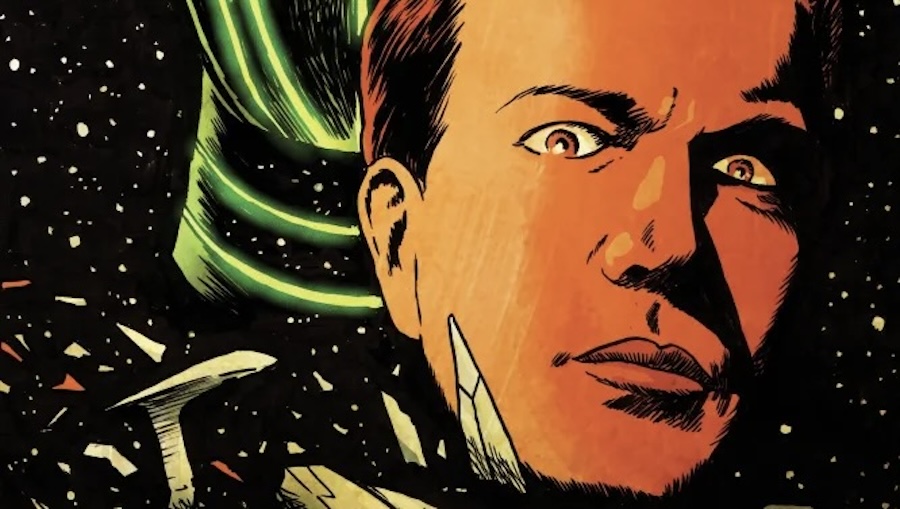
Last month saw the release of the second issue in IDW’s new flagship Star Trek series, Star Trek: The Last Starship. This new series, written by the same duo who penned the former flagship series, simply titled Star Trek, Jackon Lanzing and Collin Kelly, take Trekkies into an era that has never before been explored.
In the television series Star Trek: Discovery, the crew of the Discovery propelled themselves a thousand years into their future to defeat the evil AI Control, only to discover a galaxy in shambles. The Federation was greatly diminished, even losing founding worlds Earth and Vulcan, now Nivar. Dilithium, the key element that makes warp travel possible, was now scarce, making galactic travel difficult or impossible for most planets. All of this turmoil arose out of the cataclysmic event called “the Burn.” All at once, dilithium throughout the galaxy became unstable, causing the death of trillions. The Last Starship takes place mere weeks after the Burn and tells the story of the U.S.S. Omega, under the command of Captain Sato, whose mission is to keep the spirit of hope and the Federation alive.
As soon as I heard the setting Lanzing and Kelly would be placing their new series in, I was intrigued. And so far, that early excitement has been justified. As a fan of Discovery, I had always thought that the writers had moved on from the status quo established by the Burn too quickly. A Federation, desperate and on the verge of collapse, was an all-new canvas to take Star Trek in new directions. Even though Discovery moved on to a more identifiable status quo, I’m glad IDW is digging right back into the greatest crisis to ever hit the Federation. As if that wasn’t enough to sell the book, Lanzing and Kelly decided to resurrect one of Starfleet’s greatest heroes, James T. Kirk. I don’t want to spoil too much of Star Trek: Picard’s final two seasons, but the seeds for Kirk’s return are planted in that series, and I highly recommend you watch it. That’s not to say that this series requires that much homework on the part of the reader. Lanzing and Kelly do a great job of welcoming readers into their narrative without the need to go into a ton of exposition that would have only dragged the story down. By starting with the advent of the Burn, new readers are introduced to this new status quo right along with the characters. As a fan who has watched Discovery and Picard, I feel as if those series act to foreshadow what the crew of the Omega will face in the issues ahead.
Issue 2 begins with the newly resurrected Kirk thinking on the past and wondering why he has been brought back only to watch the Federation die. Kirk’s existence on the Omega has been kept a secret from the crew on orders of Captain Sato. Captain Sato questions whether he can trust the actions of the Borg, the Federation’s greatest foe. Why did the Queen/Jurati resurrect Kirk in the first place? And how can he trust that this man before him is really Kirk? Sato and Kirk’s debate over Kirk’s career makes me think Lanzing and Kelly would come down on the side of Picard in the eternal debate of who was the greater Captain. Though we may admire his confidence and daring, Kirk’s actions have had consequences, and Captain Sato reminds him of that. I liked that Lanzing and Kelly provide the counter argument to Kirk’s career and see his career in a different light. Hero or reckless adventurer?
As the issue continues, the Omega is called on an important mission that will challenge Captain Sato’s ethics and force him to see Kirk’s career in a new light. It is a lot easier to have clean hands as a Captain when the entire galaxy had become members of the Federation. The Omega is the only ship that can answer the call, as it runs on a Borg Transwarp drive that doesn’t use dilithium, thus allowing them to travel across the galaxy at high warp. My only issue with this conceit is that it’s established in other media, including Star Trek: Voyager, that the Borg Transwarp drive uses dilithium. And a lingering question from Discovery, why doesn’t the Federation just switch to Romulan singularity drives that have never used dilithium? Especially now that the Romulans and Vulcans are unified and Federation members? This issue adds two new cast members to the crew in Doctor Zed, a Ferengi doctor of dubious skill, and Tactical Officer VI T’Galatheon, who may or not be an agent of Section 31. At this point, most of the story has centered on Captain Sato or Captain Kirk which is to be expected this early on, but I hope we get to know these new crew members better in the issues ahead.
Adrian Bonilla provides the art on this series and I love his work here. His pencils capture this darker, grittier Star Trek perfectly. You can feel the desperation and anxiety of the characters in every panel. Captain Sato looks haggard, and the Omega, a relic of the past, truly looks like the patchwork ship it is. And his Kirk is unmistakably Kirk. Heather Moore’s colors only add to the atmosphere Bonilla is creating. I really enjoyed how she portrayed the transwarp drive in action as a swirl of psychedelic colors.
Star Trek: The Last Starship is off to a great start. Just as they started the previous flagship book off with a bang, Lanzing and Kelly do the same here. Though I’m sure the return of Kirk is a major draw for many readers, Lanzing and Kelly have kept this series relatively free of legacy characters. This has made the book feel like a new show with an all-new crew and fills this book with an energy that makes me excited whenever a new chapter is released. A classic story is brewing here, and every Trekkie should be in at the beginning.
Creative Team: Jackson Lanzing (Writer), Collin Kelly (Writer), Adrian Bonilla (Artist), Heather Moore (Colorist), Clayton Cowles (Letterer)
Publisher: IDW Publishing
Click here to purchase.
