
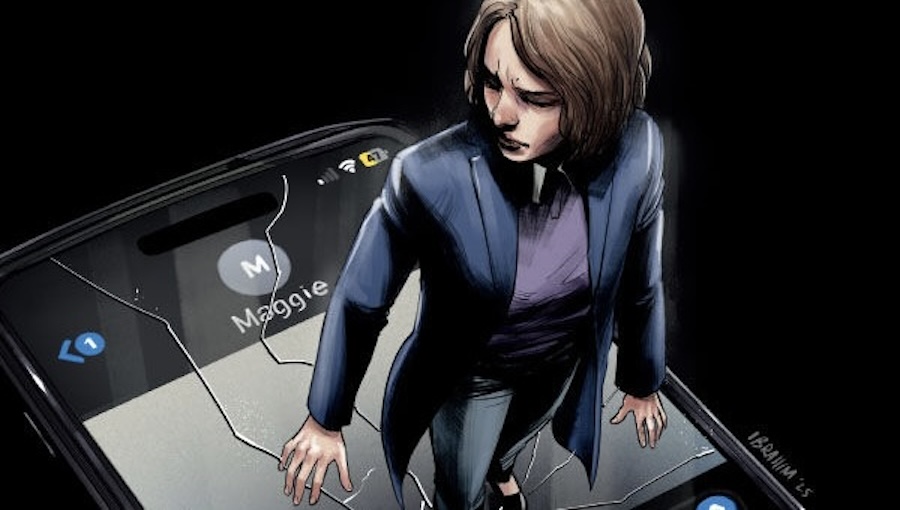
I’m ashamed to admit, I’ve not read a single novel by John le Carré, or even seen any of the movies based on them. I know of them: Tinker, Tailor, Soldier, Spy; The Spy Who Came in from the Cold; The Tailor of Panama; The Constant Gardener. I know he wrote spy novels, and that many, if not most, of them take place in the same universe, focusing on a British spy agency called The Circus, run by a man code-named Control.
That last part I only know from the plot synopsis of this comic. I know nothing about The Circus, Control, or anything else about the world in which these stories are set—much to my chagrin, as the novels and movies have both always seemed right up my alley. Fortunately, prior knowledge is not necessary. Everything you need to know is explained fairly quickly, so you can get on board with the story.
The Circus is an old-school spy agency. It doesn’t run on super advanced technology. Technology can be hacked. You can’t hack a human being. And if you train them well enough, they’re all you need to get the job done. Maggie Salinger is very well trained and the best at what she does.
The Circus is divided into sections, and each section has a different job and a different focus. Maggie is part of the Mothers—essentially the Girl Fridays for the higher-ups in the agency, but much more than that. Maggie is the Mother assigned to Control. Her job is to make sure Control’s job runs smoothly, and Control’s job is to make sure the entire agency runs smoothly. So, Maggie’s responsibility is enormous, and she has the skills to match. But when a field agent’s mission goes south and Control turns up missing the next morning, it becomes Maggie’s responsibility to figure out what happened—without letting anyone else in the agency know what’s going on.
Much as I’ve always loved gadgets and tech when it comes to spy stories, I have to admit, it’s fascinating to see spycraft unfold without it. Much of this first issue is just Maggie going about her day, visiting different areas, talking to different people in the agency—but every move she makes is carefully planned, and most have some underlying purpose. There’s not a lot of action in this issue, but there’s tons of suspense, and it’s easy to get drawn into both the story and the world.
The story reminds me a bit of Velvet, a series I reviewed over a decade ago, and which is probably my favorite spy comic of all time. It also featured a “secretary” at an elite spy agency, far more skilled at espionage than anyone realizes, who’s forced to go off-the-books when things go wrong and she’s not sure whom to trust.
The works of John le Carré predate Velvet by quite a bit, but this is also a brand new story within the universe le Carré created. So, it’s quite possible that writer Matt Kindt took some inspiration from Velvet—but it’s also very likely that Ed Brubaker, who wrote Velvet, took inspiration from John le Carré’s novels.
Whatever the inspirations may be, this is a great comic—and more than that, this is the essence of what a great spy story should be. I can’t wait to see what comes next.
Creative Team: Matt Kindt (script), Ibrahim Moustafa (art, cover art), Brad Simpson (color art), Simon Bowland (letters)
Publisher: Dark Horse
Click here to purchase.
