
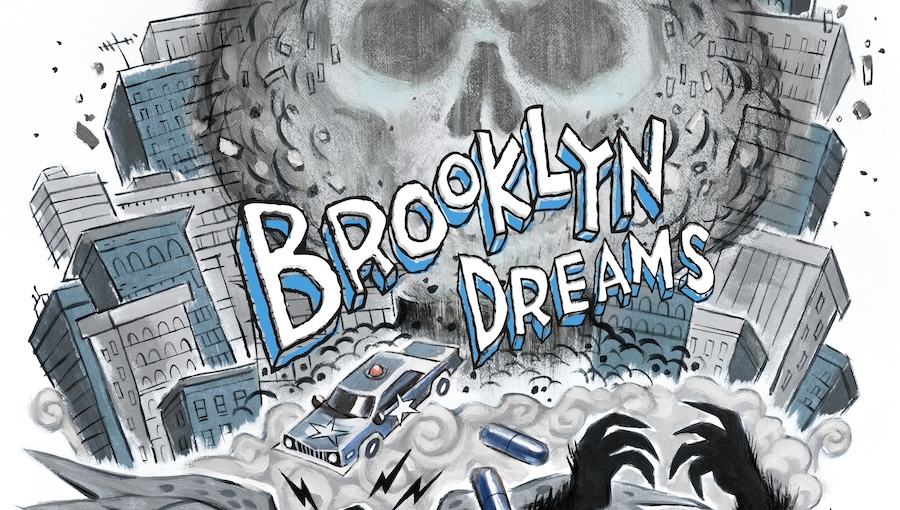
After reading first Moonshadow and now Brooklyn Dreams, both written by comic legend J.M. DeMatteis, I feel like I’ve spent long hours in deep conversation with the man about his life, his hopes, and his general philosophy of life. Both works are evidently extremely personal, and, as a reader, I don’t think I’ve ever read a story in which the author ever let me this far into their heart and mind.
Moonshadow, by J.M. DeMatteis and Jon J. Muth, was released as a collection by Dark Horse Comics earlier this year, and I’m so glad I was able to read that graphic novel before diving into Brooklyn Dreams. Though one is a sprawling satirical space saga and the other a far more down-to-Earth memoir of a childhood in 1970s Brooklyn, I nevertheless could see connections between the two narratives. The mother figure in Moonshadow clearly comes from a family similar to the Santinis of Brooklyn Dreams, and Moonshadow goes through a similar spiritual journey as Carl Santini. DeMatteis and Glenn Barr’s Brooklyn Dreams was released in its entirety from Dark Horse Comics. And it is the most personal and raw graphic novel I have ever read. As a writer myself, I know that I’m nowhere near as brave as DeMatteis is here. Brooklyn Dreams is his coming-of-age story with all the baggage laid bare. As readers, we are left to judge and take what wisdom we can from the misadventures.
Of course, this is a fictionalized version of DeMatteis’ younger years, but as the narrator, Carl Vincent Santini says, we are given “lies more accurate than truth.” The question of what is true is a central theme of the work. Right from the beginning, an older Carl tells us that he doesn’t believe in truth because human memory is faulty and our minds act to fill in gaps without us even being aware of it. Even so, he insists that these stories can still hold important, incontrovertible truths. In many ways, isn’t this true of any novel or story? Fiction writers weave fantastical tales of places and characters that don’t exist. Yet these “lies” oftentimes seek to explore certain truths of the real world or convey a particular moral to the reader. I found myself struck with this dilemma when writing my recent novel about my grandmother’s holocaust experience. My grandmother was nine years old when she was thrust into an unimaginable situation. I often sat riveted as she relayed her harrowing tales of survival. I know now how fragile a child’s memory can be, I have two daughters who can’t remember anything before age six, but my grandmother’s stories remain ingrained with important truths about the destructive nature of hate. Sometimes the truth that a story wishes to convey is more important than individual details. I’m sure many readers can relate to this. Who hasn’t heard family stories passed down from grandparents, aunts, uncles, etc. and not realized that one or more incidents seemed to be embellished. Did that impact the fundamental power of the story?
Beyond truth, DeMatteis also centers a great deal of the narrative on the question of faith. As a child of an interfaith marriage, Carl Santini never felt strongly about either religions’ view. Like many Jews, myself included, Carl felt connected to Judaism on primarily a cultural level. For me personally, DeMatteis nails what it felt like as a Jew growing up in America. As he says, the Jewishness is more important than the Judaism for many Jews. Carl didn’t feel connected to his father’s church either, but did enjoy the Christmas season. I don’t want to give too much of the story away, but Carl has been a bit afraid of churches. This quest for a deeper meaning informs much of Carl’s childhood actions, as we watch his character slowly wind his way to personal enlightenment.
As I mentioned above, this entire story is told by an older Carl to an unseen audience. Is he merely reminiscing about the past to himself? A therapist? Or is this an oral journal and he is speaking to a future reader? I recently had to help my parents clean out their basement before selling the house I grew up in and getting the chance to revisit old journals, school assignments, and notes from old friends. I can almost see Carl going through the same exercise, telling this story to himself as he sifts through the remnants of his childhood in a basement or attic. I really enjoyed this narrative structure, as it allowed us to see the impact of past events on the Carl of the present. Which past wounds still felt fresh? I also liked that we couldn’t trust that Carl was ever telling the reader the whole story. In fact, many times he would refuse to delve deeper or abruptly change subjects. In this way, DeMatteis made the narrative feel like a real conversation. Personally, I feel like I’ve sat down with DeMatteis for a cup of coffee. Like a normal interaction, Carl would branch off on tangents, continually getting sidetracked. This made Carl endearing, relatable, and above all human.
A lot of what older Carl has to say is shown not through dialogue but through Glenn Barr’s excellent artwork. So much of this novel’s emotion is told through the expressions Barr captures in his work. One panel of an older Carl sitting, his face cast in shadow, can tell the reader as much about the character as an entire page of dialogue. I also appreciated Barr’s choice to depict each time frame of Carl’s life in a different artistic style. Future Carl is drawn far more realistically than Carl as a boy with its more cartoon look. His teenage years occupy a spot in the middle of those two extremes. Letterer Bob Lappan deserves praise for a particular story beat in which a character who is described as nasally has his word balloons emanating from his nostrils. Lappan added a lot of extra humor to the scene.
Dark Horse rarely publishes a collection like this without some great extras, and Brooklyn Dreams doesn’t disappoint. We get to read early pitch pages and an outline by DeMatteis, as well as some sketchbook work from Barr. As a writer and a fan, I always enjoy these little peeks behind the curtain. DeMatteis is a writer who has literally written my childhood growing up as a comic fan in the 1980s and 1990s. After reading Brooklyn Dreams. I feel like I have such a deep insight into the man who wrote some of my favorite stories. Like Moonshadow before it, I feel like I’ve gained a greater understanding of DeMatteis’ work, and I can’t recommend these two works any higher to longtime fans.
Brooklyn Dreams is a poignant story about adolescence and truth that will stay with me long after its final page. A masterpiece by one of comic’s most talented writers.
Creative Team: J.M. DeMatteis (Writer), Glenn Barr (Artist), Bob Lappan (Letterer)
Publisher: Dark Horse Comics
Click here to purchase.
