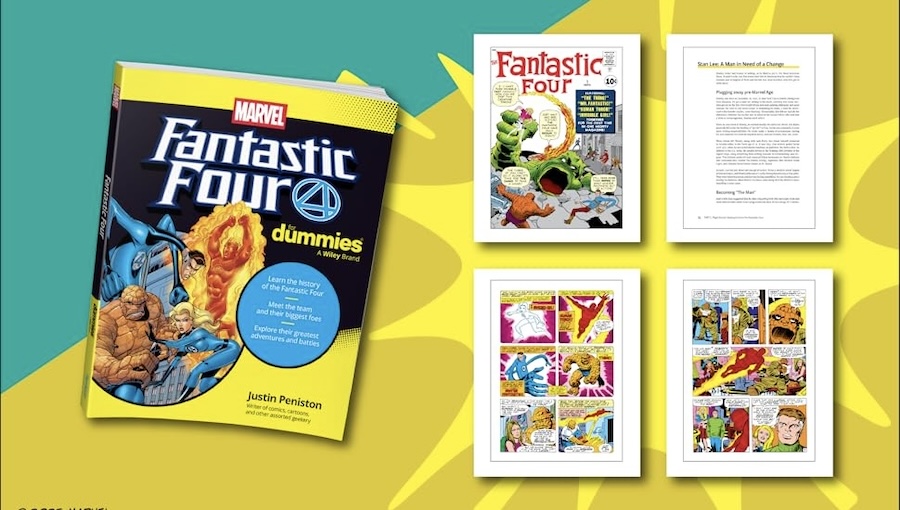
Just in time for their MCU debut, the “for Dummies” book series releases Fantastic Four for Dummies. This exhaustive guide to Marvel’s First Family is written by Justin Peniston, writer and self-professed super fan of the Richards family. Anyone who includes a special entry for Willie Lumpkin and waxes poetically for their love of Wyatt Wingfoot is a bona fide super-fan.
Billed as a book for those new to the Fantastic Four, there is still plenty here for life-long fans to enjoy, as well. I’ve followed the Fantastic Four ever since John Byrne ended his esteemed run in the 1980s. Fantastic Four #296, written by Stan Lee and Jim Shooter with art from Barry Windsor-Smith, was the book that truly drew me in as a fan of the team and began my journey into comics. I still remember asking my dad to buy it for me off of a rack at an airport bookstore, and it has been a treasured keepsake of my collection ever since. The Fantastic Four were my gateway to the Marvel universe, and they’ve held a special place in my heart ever since.
As a fan, I found Peniston’s guide to be a fun nostalgia trip that also contained several interesting entries that centered on the creative process of comic writing and Stan Lee and Jack Kirby’s history in comics. As a writer himself, Peniston is able to convey what really makes the Fantastic Four special and how they’ve continued to entertain readers for over sixty years. He devotes an entire section of the guide to point out the ingredients for a winning Fantastic Four story. Peniston delves into the personalities of each hero and their familial connections to one another. Lee and Kirby wanted the characters of the Marvel Universe to be flawed heroes. And this guide explores how those personality flaws have enabled the Fantastic Four series’ success as they spark personal drama and conflict that humanize the heroes and make them relatable to readers. The guide also doesn’t shy away from aspects of the comics that haven’t aged quite as well, such as the depiction of Sue Storm in issues from the sixties and seventies as a meek character with very little agency. Thankfully, starting with John Byrne, Sue Storm drops the moniker of Invisible Girl for Invisible Woman and becomes not just the most powerful member of the team but its center, as well.
Peniston also presents an encyclopedia of allies, villains, and cosmic entities that the team has encountered over the course of their run. Of course, I’m sure longtime fans might not find all the favorites catalogued here, but it does offer enough broad strokes that would allow anyone to pick up the latest issue and feel caught up on the narrative. What will surely entertain old fans and generate a lot of debate are the latter sections of the book in which Peniston lists the seminal creator runs and best stories of Fantastic Four. From my perspective, Peniston gets it mostly right and sends newcomers to the back issue bins with some great advice. He also includes a list of top Dr. Doom stories, and I agree wholeheartedly that no Fantastic Four discussion can end without also addressing Dr. Doom. Dr. Doom is the quintessential villain of the Marvel Universe. Introduced in Fantastic Four #5 by Lee and Kirby, Victor Von Doom has grown into every Marvel fan’s favorite ego-maniacal villain. I can’t help but want to make two additions to Peniston’s list and that would be the first Secret Wars by Jim Shooter, Mike Zeck, and Bob Layton and the recent Secret Wars by Jonathan Hickman and Esad Ribic. Older comic fans will always remember the iconic clash between Dr. Doom and the Beyonder in the first Secret Wars that really conveyed the tenacity of the character. In Hickman and Ribic’s Secret Wars, readers are treated to what felt like the climactic conclusion of almost sixty years of rivalry between Dr. Doom and Reed Richards when Doom is forced to admit that Reed would have done a better job wielding the cosmic power of the Beyonders than Doom himself.
I’ve really enjoyed my time with this guide, and, even as a diehard fan, I feel like I’ve been given a deeper understanding of the team and the creative choices made in their creation. The upcoming Fantastic Four: First Steps will undoubtedly draw even more fans to the comics, and this book will be a wonderful guide and first step (Pun intended.) in further exploring these timeless characters. An easy proposition given the excellent organization of the book as a whole. The information is logically organized into various sections and chapters that make it easy for anyone to just peruse the table of contents and dive into whatever topic they choose. It also allows for a quick check to settle any fan dispute that may arise.
A great resource for Marvel veterans and newcomers. Go pick it up.
Creative Team: Justin Peniston (Writer)
Publisher: for dummies A Wiley Brand
Click here to purchase.
