
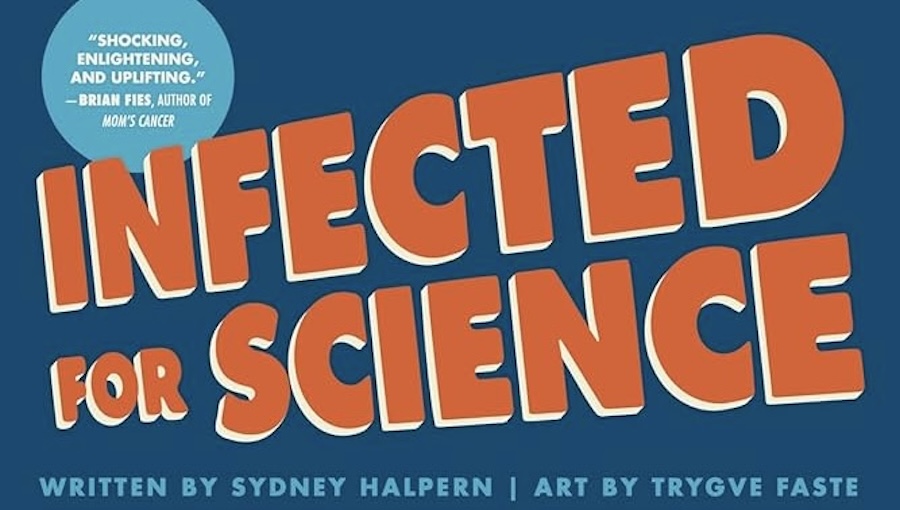
The following is an interview with Sydney Halpern and Trygve Faste regarding the upcoming release of the graphic novel, Infected for Science, through publisher Graphic Mundi. In this interview, Fanbase Press Editor-in-Chief Barbra Dillon chats with Halpern and Faste about their shared creative process in chronicling a group of conscientious objectors who volunteered to be subjects for US government–sponsored medical experiments, how they hope that these brave individuals’ story may connect with readers, and more!
Barbra Dillon, Fanbase Press Editor-in-Chief: Late May will see the release of Infected for Science. What can you share with us about the genesis behind your decision to document and share this story with readers?
Sydney Halpern: It was David Miller’s cartoons that inspired the comic. I stumbled upon several of them when collecting material for a prose book on the thirty-year US hepatitis-infection research program. Miller was one of a group of young pacifists who, during 1945, participated in virus transmission studies at an alternative service camp for conscientious objectors. Those initial cartoons grabbed my attention. I was drawn in by their vividness and how they conveyed the experience of being a subject in dangerous medical experiments. I was able to track down Miller’s adult children who sent me additional cartoons their father had drawn during the war. It struck me that the cartoons could be folded into a graphic narrative about the experiments with conscientious objectors with Miller as the central character. I wasn’t planning to create images for the graphic narrative and had the good fortune of connecting with artist Trygve Faste who became my collaborator in crafting the comic.
Trygve Faste: As soon as Sydney told me about her idea for this story and showed me Miller’s cartoons, I knew it would be an exciting project and wanted to be a part of it. I appreciated that the story illuminated an important and little-known episode in our nation’s history, and I liked the challenge of figuring out how we could tell the story in a way that seamlessly integrated Miller’s drawings. His cartoons have a dark humor while also expressing emotion and fortitude. These features sparked ideas for the characters and scenarios that we thought would convey the men’s experience as research subjects.
BD: How would you describe your shared creative process in both researching and crafting the visual narrative behind this story in order to bring it to life on the page?
SH: I did the historical research for the story and wrote a draft script for the narrative. Trygve did all the drawing. We both worked on finding visual inspiration for the comic’s images that were historically grounded. We met frequently over Zoom and collaborated in figuring out what images best fit our narrative intentions and the size and placement of panels. It was a give and take where the script, the drawings, and the panel design evolved as we fleshed out what we felt was the most effective way to tell the story.
TF: One of the first things we did was design the characters. Sydney had found a bunch of photographs of the people in the story. We had only a few photos of David Miller from that period, and, of course, we had his self-portrait cartoons. I created brainstorm sketches of Miller and the other characters and then we discussed what was and wasn’t working. It was a back-and-forth process where I would integrate Sydney’s feedback in the next round of sketches. Some characters were easy and some, like Miller, took a while to get right. I think he was particularly challenging because we didn’t want to copy his artistic style and we needed a simplified cartoon depiction that was recognizably him. We tested things until I had a version of David Miller that we both liked, and an over-all drawing style that complemented Miller’s artwork. It took some experimentation to arrive at a place where my drawings and Miller’s drawings paired nicely on the page.
BD: At Fanbase Press, our #StoriesMatter initiative endeavors to highlight the impact that stories can have on audiences of various mediums. How do you feel that these brave individuals’ story may connect with and impact today’s readers, and what, if any, conversations do you hope that it will invite?
SH: Miller and his comrades displayed a great deal of moral courage. In refusing to bear arms, they took a widely disapproved position on the ongoing war, instead pursuing their own paths for contributing to the nation’s efforts. Guided by deeply held principles and a strong sense of community, they chose to place themselves in harm’s way for the benefit of others. We would be pleased if the story encourages readers to consider what it means to have a moral center and to act in the world on the basis of conscience.
TF: Yes, I think this story provides an additional perspective on preconceived or simplistic notions of who is brave and who can be seen as a hero.
BD: What makes Graphic Mundi the perfect publishing partner for this book?
SH: Graphic Mundi—along with its sister imprint, Graphic Medicine—publishes graphic novels exploring issues in medicine, health and healing, and the experience of illness. Infected for Science has been a very good fit with the imprint’s purview, and we greatly appreciate the continuing interest and support of its staff and editor.
BD: If readers are interested in learning more about these experiments and their real-world impact, what, if any, resources might you suggest to get them started?
SH: A good place to go would be my book, Dangerous Medicine: The Story Behind Human Experiments with Hepatitis (Yale University Press, 2021). It follows the full extent of the US hepatitis-research program which extended from 1942 through 1972. The book details the wide range of people scientists enrolled as subjects and the resulting harms to human participants—including long-term threats to health not anticipated at the time of the research. It elaborates ethical issues surrounding the experiments that Infected for Science raises in a more abbreviated manner.
BD: Lastly, what would you like to tell readers who want to learn more about Infected for Science and your other work?
TF: We both have websites with additional information on Infected for Science that we invite readers to check out. (https://www.trygvefaste.com/ / https://www.sydneyhalpern.com/) Creating this non-fiction graphic narrative was new to both of us, so readers may find it interesting to see the many projects we’ve worked on over the years that lead up to this. And of course, there are always exciting, new projects we’re each developing, as well.
