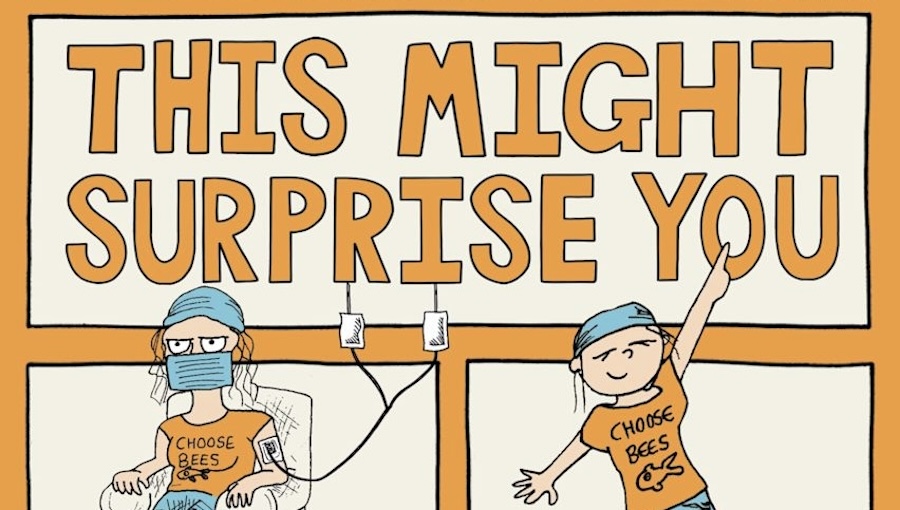
The following is an interview with Hayley Gullen regarding the upcoming release of the graphic memoir, This Might Surprise You: A Breast Cancer Story, with Bloomsbury Green Tree. In this interview, Fanbase Press Editor-in-Chief Barbra Dillon chats with Gullen about her creative process in bringing her personal narrative to life on the page, what readers may take away from her experiences, and more!
Barbra Dillon, Fanbase Press Editor-in-Chief: This month will see the release of your graphic memoir, This Might Surprise You: A Breast Cancer Story. What inspired you to share your story with readers?
Hayley Gullen: When I received my diagnosis of primary breast cancer at the age of 37, it was shocking and traumatic, but I was also struck by how my identity changed in an instant. I’d gone from “wife, mother, professional, interesting person” to “cancer patient.” It felt dehumanizing. I felt as if the doctors and nurses – kind though they were – saw me as the next patient, as another set of diagnoses rather than the full human being that I am. Which I understand, of course, as they are very busy, but it still felt extremely alienating. And, of course, my appearance changed profoundly, as I lost most of my hair due to chemo. I felt an overwhelming urge to express myself but didn’t want to impinge on the time of busy healthcare workers. I felt deeply frustrated and didn’t know what to do with all these feelings.
Then I found out that my surgeon was going on paternity leave for a couple of weeks. I liked my surgeon but definitely felt that sense of distance when I was in the consultation room. I had the idea to draw him a funny card which showed his baby handing him a knife as he was about to operate on me. He loved the card and wrote about it in my medical notes. This led me to realise that cartoons can be incredibly effective as a means of human connection. The idea for the book grew from there.
BD: In balancing the writing and illustrative duties of the project, what can you tell us about your creative process in bringing this personal narrative to life on the page?
HG: I was diagnosed with breast cancer in May 2022 and went through chemo and surgery between June and November that year. I began the book in early 2023, with radiotherapy and 13 Kadcyla infusions ahead of me. So, I was still in the midst of active treatment while working on the book.
I worked on a page at a time, following the chronological order of my experiences. I’ve dabbled with comics in the past but never fully committed to a visual project like this (although I’ve written five unpublished novels). I decided to keep it simple and immediate with black-and-white line drawings.
People often say to me that it must have been cathartic to process my experiences through my art. I always respond, “No; it was quite the opposite!” Mentally revisiting the worst times of my life was not a pleasant experience but was necessary to fulfill the vision I had for this book.
I think there is a clear difference between art therapy (which benefits the person creating the art) and art that’s intended, primarily, to benefit others. I processed my traumatic experiences through therapy. This gave me the perspective required to make the right artistic decisions to tell my story in a way that would be of interest to – and help – as many people as possible.
I started the book without knowing how my story ended. I figured out along the way that the story I wanted to tell was one about the importance of human connection. I needed to find this connection in order to heal fully from cancer. I think this is a universal message that will resonate with many.
BD: Graphic Medicine is an emerging genre that combines the field of medicine with the medium of comics. How do you feel that Graphic Medicine stories like this one can not only help to engender empathy, but to initiate conversations around necessary topics like an individual’s lived experience with cancer?
HG: I think the comic format is ideal for telling medical stories. You can see me nodding along with the doctors who throw jargon at me, but in the thought bubble I’m thinking, “Wait, what’s he on about?” The way that internal thoughts and external conversations can coexist is illuminating for medical professionals, but, most importantly, it’s fun to read. Humour is crucial, too: If you can make people laugh, they’ll remember you.
Graphic Medicine stories often tackle scary, traumatic, dark experiences. It’s important to tell the truth of these. Cancer certainly took me to some very dark places. But relentlessly grim stories are not going to draw people in. I sought to strike a balance between the dark and the light – the fear and the humour – because this felt most truthful and most relatable. Too much emphasis on either side won’t have the same impact. The balance is vital.
I would encourage anyone else working on a Graphic Medicine story to try and strike a similar balance. We’ve got to think about how we make our stories accessible and appealing, while also being truthful.
BD: At Fanbase Press, our #StoriesMatter initiative endeavors to highlight the impact that stories can have on audiences of various mediums. How do you feel that the story may connect with and impact readers?
HG: I know that my story has connected with readers, because they have told me this. People who have been through cancer themselves constantly message me on Instagram about the individual cartoons that I’ve shared on the platform, or about the book. They’ve told me that I’ve expressed something they didn’t have the words for. Some have bought copies of my book for their medical teams or have shared my cartoons with their loved ones to help explain how they feel.
I’ve also had an enthusiastic response from my own medical team and from other medical professionals who I’ve got to know through the process of creating the book. I was invited to speak at Radiopaedia earlier this year and hope to visit some hospital teams next year. I hope that my work helps medical professionals to remember or recognize the importance of this human connection.
BD: What makes Bloomsbury Green Tree the perfect publishing home for your story?
HG: I really wanted to try and find a publisher outside of the comics/graphic novel world. I wanted my book to be marketed as health non-fiction first, and a graphic novel second, because I knew that the potential audience for it was larger than the comics community alone.
Green Tree, being the health and wellness imprint of Bloomsbury, was ideal. My book is their first graphic novel and I’ve been blown away by the level of enthusiasm and support from the team. It’s been a delight to work with them and I hope that this will help open the door to other graphic non-fiction for them.
BD: Are there any other projects – past or current – that you would like to highlight for our readers?
HG: I’ve worked with Colossive Press (a small press here in London) on two zines as part of their Colossive Cartographies series:
https://colossive.com/product/hayley-gullen-guide-to-chemo-colossive-cartographies-54/
https://colossive.com/product/adventures-in-pictland-hayley-gullen-colossive-cartographies-65/
I’ve joined a Proust book club and for every part of “In Search of Lost Time” that I read I’m producing a 2-page comic about my reaction to it. These are on my Substack.
I love the idea of creating something very short out of something very long, like Proust! And although I like to create quickly, I am interested in the idea of creating work that references a long timespan! (This is of increasing interest to me as I get older!)
With that in mind, my work-in-progress is an exploration of my lifelong interest in Pictish symbol stones, which I studied at university 20 years ago. I want to tie this in – somehow – with my obsession with modern politics and how we interpret the information we are bombarded with every day.
BD: Lastly, what is the best way for our readers to find out more about This Might Surprise You and your other work?
HG: My website has all the links: www.hayleygullen.com
I’m also on Instagram (hayleygullen) and BlueSky (hayleygullen.com).
