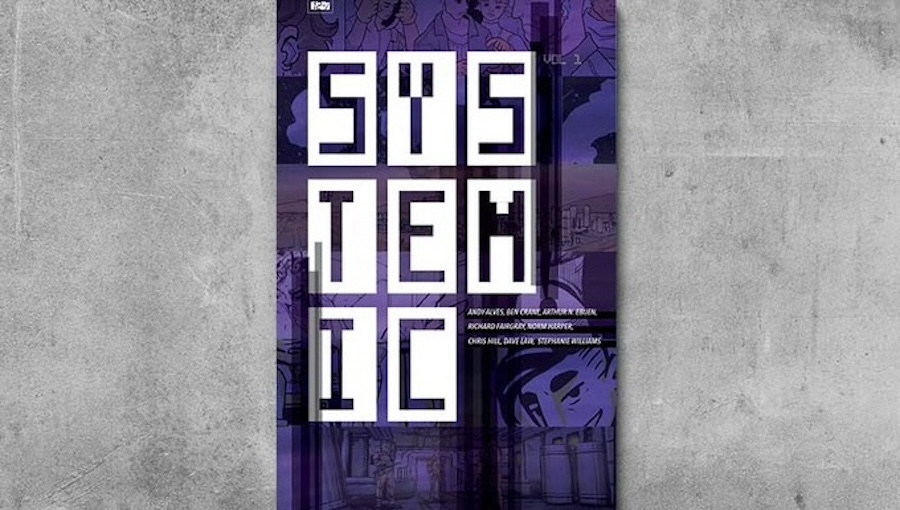
The following is an interview with Stephanie Williams, Norm Harper, and Richard Fairgray – contributors to the new comic book anthology, Systemic: Volume 1, which recently launched on Kickstarter. In this interview, Fanbase Press Editor-in-Chief Barbra Dillon chats with Williams, Harper, and Fairgray about what most inspired them to participate in the anthology, what they hope that readers may take away from their stories’ themes, and more!
Barbra Dillon, Fanbase Press Editor-in-Chief: You have all contributed to the sci-fi comic book anthology, Systemic, which is currently funding on Kickstarter. As prolific creators, what most intrigued you about this anthology?
Norm Harper: First of all, just the fact that it’s headed up by Art and Ben. I respect the work they’ve been doing so much that whatever they were asking, I was pretty much going to be in. But, also, there were some ideas that I’d been wrestling with recently that I wanted to explore, and I wasn’t sure what form it should be in. When they came and pitched the concept for Systemic, it was like finding a port in a storm. A sci-fi short isn’t something I’d have considered, but it is in a lot of ways the perfect vehicle for what I’d been wanting to get off my chest.
Richard Fairgray: Like I said to Ben when he first mentioned it, “If an idea comes to me that I feel like I have to make, I’ll let you know.” More and more I’m not letting my work be driven by anything other than ‘do I want to make this right now?’ On top of that, I’ve done so little in the sci-fi genre, it felt like a challenge to bring my niche energy to outer space. Comics get boring if they get easy, right?
Stephanie Williams: I’m a sci-fi junkie and I’m an easy sell when I’m at a comic convention. All Art and Ben had to do is say, “Hey, Stephanie, would you like to write a sci-fi story?” and I would have immediately said, “Count me in!” In fact, I did say exactly that before even receiving the official email with the breakdown of what the Systemic anthology was going to be, which is the opportunity to create a story that will hopefully have some kind of positive impact on readers. People are running on empty and our task as creators right now is to inspire and reaffirm.
BD: What can you tell us about the premise of your respective stories in the collection, and how would you describe your shared (or solo) creative process in bringing the world and characters to life on the page?
NH: The story I’m doing with Val Halvorson is about a young soldier learning from his teammates about an artifact that almost ended the war they’re fighting…and whether that artifact is now useless or still has any place in the conflict. Normally, I do longer-form stories and I’m very concerned with story structure. I outline meticulously and I know what page 100 looks like when I’m writing page 1. So, the 8 pages of this story was, in a lot ways, super challenging. Like writing a haiku. But then I handed it off to Val and, in part because we’ve worked together before, it was just very easy to let it go and trust that whatever he comes back with is going to be great. And the art that’s come back has been incredible.
RF: My story is about the illusion of safety through products and purchases, and how we get promised so much through gadgetry, when really we’re just being manipulated through our fear. Then, when it doesn’t work out right, we blame ourselves rather than the corporations who tricked us, because it’s actually less embarrassing than admitting we were fooled. Science fiction is often about the promise of a better future, and we want to believe in that because it’s so much harder to focus on the problems that are happening right now if we don’t think anything can get better.
I wanted to show that the problems of the future were the same as the problems of the past, so while it’s a story about a woman floating through space, I just put her in a nice sun dress and made all the pieces by hand. The starscapes are just ink flicked from a toothbrush (now unusable) and all the figures and text are pencil on graph paper, cut out and glued on.
SW: “Resonance” is set in a dystopian Atlantis of 2087, where something called the Harmony Protocols suppress human emotions to maintain societal control following devastating wars decades earlier. The story follows Zara Chen-Humphrey, a 24-year-old underground musician who uses illegal performances to break through the neural dampeners that keep citizens emotionally numb, even as authorities escalate their countermeasures against such artistic rebellion. Working with Kevin Betou as the visual storyteller was an absolute treat! His creative talent brilliantly captured the stark contrasts between the sterile, synchronized corporate zones and the raw, vibrant energy of underground gatherings. There was a lot to pack into eight pages, and Kevin did so masterfully. The collaborative process focused on creating a visual vocabulary that contrasts oppression with resistance—the cold blue pulse of control technology against the warm, chaotic energy of human expression. Our creative harmony on this story allowed us to explore themes of artistic resistance, emotional freedom, and the power of music to awaken the human spirit, making it a perfect showcase for the anthology.
BD: Why do you feel that crowdfunding has been such a valuable resource to ensuring the success of today’s comic book creators?
NH: It removes the gatekeepers and gives creators a chance to put art into the world that’s truer to their vision. Which, in its own way, can be very scary. When you struggle with things like imposter syndrome, there’s something very comforting about the words “my publisher.” And having a good editor watching your back can make you a better creator. But, ultimately, the more established publishers are limited by trying to serve an audience that exists in an older distribution system. We see time and again that crowdfunding can help creators connect with audiences that those older systems don’t serve, and that allows for a greater variety of expression.
RF: Crowdfunding is both the best and worst thing to happen to comics. It has given us total freedom to create exactly the stories we want, while creating an ecosystem just big enough that we don’t need to escape it. But, who knows—maybe if we push at the walls of the chamber, it will expand.
SW: Crowdfunding has helped revolutionize comics by putting creative control directly in the hands of creators, breaking down traditional gatekeeping barriers that once limited which stories were published. It’s invaluable for projects like Systemic because it connects us directly with readers hungry for diverse, innovative storytelling that publishers might consider “too risky.” Most importantly, crowdfunding has helped to democratize the medium to an extent, enabling marginalized voices to tell authentic stories and find their audiences; while proving there’s real demand for comics that explore complex themes and push creative boundaries. It’s not just funding comics. It’s empowering creators to enrich the entire medium with fresh perspectives.
BD: At Fanbase Press, our #StoriesMatter initiative endeavors to highlight the impact that stories can have on audiences of various mediums. How do you feel that your story may connect with and impact readers?
NH: Here’s where I have to be a bit of a bummer. Val and I are doing a story that says, “Stories matter…but maybe not always like we want them to…” We see so much media illiteracy nowadays. Stuff like, “When did Rage Against the Machine get all woke.” And I’d been thinking a lot about how hearts and minds get changed when they might not be reachable in the ways they used to be. And I want to say, full credit to Art and Ben for letting us explore that in an anthology meant to reach hearts and minds.
RF: I want my stories to make people ask questions. Especially with shorter pieces, I don’t want to give answers, but I want to reflect and abstract the things I see other people ignoring in themselves and in their lives.
SW: “Resonance” speaks to anyone who has felt pressure to suppress their authentic self or emotions to fit societal expectations. I hope it offers a powerful metaphor for how art in any form can become acts of resistance against systems that try to control us.
BD: Are there any other projects – past or current – that you would like to share with our readers?
NH: If you like what Val and I do in this anthology, then you’re going to want to check out our previous book, The Sequels, available now at Fanbase Press! Also, I hope to have news soon about the Kickstarter for The Iron Barge Book 2, the book Meaghan Carter and I are working on. If you missed Book 1, we’re slowly releasing it as a webcomic at www.ironbargecomic.com so you can go and get caught up.
RF: I have a lot of stuff coming up. If people like my piece in this, then they’ll probably like my new horror book coming out for Halloween. It’s called Feeding The Dark. Or, if they want to see me turn this all on myself, my new memoir, Oops All Richards, is currently in Prelaunch on the Kickstarter platform.
SW: Yes! I have two of my first creator-owned projects debuting in October. Roots of Madness #1 with Ignition Press on October 1st. It’s a cosmic horror set in 1905 that explores themes of family legacy, being the first to go where no one has in your family or community, and what different forms of reclamation can look like.
Temporal #1 with Mad Cave Studios on October 8th. It’s a sci-fi adventure rump starring a mom who was once a time-traveling thief. It explores themes of motherhood, the expectations we place on ourselves, and the complicated reality of finding peace with the life you’ve chosen for yourself.
I’m also writing Street Sharks for IDW, and I mean sharks with abs and wrestling moves. It’s a fun time!
BD: Lastly, what would you like to tell readers who want to learn more about the Systemic campaign and your other work?
NH: If you want to learn more about Systemic, definitely make sure to follow Ben Crane and Arthur Ebuen on their socials, and also Art’s imprint Studio 12-7. And you can find me at www.thatnormdude.com and as @ThatNormDude on most of the internet places.
RF: Other than checking out the Systemic Kickstarter, people can find me @richardfairgray everywhere that matters (but mostly just Bluesky) and kickrichard.com for all my campaigns.
SW: If you would like to see me at my most creative, Systemic and the projects mentioned are me fully embracing my creative freedom. If you’re interested in how that looks, then please check them out!
