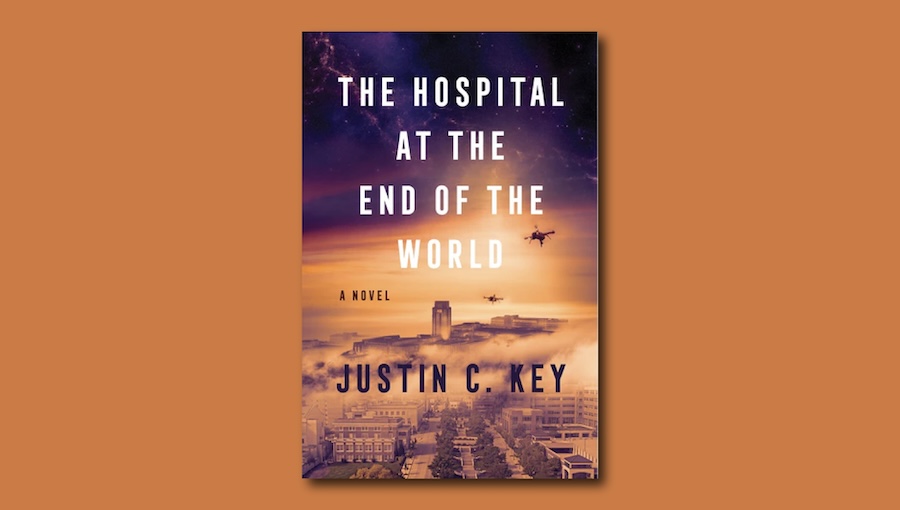
The following is an interview with practicing psychiatrist and a speculative fiction author Justin C. Key regarding the recent release of his novel, The Hospital at the End of the World, through publisher Harper. In this interview, Fanbase Press Editor-in-Chief Barbra Dillon chats with Key about his creative process in bringing the world and characters to life on the page, how he hopes that the story’s themes may connect with readers, and more!
Barbra Dillon, Fanbase Press Editor-in-Chief: Congratulations on the recent release of The Hospital at the End of the World! How would you describe the genesis behind this project, and what can you tell us about the story’s overall premise?
Justin C. Key: I originally started this story during my first year in medical school. I’d been writing for quite some time and was still trying to break into the short fiction market. An online speculative fiction magazine, Crossed Genres, had themed submissions and there was a call for stories about ‘school.’ I jumped on it. I had just entered the medical field and, with my whole career ahead of me, pondered about what could change in my lifetime. I’d always been fascinated by consciousness and, by extension, artificial intelligence. What would medicine look like in a robot-controlled future? What if a small medical community was trying to take our autonomy back?
Pok and Hippocrates were born.
The story has changed and grown a lot, as have I, since its inception. The Hospital at the End of the World, on the surface, is an AI versus medicine story, but it’s so much more. It’s about the power of human-human interaction, the wonders of the human body, the implication of technology for the future of law, sports, and art, and what it means to be a healer. The novel follows young medical-student Pok as he deals with the ups and downs of learning human-led medicine in a robot-powered world while uncovering the secrets of his father’s mysterious death and trying to hold on to his humanity. It’s part thriller, part medical mystery, and all heart.
BD: How would you describe your creative process for bringing this story and characters to life on the page, and how much of your own experience in medical training influenced your narrative?
JCK: I’m mostly a ‘pantser’ meaning I usually write my first draft beginning to end without outlining. This novel was a little bit of a detour for me, as it started off as a short story and expanded. And there was honestly a lot of stop and go over the years. I spent a lot of time exploring the characters and the settings as they happened and then went back and mapped those elements onto outlines and charts and themes to make everything make sense. I studied old and new and non-Western medicine, tried to keep up with the latest in AI, took the story hundreds of years into the future and then brought it back to a step away. All along I was becoming a doctor, going through psychiatry residency, starting my own insurance-based practice, and becoming a three-times dad. Like I said before, Pok and this novel grew with me over the years.
I am very intentional about keeping my medical practice and my writing separate. Which is to say, I’m not actively thinking how certain patients can translate to characters or stories. That said, my experience has greatly informed what I want to focus on, the themes I’m interested in, and the care I put into the landscapes and interactions. Some of my medical school experiences that were less connected to specific patients—like dissecting a cadaver, mental and emotional exhaustion, navigating the hierarchy of medicine, not doing well on that first exam, and sudden patient deaths—did more directly make it into the book. Everything else is a derivative of my collected experience rather than specific incidents.
Rest assured, if you walk into Dr. Key’s office, you won’t find yourself in one of Justin C. Key’s books.
BD: At Fanbase Press, our #StoriesMatter initiative endeavors to highlight the impact that stories can have on audiences of various mediums – no matter the genre. How do you feel that Pok’s story may connect with and impact readers, and what, if any, conversations do you hope that it might inspire in relation to our healthcare industry and the utilization of AI?
JCK: My hope is that first and foremost the human connection comes through. We’re at a crossroads now where we’re deciding (or waiting to see) what things we outsource to AI. My thoughts are that even if a Large Language Model, for example, can say all the right things, have all the right insights, and seem to make all the right decisions, there’s something inherently valuable about being seen and cared for by another human being. Technology has done great things for the advancement of medicine, especially over the last hundred and fifty years, but it’s always been a tool in human hands. AI seems to be here whether we like it or not and, when it comes to medicine at least, my hope is that we shape it to be a tool to guide human conductors instead of putting us in the passenger’s seat.
BD: What makes Harper the perfect publishing partner for this story?
JCK: This is a big story and it’s a big topic. It’s become even bigger since I landed the publishing contract in 2022 because of the advances in AI. And the book came out right when these systems are knocking at our hospital doors. All that to say is, Harper has a history of landing the plane for major narratives time after time after time. It’s exciting to see my first novel be apart of such an accomplished legacy.
But history doesn’t matter as much as the current people involved. My editor over at HarperCollins has been an amazing partner in bringing Pok’s story to its best version. The marketing and publicity teams have been thoughtful, responsive and, most importantly, excited about getting this book out in the world.
BD: Are there any projects – past or current – that you would like to highlight for our readers?
JCK: I will have a short story and a companion essay in 88 Unashamed Black Mental Health Stories: A Blacklandia Anthology out in May, my short story, “Empathetic Psychosis,” will be out in Lightspeed in April, and I have a new short story based in the novel’s world called “Austin’s Memorandium” that will be in May’s issue of Tar Baby Magazine, guest-edited by Sheree Renée Thomas. Also, my novelette, The Final Trial of Jalen, Oba of Uhuri, was just out in The Magazine of Fantasy and Science Fiction. Really proud of that story.
BD: Lastly, what is the best way for our readers to find more information about The Hospital at the End of the World?
JCK: My first novel is available from wherever you buy books. If you’re unsure where to start or just want to check out more about the book or the guy who wrote it, my website, JustinCKey.com, is a pretty comprehensive one-stop shop for all the reviews, interviews, features, op-eds, and more related to The Hospital at the End of the World.
Additionally, I’m very active on social media. Find me. I’ll engage!
