“Between the Panels” is a monthly interview series focusing on comic book creators of all experience levels, seeking to examine not just what each individual creates, but how they go about creating it.
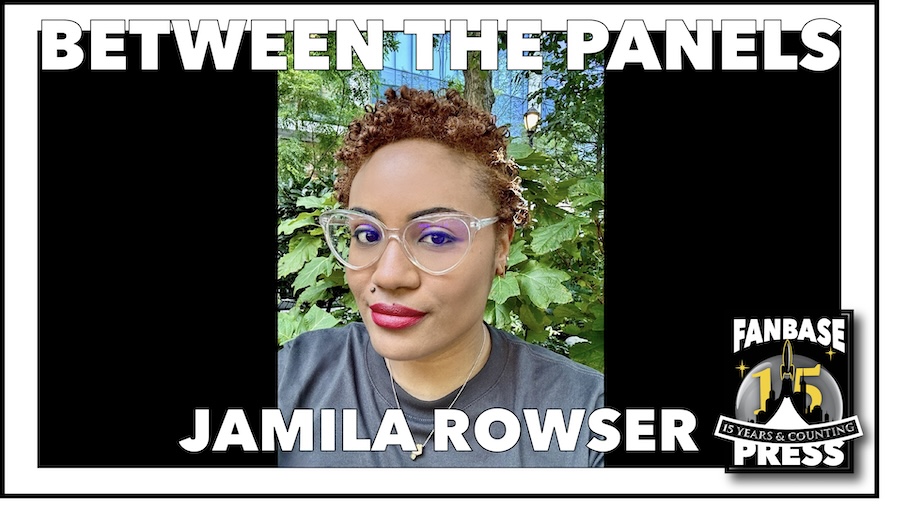
Listing Jamila Rowser’s full creative CV would take up more room than we have available here. Blogger. Podcaster. Publisher. Writer. Editor. Eisner nominee. Ignatz and Alex Award winner. The list keeps going, but let’s meet Jamila…
First off, the basics…
Your specialties (artist/writer/letterer/inker/etc.): writer, editor, publisher
Your home base: North Carolina
Website: jamilarowser.com
Social Media
Instagram: @jamilarowser
Bluesky: @jamilarowser.bsky.social
Fanbase Press Contributor Kevin Sharp: We start with the same question for all guests: Why comics? What does this medium offer you as a creator that’s unique from others?
Jamila Rowser: When it comes to story ideas, I always imagine them as comics first. It’s the medium I love the most, hands down. It incorporates so many creative elements and taps into different parts of my brain; it’s exciting to discover how to use them all to tell a story. Kinda like the game Katamari Damacy, the story concept is rolling around in my head, picking up different elements and ideas as it goes, until it has enough to build a full story.
I want to explore story ideas with little-to-no imaginative constraints, but I also need structure when writing, and comics give me both. Oh, and I love collaborating, too; it just makes the work better and helps me be a better storyteller.

KS: What did your writing life look like growing up? Was this a hobby you came to early on?
JR: I was always a big reader, but I didn’t write a lot of fiction growing up, even before I started writing comics. I always wanted to be a writer, but I doubted myself because of the high pedestal I held authors on. That held me back for most of my life. It was my excuse for not pushing myself. Anxiety sure is a bitch! I danced around creative writing for years until I finally wasn’t scared of “the worst that could happen,” which is really just people not liking the work. Well, not that scared.
KS: When you were first able to differentiate the “voices” of various authors, who were some of your earliest favorites?
JR: Roald Dahl and Shel Silverstein pop into my mind immediately. They are the authors I read early on whose voices were very distinguishable. I was obsessed with their poems and stories and wanted to read everything they wrote. The concepts in their work were eccentric and peculiar in a way that felt tangible. I still think about Witches whenever I see square-toed shoes.
KS: Was there a creative project that felt like a particularly “big deal” to accomplish at the time, whatever age you were and whether or not anyone else ever saw it?
JR: There’s an essay I wrote in college that I’m still very proud of. It was for my philosophy class, and the prompt was, “What is an author?” No page requirement either. All of the students were gagged. That’s it?! We wanted more direction. It ended up being a really rewarding and impactful assignment because it helped shape my beliefs about authorship, intent, interpretation, media, and the medium.
In my essay, I grouped the philosophers based on what I assumed they’d agree an author to be — whether or not their philosophies were related to authorship. Then, I placed those theorists in different rooms, some together and some alone, and arranged them in various areas of the room based on how well they would get along, considering their respective ideas. I even added doors and windows to the rooms for an extra layer of interpretation.
With the prompt being so vague, I didn’t know if my approach was “right.” But my professor praised my essay in class and asked me to explain my process. I was really proud! I still am. I think I ate that essay up. If I were to include myself in the essay, I’d be in the room with Roland Barthes (The Death of the Author).
KS: As far as writing as an actual profession, when did that idea occur to you, if you remember? Would it have been an a-ha moment of inspiration or something long-simmering?
JR: I wanted to be a writer since high school, but self-doubt had prevented me from seeing myself as a professional writer. So, I kept that desire right below the surface.
I wanted to get my bachelor’s in English Lit or Creative Writing, but I felt it was too risky during a recession, and I still doubted my talent, of course. (You see the common theme here!) So, I got my degree in Secondary Education with a specialty in English. After I graduated, I went straight to getting a Master’s, like many millennials at that time. I got mine in Communications. Even though it wasn’t a writing-focused degree, it helped me believe that a career in writing was possible.
I mustered up the nerve to cold apply for an internship at my favorite magazine, Nylon. I really, really wanted it, and I was surprised to be accepted so quickly! I was one of three or four editorial interns during that time. I did everything from walking the Editor-in-Chief’s two pugs in the snow and picking up their sh*t, to getting a few pieces published in their print mag. It was validating because it wasn’t something that all interns were guaranteed to get (the publishing part, we all had to walk the dogs).
The editors took the time to give us valuable feedback on our writing, too. The internship made me realize that being a writer didn’t mean being in isolation. I could get feedback and discuss things with an editor, and work with other people from the team. I crave collaboration, which is a core reason I like writing comics.
KS: What was your writing output like at that time, away from the job?
JR: During that same time, I started a blog so I could write more. I wasn’t sure what to write about, though, so I chose what I loved, geek culture — comics, games, anime, SF/F. My blog, “Girl Gone Geek,” ran for a few years, helping me become confident and find my voice. Eventually, I started getting requests to do podcasts, panels, and talks. I ended up writing pieces for a few magazines and blogs. And even got paid! Writing as a career began to feel more and more attainable during those years. But still not something that I could live off of, so I didn’t put all my energy into it.
KS: How did you ultimately land on the idea of making comics?
JR: Nana by Ai “The GOAT” Yazawa is the direct reason I started writing comics. I read comics before Nana that I loved, but they never made me feel that comics were something that I should or could create. What I read wasn’t “me,” so it didn’t really cross my mind.
I learned about josei comics thanks to Solanin by Inio Asano which is technically a seinen manga, but labels are often blurry. I wanted to read more like it and went down a MyAnimeList.net rabbit hole, discovering josei manga and anime. I started watching the anime Nana at first, and I probably got through a few episodes before deciding I wanted to read it instead. Not because I didn’t like the anime, but because I wanted to experience reading it as a manga. I knew I’d love it, and boy did I, haha.
I connected to Nana on a deep level. I love the art style, and the characters were older and had similar experiences, for better or worse! Seeing myself more fully in those stories showed me the kind of comics I wanted to create. I wanted to make comics like that, but with Black girls.
I dove into josei after that and found other mangaka that heavily influenced me, like Kyoko Okazaki, Erica Sakurazawa, Mari Okazaki, Moyoco Anno, Iketani Rikako, and Kiriko Nananan. I know I listed a bunch of mangaka, but they all play a big part in different ways. Their manga helped mold my creative style and approach to comics.
My comic writing style, pacing, and storytelling were molded by josei. It felt like I finally found what fit me.
KS: Backing up in the timeline before you discovered those, when (roughly) did comics come into your life as a reader?
JR: I read some newspaper strips growing up, but it wasn’t until The Boondocks came out that I was intentional about keeping up with strips regularly.
KS: What was it about that strip that spoke to you?
JR: My political views became clearer during high school, and The Boondocks was a big influence. I loved how Blackity Black it was, and it had funny and clever commentary. Thinking back on it now, it encouraged me to talk politics more often and with confidence. When I was living in Germany — I’m a military brat — someone wrote a letter to the editor because they found The Boondocks offensive and wanted the paper to stop publishing it. I thought it was hilarious and loved how mad it made him.
KS: How did your first paid comics gig come about? Was the blog a helpful springboard to getting there since people already knew your writer’s voice?
JR: So, that story is a bit of work, plus luck. My blog helped a ton, especially for the Kickstarter campaign to fund my first comic, Wash Day. Having been blogging, doing panels, podcasts, and stuff for several years, more people knew about me, which made me believe I’d have enough interest and reach for a Kickstarter campaign to succeed. Plus, my skills from my day job in tech, social, project management, and communications gave me confidence that I could run a successful campaign.
KS: When did [artist] Robyn [Smith] come into the picture?
JR: I reached out to two artists after I finished. I loved their art and thought they would be a good fit, but it didn’t pan out, so I searched for new artists for a while. Probably several weeks went by, and I saw Robyn’s art for the first time in a retweet. It was a black-and-white illustration of a badass Black woman with text that read, “Fittin’ to punch a Nazi.” I knew immediately it had to be Robyn. I was so captivated by her linework; it has so much expression and boldness, the way she drew hair. I wanted to see more of her work and ended up buying almost everything from her shop, including her award-winning comic, The Saddest Angriest Black Girl in Town. I was totally blown away when I read it. I still am.
Not too long after, I reached out to Robyn and made sure it was clear that it was a paid gig. Robyn said yes, and the rest is history, as they say. While working on Wash Day, we became close friends. We have so much in common and just clicked; it’s wonderful. It’s one of the best gifts I got from Wash Day. I think people can feel our friendship in the graphic novel.

KS: How did the idea come to go from the Wash Day comic to a full graphic novel?
JR: About a year after the mini-comic came out, Chronicle Books reached out to me and Robyn and was interested in developing it into a larger graphic novel. At first, we didn’t think it was real. We didn’t consider that something like that would happen or even seek it out. But it was real! We found out later that our editor was introduced to Wash Day thanks to a friend who gave her a copy. Wild, right?!
KS: In addition to writing, you’re also a publisher. Why was the time right to start Black Josei Press? What space did you see the label occupying in the comics world?
JR: Just as josei manga was the genesis for me writing comics, it also showed me what I wanted to read more of. I wanted comics by and for Black and brown women, and nonbinary folks. Very much a FUBU mindset. I didn’t want artists to have to change their story to fit a wider audience or explain things in a way that would be more accessible to everyone. If you get it, you get it; if you don’t, you can Google it.
KS: Please shout-out someone who’s been helpful to you on your comics journey. Maybe someone who gave advice, opened a certain door, or just offered encouragement when you needed it…
JR: Regine Sawyer for sure. She’s a comics writer, editor, and founder of Women in Comics NYC Collective. Regine has always been really supportive since my “Girl Gone Geek” blog days and still is. She really goes out of her way to help Black women in comics. Regine first put me on a panel back in 2013 at Edgar Allen Poe Park in The Bronx. (The location made it extra memorable.) It wasn’t long before I was asked to join other panels about blogging, comics, and more. I have severe anxiety and have always been terrified of public speaking. I would get so nervous that I’d get sick before panels. But I pushed through, and I’m glad I did. It’s helped me become a better panelist, public speaker, and increase my visibility. I still get anxious, though!
KS: Here’s a hypothetical: I can hook you up to one of those machines from The Matrix that will upload instant expert skill in any area. This can be something you have no aptitude for, or are decent at but would like to be great. What’s your new expertise?
JR: Illustrating for sure! I drew a little when I was younger, but didn’t have the discipline to continue. If I had read more comics during that time, I might have kept up with it. I think it’d help me become a better comic reader, creator, and collaborator. I want to take some beginner classes for that reason.

KS: Imagine a Comic Book Hall of Fame abd you get to induct one title you feel represents the medium at its very best. This can be a GN or a series — what gets your plaque?
JR: I’d say We3 by Grant Morrison and Frank Quitely. It broke my heart and broke my brain. Quietly and Morrison seem to have otherworldly brains, and that combo made me engage with the medium in a way I hadn’t before.
KS: To wrap up, please let readers know what you have out now or coming out in the near or further future.
JR: I have some upcoming projects that haven’t been announced yet, including a horror audio drama, a middle-grade graphic novel, and a mini-comic in an anthology. And I’m available for editing and script consultation gigs — gotta throw that out there! I also have a self-published project idea that I’m excited about, but I’m working on it slowly, haha. And some graphic novel pitches that will hopefully turn into their own announcements.
