
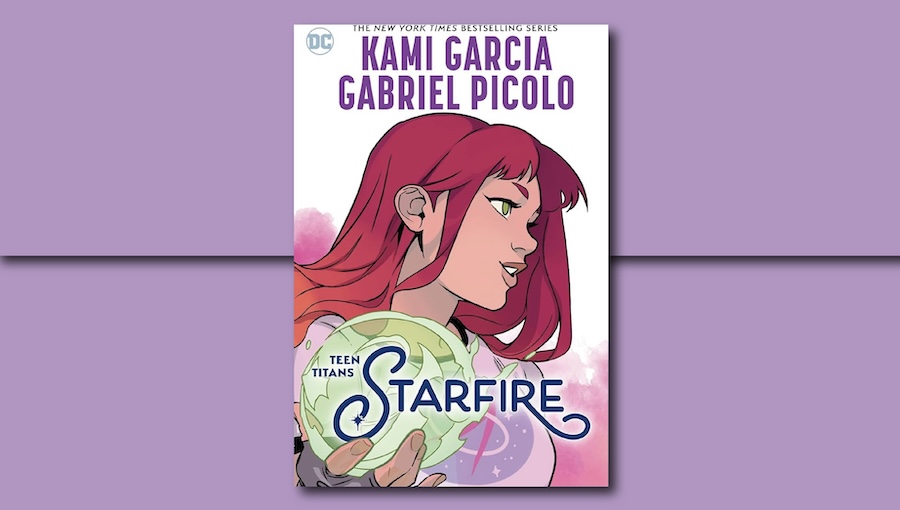
Kami Garcia and Gabriel Picolo do it again with the fifth, penultimate installment of their Teen Titans series: Starfire. Focusing on the emerging powers of Kori (Starfire) and her relationship with her sister, Kira, this book showcases the beautiful symmetry of the series as a whole. The first two books were lovely mirrors of each other, deep diving into the personal lives of Raven and Gar, while the Robin and Starfire books provide the same mirroring but with a lens angled on delightfully angsty sibling dynamics.
In addition to this, we get some great disability representation in this book with Kori’s chronic genetic disorder and Victor’s prosthetics. I love that Garcia was able to sneak the spoon theory in here. I’ve normally heard it used in reference to people with ADHD, but it’s a useful tool even for neurotypical and non-disabled people to use to express and evaluate how much energy they have in a given day. It’s also a great way to acknowledge that our energy and abilities vary and we can have compassion for ourselves when we’re unable to perform consistently from one day to the next. It’s all about meeting yourself where you are. That doesn’t mean it’s not super frustrating; after all, I know I’d love to have consistent, reliable energy and output every day to help make my life more predictable – and I’m sure others would appreciate that, as well – but alas, I must honor the fact that my energy is constantly changing. If that’s all people take away from this book, I’d say that Garcia has done the world a great service. But of course, she gives us even more to dig into.
Kori and Kira make great reflections of Dick and Damian. Kori and Dick are the more heart led, compassionate ones and Kira and Damian are the more self-important, arrogant ones. Kira is written as your classic popular girl: pretty, rich boyfriend, and charming, yet manipulative. Kori is written as more of a nerdy introvert: reads a lot, doesn’t like parties, compassionate, and caring. Honestly, this is the kind of protagonist I can relate to. If I ever do make it out to party, I’m usually the one playing with the resident pet or hiding out in a quiet spot. Also, the way Kori and Kira argue is spot on. Growing up with sisters, I know firsthand that they can absolutely be best friends one day then at each other’s throats the next, especially in those teenage years.
We’re positioned to dislike Kira from the start – I mean, she takes the last of the coffee when Kori clearly wants some; that’s savage in my book. It’s clear that their relationship will be the emotional core of this book, and it absolutely delivers on that front. Kira loves to make everything about her, to feel important, and feels threatened by Kori and the attention she’s gotten from her disability. Beyond that, she accuses Kori of being jealous of her – a glaring projection, I would say – which reeks of insecurity and a need to feel like she’s better than Kori. Well now, who does that remind us of? (Damian. The answer is Damian.) But Kori still loves her sister, and that’s admirable. But just like with Dick and Damian, it makes us feel conflicted. The love can feel one-sided at times, like Kori genuinely cares about Kira but Kira only cares about about herself and how things affect her.
However, I totally understand Kori’s propensity to just take that kind of behavior from her sister. Kori truly loves Kira and sees her as her best friend – you can dismiss and rationalize a lot of bad behavior when that’s your underlying belief. How many times have you rationalized the bad behavior of a loved one because, well, you love them? It’s one of those things that makes us yell at Kori for being so understanding with her sister and giving Kira the benefit of the doubt. But at the same time, if we look at Kira’s perspective and what she’s seen firsthand, Kori’s reactions and ideas seem just as illogical. Personal experience is a hard thing to argue against, and Kira has a lot of it that contradicts Kori’s and the rest of our teen’s suspicions.
The thing is, when you’re so entrenched in your beliefs and they’re closely tied to your identity, you can’t accept contradictory evidence; it’s called the backfire effect. Have you ever tried to show someone the “facts” of a situation, and they refuse to acknowledge them or say that your evidence is flawed or invalid? That’s the backfire effect at work. Your attempt to educate them and set them straight is literally backfiring. This is why Kira digs her heels in when Kori tries to tell her the truth about H.I.V.E. She’ll have so much more to lose if she’s wrong and Kori is right. In this case, Kori is more cognitively mature and developed because she can reconcile these differences. But Kira’s no dummy; she has high social intelligence, she knows how to get under people’s skin and manipulate him, which makes her a great antagonist because we know it’s working and we’re yelling at her the whole time.
Kori’s slight naivety and propensity to be quite literal and practical also gets her in trouble with Kira. I really love this characterization of Kori. It feels like an honest interpretation of her character considering in other media versions she is literally from another planet and often doesn’t understand earthly customs. But for someone like Kira who seems to be more about vibes, I can totally see how this would frustrate her. They’re basically an odd couple pairing.
Despite this book focusing on Kori, one of the biggest revelations that hit home for me was about Dick. Near the end, Dick confides in Kori and we learn he feels responsible for the others but often neglects and disregards his own need for care. Honestly, I could easily see someone just breezing by this part and thinking ‘yup, the helper doesn’t ask for or think they need or deserve help,’ but for some reason, this was just the right flavor of that sentiment to stop me in my tracks and bring me to tears because I was able to recognize part of myself in Dick. Somewhere along the line, he started conflating ‘care’ with ‘responsibility.’ Damn. Honestly, the best stories do this, they reflect ourselves back to us in an impactful way. This is why stories, art, and creativity matter. It helps us understand ourselves better – even if sometimes that understanding breaks us down before it builds us back up. To me, being this moved by a story is a hallmark of writers and artists at the top of their craft. It’s kind of nuts how certain things will hit you just right. I was just minding my own business, reading about Kori and the others then I had to go and get hit with this truth bomb – and I’m totally here for it, it’s why I love storytelling so much.
There are lots of threads of curiosity in this book, as well. For starters: What’s Victor’s beef with his dad? The kid went all the way to LA to get away from him. Tell me more, tell me more! This series is ripe for that kind of parental and teen angst. And also: Why does Slade care so much about finding our teens? Especially once his contract changes and it seems like money isn’t a driving factor, he becomes quite enraged. I wonder if it’s more about his reputation that he always finishes a job. He doesn’t seem like the kind of guy who really cares all that much what H.I.V.E is doing, just that he wants to get credit and do his job.
When it comes to the art, Picolo shines again. When does he not? I love how he constructed Kira’s boyfriend Tate. From just one look, you know that this guy is a total bro. (I could use a more colorful word, but I won’t.) His personality is totally reinforced when he makes a comment to the valet about not scratching his car and says he’s on keto. I think we all know a Tate. However, he’s clearly got some humanity in him since he actually takes Kori’s disability into consideration, so there’s hope for everyone… maybe. It just goes to show you how much someone’s physical look can signal to others what kind of person they are.
The facial expressions Picolo draws are top tier. I especially love Kira’s expressions. She can emote so much stank and disdain on her face. She is just so full of sass, and I love it. When you contrast that with Kori’s open, joyful expressions, they’re able to play off each other beautifully. The ombré coloring of their hair is also stunning. Then, we have Victor; his design is very visually appealing and incredibly intricate with all the circuitry. Stylistically, he’s probably the most complex to draw and has the most going on with him, so it’s fascinating to appreciate all the detail in his character.
I have a couple stand-out visual moments from the book. One is when Dick meets Kori… wow. The look on both their faces is so sweet and so priceless. Talk about an absolute meet-cute! It’s early days but I’m already so invested in these two kids getting together! My other favorite moment is the panel where the gang is sitting in LA traffic. I laughed so hard when I saw everyone’s reactions. As someone who has braved LA traffic, I can relate to all of them: Damian’s anger, Dick’s resignation, Gar’s exhaustion, Raven’s annoyance, and Max’s frustration. Picolo captured all the emotions you feel while sitting in traffic perfectly! I love how he can draw something that makes us laugh out loud and moments later draw something that completely devastates us. It’s wonderful and all done in that unique anime/Disney-type style Picolo’s become known for and that I absolutely love.
Garcia and Picolo have created another wonderful book. Now that the team is finally together, we’re racing to the end to see just what will happen to these misfit teens we’ve fallen in love with.
Creative Team: Kami Garcia (writer), Gabriel Picolo (artist), Rob Haynes (artist), David Calderon (colorist), Wes Abbott (letterer)
Publisher: DC Comics
Click here to purchase.
